When an AIO search service says "check Google's index before any AI answer": what a technical B2B founder should test before paying someone to get pages into AI results
A free five-test audit separates blocked pages from pages AI never cites.

Before paying an AI search optimization service to “get pages into AI results,” a technical B2B founder needs to test two things separately. Can the relevant systems access the pages, and do they choose those pages as sources? Checking Google’s index helps with the first question, but cannot answer the second. A free self-audit can tell these problems apart and give the founder a starting point for measuring a vendor’s later work.
Why a founder should audit before buying: indexing and citation are two different tests
A founder hears the pitch and wants to pressure-test it. The service promises visibility in AI answers, perhaps starting with a check of Google’s index. That sounds concrete, but what would success mean? An indexed product page and a product page cited in an answer are different outcomes. A proposal that treats them as interchangeable can leave the founder paying for work that never addresses the actual obstacle.
The ambiguity works in the vendor’s favor. A page can be fully indexed and still never appear as a citation in ChatGPT or Perplexity, while a page blocked from the relevant crawler cannot benefit from better content through that retrieval path. Most of the initial diagnosis costs nothing beyond time, using robots.txt inspection, Search Console, manual prompt testing, and on-page review. The useful frame is therefore two gates, access and citation selection.
How AI crawlers actually access pages, and where the access breaks
An AI crawler must be able to request a page and read its text before that content can enter its retrieval system. If the request is blocked or fails to return readable HTML, rewriting the page does not fix the failure.
OpenAI separates model training from live web retrieval. GPTBot handles training, while OAI-SearchBot handles ChatGPT’s live web retrieval, so blocking one does not automatically block the other. A site that intended to protect its content from training may also have blocked OAI-SearchBot. Those are separate decisions with separate consequences. The audit needs to check both entries on their own, since an OpenAI-related rule does not act as one switch for both.
A permissive robots.txt file is only the beginning. Important text still needs to be in the served HTML, where it can be read without JavaScript hydration or going through a login or paywall. An accordion also needs scrutiny if its text becomes available in the HTML only after interaction. What counts for this check is the text available to the crawler.
What Google's own documentation says about its AI features, and why it changes what you need to build
Google’s documentation says pages must be indexed and snippet-eligible to have the technical foundation they need to appear in its AI features. Crawling best practices support that foundation, but access alone is not the whole requirement. A nosnippet directive prevents the snippet use the founder is seeking, while a restrictive max-snippet value can constrain eligibility. These are concrete settings to inspect before commissioning anything new. A page may be reachable yet restricted in how Google can use it.
Google’s AI optimization guide also says that publishers do not need new machine-readable files, AI text files, markup, or Markdown to appear in Google Search, including its generative AI capabilities. The guide says Google Search itself does not use them. If a proposed deliverable is sold as a Google requirement, ask where Google’s documentation requires it. The vendor needs to distinguish a documented prerequisite from its own proposed tactic.
That test has a defined boundary, however. Google’s documentation describes Google’s surfaces. A clean Google eligibility check cannot establish that ChatGPT or Perplexity will retrieve a page, much less cite it. The target surface must stay explicit. Otherwise, evidence about one system becomes a promise about another.
Why ranking on Google no longer predicts whether an AI engine cites you
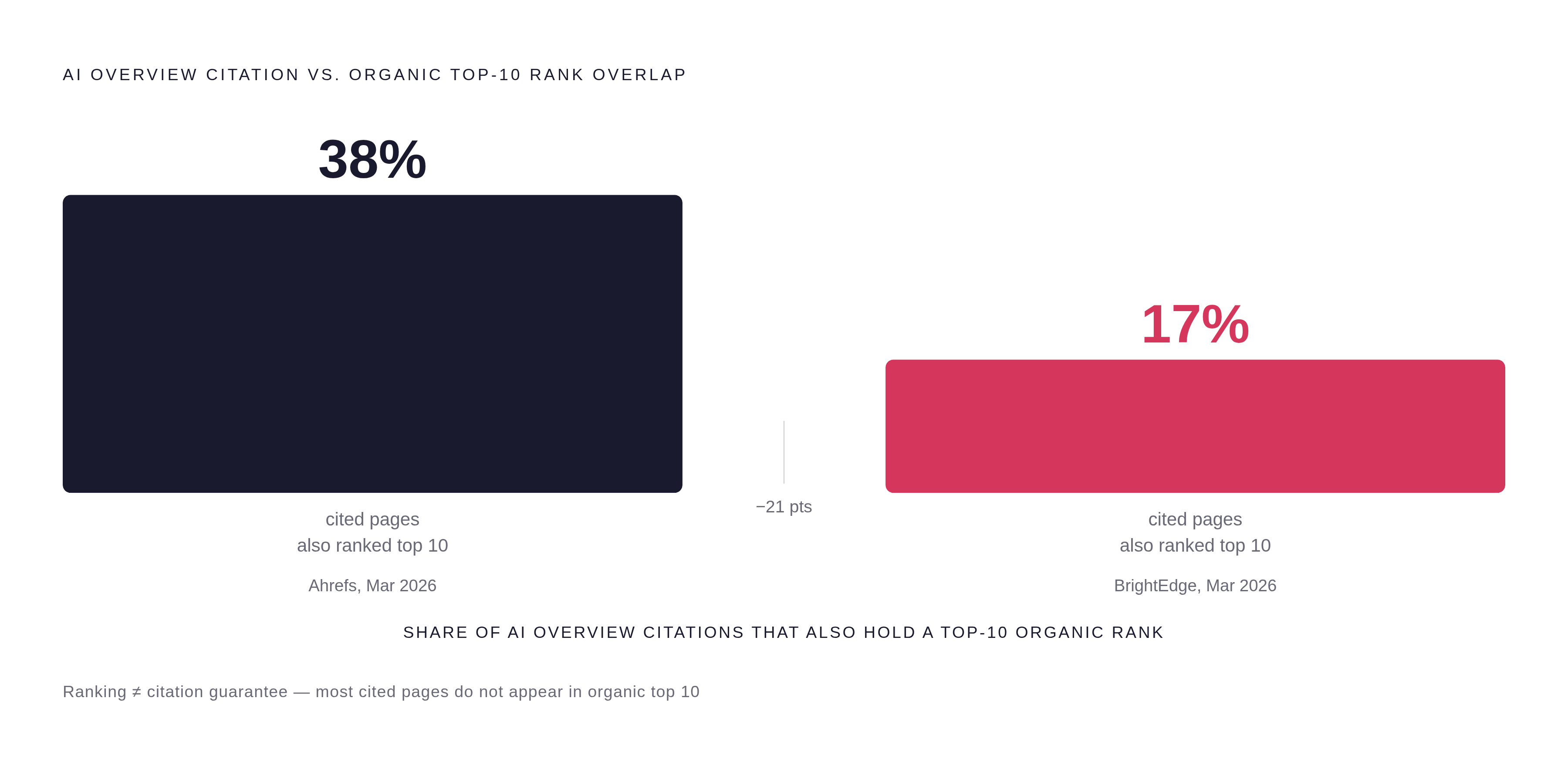
Ahrefs’ March 2026 study found that only 38% of the pages cited in AI Overviews also ranked in Google’s organic top 10. BrightEdge puts the overlap lower, at about 17%. Ranking is not a citation guarantee. A founder who already performs well in search still has a separate question to investigate.
A panel of commercial B2B software queries illustrates another part of that gap. The large majority of AI Overview citations pointed to third-party sources, including directories, roundups, and comparison pages. A brand can therefore be named without getting a link. That distinction changes what a visibility claim means. A recommendation and a citation to the company’s page are not interchangeable evidence of success.
The engines also differ in how they select sources. Google AI Overviews are more SEO-adjacent, ChatGPT Search aligns with Bing signals, and Perplexity favors freshness and real-time retrieval. For a founder choosing a service, the practical step is to name the surfaces that buyers use before judging the proposed approach. “AI results” is too broad a unit of diagnosis.
The five technical tests a founder can run before any vendor conversation
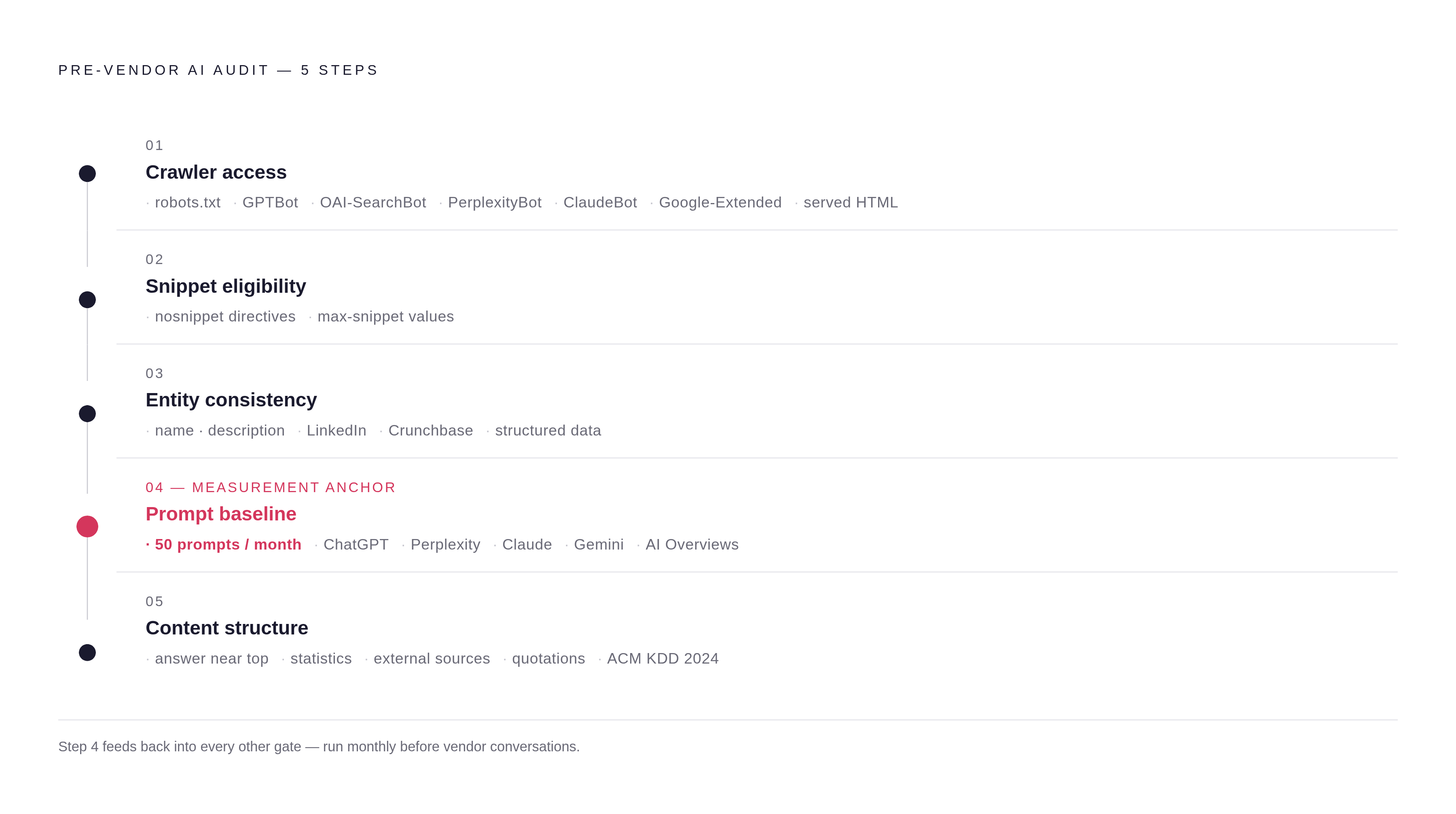
Test 1. Crawler access. Inspect robots.txt for GPTBot, OAI-SearchBot, PerplexityBot, ClaudeBot, and Google-Extended, checking that no restriction is unintended. Keep their functions distinct during the review. Google’s crawler documentation says Google-Extended has no separate HTTP request user-agent string and controls how content is used for training, without acting as a separate search crawler. Then inspect the served HTML of important pages for the text buyers need, rather than relying on what appears after hydration, login, or interaction.
Test 2. Snippet eligibility. Check key pages for nosnippet directives and restrictive max-snippet values. These settings deserve their own pass because a successful crawl does not establish permission to show a useful snippet. Keep the result separate from the crawler-access finding. If a vendor proposes content changes for a page restricted at this layer, the diagnosis should explain that restriction first.
Test 3. Entity consistency. Check the company name, description, employee count, and customer claims for consistency across the homepage, LinkedIn, Crunchbase, and any structured data. Look for conflicts and missing fields. When sources disagree about the same company, AI has less trust in the brand as a source to cite. For most B2B SaaS brands, making the entity clear across these sources is the fastest way to improve results before starting work on new content.
Test 4. Prompt baseline. Build a set of questions buyers actually ask in AI, using 50 prompts as the panel to track in the ongoing scorecard. Run them against ChatGPT, Perplexity, Claude, Gemini, and Google AI Overviews on a fixed monthly cadence, recording citation share separately for each surface. Start before buying a monitoring service. Using the same panel each time lets the founder compare results for the same questions. The resulting time series establishes the before-state against which vendor work can be judged.
Test 5. Content structure. Review existing pages for a clear answer near the beginning, supported where appropriate by statistics, external sources, and quotations. The Princeton, Georgia Tech, IIT Delhi, and Allen Institute for AI team’s research, published at ACM KDD 2024, found that each of those three additions produced meaningful lifts in AI visibility. Analysis of Google AI Overview citations also found that a majority came from the early portion of the source page. Answer placement therefore deserves attention beyond readability alone. These are changes the founder controls without first commissioning a new body of content.
What the citation gap means for where content needs to live
If an engine recommends a product using a directory or comparison page as evidence, improving the product’s own page addresses only one part of the source landscape. The third-party page may still be the citation the buyer sees. For the audit, the next step is to record which sources justify recommendations.
Comparative and decision-support formats deserve particular attention in B2B software queries. These include comparison pages, alternatives pages, and “X vs. Y” content on third-party domains. Having those formats on the company’s own site does not establish a presence in the sources engines select. The audit should identify where the brand already appears in those decisions.
Distribution can also change citation visibility. Stacker and Scrunch’s March 2026 study found measurable citation lift when the same content was distributed across third-party news sites. The mechanism described in the notes is that generative engines already have trust signals for certain domains, which content placed there inherits at retrieval time. Placement is not the end of the work. Pages that are not refreshed regularly are more likely to lose citations over time, making third-party presence an ongoing maintenance budget item.
How to measure AI citation before and after any vendor engagement
Measurement starts with the free reports built into each platform and the manual prompt panel. They answer related but different questions. Platform reports show what happens in the experiences they cover, while the panel tests the same set of buyer questions each time. Referral traffic adds another view, but a visit is not the same event as a citation. Keeping these measures distinct prevents a vendor from substituting one kind of improvement for another.
Google Search Console includes a Generative AI performance report for eligible properties, showing impressions from AI Overviews and AI Mode by page, country, device, and date. Microsoft launched its AI Performance report in Bing Webmaster Tools in public preview in February 2026. The report covers Microsoft Copilot, AI-generated Bing summaries, and selected partner experiences, with total citations, average cited pages, grounding queries, page-level citation activity, and visibility trends. For other engines, GA4 referral traffic filtered by source offers a directional view of AI-referred visits.
The 50-prompt panel is still the main scorecard for results. Running it each month and tracking citation share for each surface shows what has changed from the same before-state. A vendor should be able to show movement on that record. If it cannot, the engagement lacks a verifiable outcome, even if it has produced pages, technical changes, or reports.
A paid AI-visibility monitoring service can automate the work the manual test already does and do it on a larger scale. Evaluating the service after the baseline exists gives the founder a clear task to judge it by. Without it, a polished dashboard can define success without providing evidence of it.
What to ask any vendor before signing: the two questions this audit produces
“Can you show me which of my pages are currently blocked from the crawlers relevant to the surfaces you are targeting, and what specific changes you will make to fix that?” The answer should use technical terms to name the pages with problems, the systems involved, and the changes the vendor plans to make. A vendor that cannot do that has not established an access-layer diagnosis.
“What is my current citation share on a fixed prompt panel across ChatGPT, Perplexity, Gemini, and Google AI Overviews, and what will that number be after your engagement?” The answer needs a baseline and an outcome, with the platform differences reflected in the proposed work. A single tactic offered for every surface leaves that distinction unexplained. The founder’s audit is now the brief against which the proposal can be judged.