The State of AI Search: What It Means for Builders Who Treat Marketing as an Engineering Problem
Measure AI citations, not rankings, to understand your visibility in generated answers.

AI search is an infrastructure problem. For builders who treat marketing as an engineering problem, the task is to make content readable by machines, measure whether engines cite it, and use those outcomes to guide changes. Rankings and publishing volume cannot tell a team whether that system is working.
AI search has crossed from experiment to infrastructure, and most marketing teams are measuring the wrong thing
A majority name AI search optimization a core priority, yet only a small minority track whether ChatGPT, Claude, Gemini, or Perplexity cites them. Spending without that feedback resembles deploying a service without uptime monitoring. Work may be happening, but the team cannot tell whether it produces the outcome the system exists to deliver.
That gap becomes harder to ignore as AI search becomes a front door to discovery for a growing share of buyers. When an engine answers rather than listing links, a brand’s appearance in that answer becomes a distinct visibility outcome. An organic ranking does not record it. Nor does the publication of a new page establish that any engine has used it.
For an engineering-minded marketer, the useful starting question is therefore what the system can actually observe. Can it distinguish content that is available to an engine from content that the engine cites. Can it connect those citations to buyer activity. Those distinctions set the requirements for the site, the content pipeline, and the measurement layer. They also give teams a way to judge vendor claims without relying on the vocabulary surrounding them.
GEO, AEO, and LLMO are the same discipline under different labels — and the acronym sprawl is costing teams real time
GEO, AEO, LLMO, and AI SEO describe the same job. Each concerns getting a brand cited when an AI engine generates an answer. Treating the labels as separate disciplines makes teams plan the same work more than once before they even start.
Major 2026 field reports put the overlap with classic SEO at roughly 80%. The work still rests on crawlability, clear structure, and real expertise. Google’s 2026 documentation describes GEO and AEO as terms “you may see used” while arguing that optimizing for generative AI search is still SEO. Microsoft Bing uses “GEO” in its guidelines but says SEO fundamentals “support eligibility for AI-generated experiences”.
The new work shifts the focus from ranking to citation and adds third-party authority signals and the ways engines differ. A team needs a precise outcome that the whole team can use, namely inclusion in a generated answer, measured as a citation event.
SEO rank and AI citation are decoupled, which breaks every assumption about how visibility compounds
The 2026 AI search field report finds that a large majority of AI Overview citations come from pages outside the organic top 10. More than half come from URLs that do not rank in the organic top 20 at all. A strong ranking cannot serve as a reliable proxy for citation, and a weak ranking does not establish that a page is absent from AI answers.
That finding separates two outcomes that teams may have assumed would move together. A page can rank organically well below the top, so organic eligibility can still matter even when top positions fail to predict citations.
For teams deciding what to rebuild toward, the strongest directional signal is web-wide brand presence. The same report finds that brand mentions correlate strongly with AI citation probability, while backlinks correlate weakly. How content is structured is another strong signal, including whether it has sequential headings and a single clear H1. These correlations point toward different priorities from link acquisition alone.
By contrast, llms.txt receives almost no actual requests from AI crawlers. It is a one-hour task. Domain authority and ranking position can describe part of the search system, but they leave the generated-answer outcome largely unobserved.
Each AI engine is a distinct retrieval system with its own citation source stack — optimizing for one leaves most visibility on the table
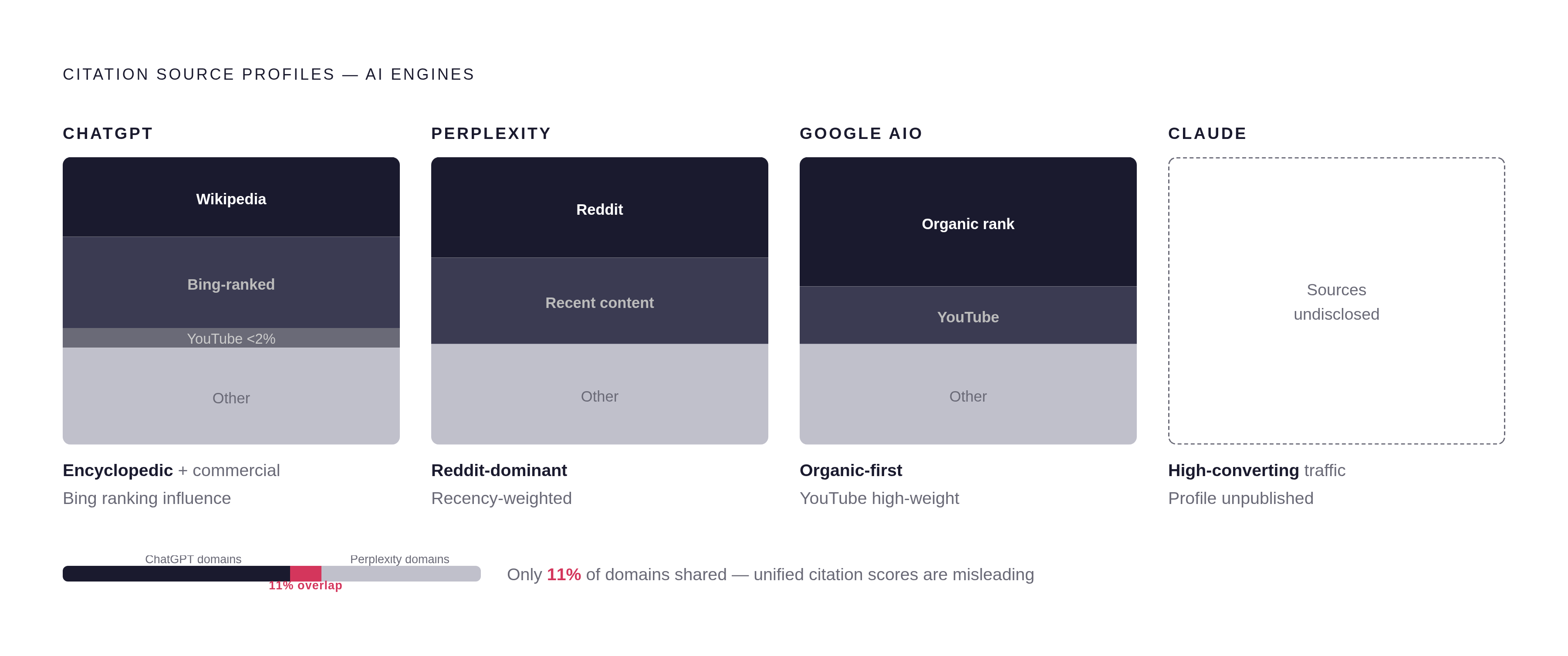
The field report documents wide differences in brand citation rates across platforms, with only 11% of domains cited by both ChatGPT and Perplexity. Presence does not transfer reliably between the two. Their retrieval and grounding behavior differs enough that a unified visibility score can hide the very differences a team needs to understand. Each engine needs its own measurement view.
ChatGPT draws a large share of its top citations from encyclopedic sources, including Wikipedia. Commercial-intent prompts trigger live web search at a much higher rate than informational queries. That makes Bing ranking relevant specifically for bottom-funnel queries, rather than a universal explanation of ChatGPT visibility.
Perplexity has a different set of dependencies. Reddit dominates its citation stack, and it strongly favors very recently published content. For teams targeting that engine, monthly publication cadence is a floor. Perplexity has also abandoned in-answer ads, making earned citations the available lever there.
Google AI Overviews depends more heavily on organic search. A large majority of its citations come from pages that already rank organically, though not necessarily near the top. Structured answer blocks, FAQPage schema, and descriptive images therefore add to the organic foundation. YouTube is also a high-citation source for AI Overviews, which gives its third-party source stack a different shape from ChatGPT’s.
Claude presents a different reason for attention. It sends AI-referred traffic that converts at a high rate compared with organic baselines, though data on its citation sources has not been published. ChatGPT, Claude, Gemini, and Perplexity form the minimum instrumentation surface because they account for nearly all measurable AI referral traffic. The absence of equivalent source-stack detail for every engine is a limit on what teams can infer, not a reason to collapse their results into one score.
The content architecture that gets cited is an owned ground site plus engineered third-party presence
AI systems draw the majority of their citations from third-party sources. The architecture needs two connected layers: a ground site with machine-readable material the brand owns and a third-party presence that puts authentic information in the sources engines use.
The ground site begins with crawlability and indexing. Google’s crawling best practices remain the base because a page that cannot be crawled has the same basic failure in AI search as in classic search. Above that base sit sequential headings, a single clear H1, and FAQ sections that directly answer follow-up questions. The content needs cited sources and statistics, along with regular updates after it is published.
The third-party layer has a different role. Reddit AMAs and threads, LinkedIn original posts, G2, Capterra, and Trustpilot reviews, YouTube transcripts, and Wikipedia entity pages provide sources beyond the owned domain. YouTube’s high citation rate in Google AI Overviews, compared with under 2% in ChatGPT, shows why teams must judge a platform by how much the engine they hope to reach uses it.
Authenticity is a requirement of that layer. AI models prioritize human-first content to avoid model collapse, the degradation that occurs when models train on AI-generated text. Third-party material based on experience thus has a different value from generic text spread across many sites. The architectural goal is not simply more locations containing the brand’s name, but a source base that offers information worth retrieving.
Before either layer can work, crawler access needs a deliberate decision. Blocking all AI crawlers can protect content at the cost of search access. The recommended configuration selectively blocks training bots such as GPTBot and ClaudeBot while allowing search-specific bots such as OAI-SearchBot, PerplexityBot, and GoogleOther. That separates the training-scraping decision from the goal of preserving citation eligibility.
Content production at citation-worthy volume requires a pipeline, not a writing team — and the human review gate is not optional
A two-layer architecture creates a production problem that faster drafting alone cannot solve. AI has made drafting nearly free, but topic selection, briefing, voice consistency, accuracy review, and performance-based iteration still require work. The bottleneck has moved around the draft. Producing more text does not remove those dependencies and can increase the amount of material waiting for judgment.
The best-performing pipeline spans source collection, topic and keyword research, content briefs, and AI-assisted drafting. People then enrich the drafts and review their quality, while structured optimization and performance-based rewrites tie the work to its results. Each stage serves a different purpose. Source collection supplies grounding, while review checks the draft’s accurate use of that material and its contribution beyond a generic answer.
Human-in-the-loop systems place review at strategic checkpoints during production, before content is finished. That distinction changes the reviewer’s role. Instead of only correcting a completed draft, a person can guide the AI while the work is taking shape. The notes hold that working this way leads to better output than post-production review alone.
To prevent model collapse, model developers are filtering generic AI-written content out of the pools they draw citations from. What the industry calls “AI slop” is therefore not merely an editorial disappointment. Ungrounded output can fail the retrieval requirement the whole production system is meant to meet.
Lumar’s 2026 GEO guide reports that the SEO practitioners surveyed stress again and again the need for original insights, first-party data, and evidence-backed content. Volume without those properties becomes a liability. For engineering-minded teams, the lesson is to treat the pipeline as the product, with drafts as outputs of a system that can be instrumented, versioned, and improved. Human review needs to be part of that system, with its cost built into the work through to the finish.
Measuring AI citation is not a reporting task — it is the instrumentation layer the whole system depends on
Citation visibility changes as models retrain, context windows shift, and source stacks change. The majority of cited sources turn over month to month across Google AI Mode and ChatGPT. A point-in-time report cannot describe that operating condition well enough to guide ongoing work.
The first measurement is whether each engine names and cites the brand. Those outcomes need to remain separate for ChatGPT, Claude, Gemini, and Perplexity because their citation behavior differs so sharply. An aggregate can conceal where visibility is actually coming from. Measuring each engine on its own lets teams link the results to the ways their source stacks differ.
Next, measure which pages receive citations and whether they belong to the ground site or the third-party layer. That distinction routes feedback to the right part of the architecture. Without it, a team cannot tell whether its owned content or its external presence is contributing to inclusion. The purpose is not to collect more reporting fields, but to make the evidence useful for the next revision.
AI referral traffic also needs to be tagged by engine in analytics so that citation events can be connected to conversion outcomes. Visibility alone is an incomplete result. AI-referred traffic converts at a substantially higher rate than organic search baselines across ChatGPT, Claude, and Perplexity, making this a revenue instrumentation problem.
This is where the architecture becomes a feedback loop. What teams learn from citations guides performance-based rewrites, while results from referrals help them judge how much that work is worth. A well-structured site and a reviewed content pipeline provide something to improve. Instrumentation provides the evidence for deciding how.