A saved agent workflow is only as trustworthy as its inputs, evals and run record: what a technical founder should check when a vendor sells repeatable marketing jobs for coding agents
Before buying, check what each run read, how it was judged, and who approved it.

A saved marketing workflow is only as trustworthy as its inputs, evals and run record. For a technical founder buying repeatable jobs for coding agents, the audit should establish whether the vendor can show what each run read, how its output was judged, and who approved what was published.
Why a "saved workflow" for marketing is a different category of risk than a saved workflow for code
A founder buys a marketing agent expecting the kind of inspectable work associated with coding agents, then discovers that a clean execution says little about the truth of the output. The workflow finished without an error. But did its claims have support, did its citations actually back them, and did the published content appear in AI answers? Those questions need a different kind of evidence from what a reviewable pull request provides.
In code, people can inspect diffs, and tests give a pass-or-fail check against what the code is meant to do. Marketing workflows sold for GEO/AEO deal with probabilistic outputs and policy-bound claims, where accuracy, citation fidelity, brand voice and visibility do not collapse into one binary result. The relevant category is regulated-evidence work. Coding agents carry risks, and repeating an execution is insufficient evidence when the result can be wrong, uncited, off-brand or invisible to the engines it was meant to reach.
What the vendor is actually selling when they pitch "repeatable marketing jobs for coding agents"
One job is AI visibility and brand presence, which aims to get a brand cited or recommended when ChatGPT, Perplexity, Gemini and Claude synthesize answers. That differs from SEO because citation-friendly structure, verifiable claims and distributed authority signals count alongside on-page technique. The deliverable is therefore not simply a page. It includes evidence of whether the brand appears in the answers the workflow targets.
Another job is the content pipeline itself. The pipeline moves from context gathering to drafting to checks against brand and policy rules, with human review governing the result. Each handoff introduces something the founder needs to inspect, from retrieved context to edits and approvals. The supporting deliverable is a replayable record showing the prompt version, model, tool calls, resulting diff and route back to the prior published state.
The third job is content production and campaign execution as an ongoing service. People do pay for content production, but it is harder to defend against competitors than work in action-taking categories, so useful work alone does not show that a vendor has an edge it can keep. These are distinct promises within one pitch. Keeping visibility, production and execution separate lets the founder see what inputs each promise needs, how it can fail and what evidence should back it.
Why the declared inputs are the first thing to audit
Before judging execution, a founder needs to know what the workflow reads. The concrete ask is an input manifest. It should declare the product context profile that supplies positioning, users and competitors, the prompt template version, the retrieval corpus and its freshness, and external sources such as search console, competitor pages and citation databases. Without that boundary, a saved workflow can quietly do a different job each time it runs. Stable execution cannot compensate for undeclared context.
The marketingskills design illustrates why that shared context is important. Copywriting can compose with cro and ab-testing because each skill reads the same declared product-marketing base. Without that base, the pieces can give outputs that disagree even when each piece works on its own. The shared base is the contract between skills. For a founder wiring tools into a stack, small primitives reachable through an API or MCP hook are more auditable than a monolithic suite because each component exposes its own inputs and outputs.
Versioning makes that contract inspectable over time. Is the manifest machine-readable and stored under version control, or can someone edit a document between runs without leaving a trace? When a competitor changes a pricing page or a citation source shifts, the workflow should detect and log the change to avoid silently using stale context. Freshness needs evidence. Bidirectional sync, field-level mapping, permission scoping and trigger support are useful signs of what the tools can do, but a one-way pull alone cannot ensure freshness. GEO also depends on sources that change over time because citation source distributions shift over weeks to months, so a fixed list of authoritative sources can go out of date even when a run seems to work.
What evals actually gate in a marketing pipeline, and how to tell if a vendor's are real
Once inputs are declared, the next question is what can stop an unsuitable output from advancing. A marketing eval harness needs to check accuracy, citation fidelity, brand-voice compliance and per-engine visibility as well as whether the prose makes sense. LLMs can hallucinate citations even in structured pipelines, which makes intermediate decisions part of the evidence a founder needs to inspect. A confident reference is not proof of support.
Human review belongs inside that harness, with a record at each checkpoint. A brief-stage gate can prevent generation of policy-sensitive content, while pre-publish review lets a person inspect compliance output before scheduling. Post-publish review then checks how the content performs from time to time. Each checkpoint should produce a logged artifact. Otherwise, a claim that humans are involved says nothing about which output they reviewed or whether their approval preceded publication.
A vendor may fairly point out that its dashboard shows brand mentions across all major engines. That is useful, but incomplete. ChatGPT, Claude, Gemini and Perplexity have very different citation patterns, so a pooled mention rate mixes how they behave and cannot serve as a common measure of visibility. An engine that gives longer answers may mention more brands without making any of them stand out more. Per-engine tracking therefore needs normalization for answer length or position, with a position-aware measure such as presence in the top three cited sources.
Mentions and citations also need separate definitions, because naming a brand without linking it is a different signal from citing it. This is a genuine measurement problem. The founder's audit should establish which engines are queried, how each metric is defined, and whether the harness itself has a version history. Evaluation changes can alter the apparent result. Recording those changes helps distinguish a shift in brand visibility from a shift in how visibility was judged.
What a run record must contain for a founder to actually trust a replay
A founder should be able to select a past run and reconstruct what it used, what changed at each stage and who approved it. Start with the exact prompt template version ID, model identifier and version, and temperature or other parameter settings. The retrieved context must be a snapshot. A pointer to a live URL cannot establish what the agent read before that page changed.
The tool call log should include inputs and outputs, so inspection does not stop at the prompt boundary. The resulting content diff should show what changed between stages, while the approval record should name the reviewer and give the timestamp and any changes they made. These artifacts answer different questions about responsibility. Was a claim present in the retrieved material, introduced during drafting, or changed in review?
The founder should be able to use a rollback handle to return to the prior published state as well as view an earlier draft. For off-domain output, the record must also identify where content was published, to which properties, under what attribution and when. Distribution is part of the run's effect. Omitting it leaves the founder able to inspect the text but unable to audit its placement.
The record must be immutable after the run closes, exportable in a machine-readable format and accessible through an API. An editable history cannot anchor an audit. If the vendor can alter the evidence after the event, the founder cannot rely on it to settle what happened. Replay, diffing and rollback are therefore concrete capabilities to demonstrate.
The off-domain content dimension: how to audit phantom-site strategy without crossing into practices platforms flag
Reciprocal-listing schemes or fake-review placements can cause harm that a run record may log without stopping it. The external strategy needs its own audit. The audit should establish whether the content passed internal review and whether the destination, attribution and editorial process were acceptable before the workflow published it.
There is a sound reason to pursue third-party placement. A large share of AI brand mentions comes from review sites, comparison platforms and editorial coverage. Useful content, claims that are accurate and editorial outreach can help a brand get into roundups, comparison posts and curated lists on neutral sites. Such content gives engines retrievable, verifiable material to cite. But bulk-seeding Reddit, gaming Wikipedia and reciprocal-listing schemes break platform rules, and that risk remains when the work is automated.
The audit should distinguish earned placements, accepted on their merits by an independent publisher, from placements on properties the vendor or client controls or pays. That distinction belongs in the product's governance model. For each placement, the run record should show the destination property, the attribution and the editorial basis for placing it there. The founder should also ask whether the workflow detects a property's editorial-policy change, deindexing or flagging by an AI engine, and whether it records that event. A placement's risk does not end at publication.
The five questions to put to a vendor before signing
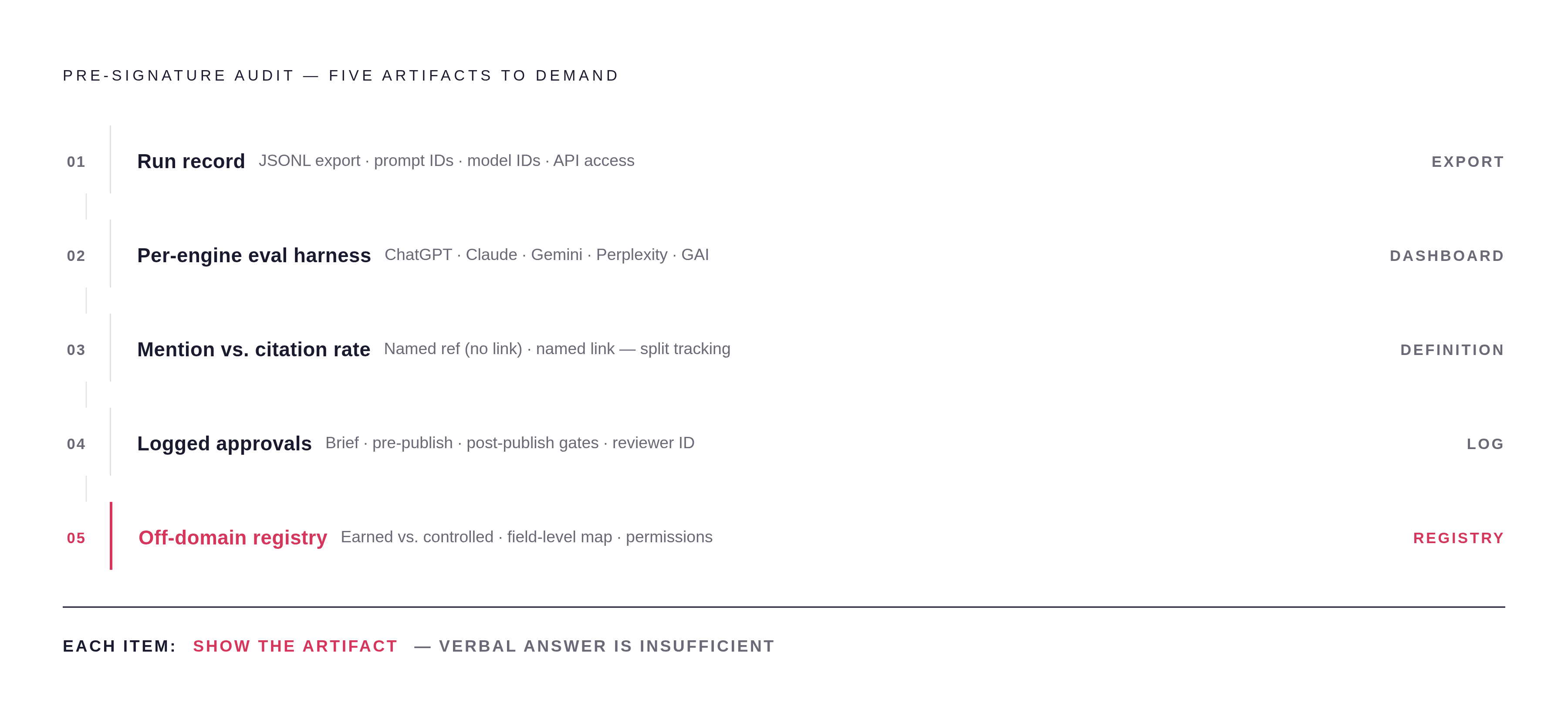
The vendor call should turn these requirements into five concrete requests for evidence already built into the product.
First, can the vendor provide the schema and an export showing that the run record is replayable, versioned and rollback-capable? The expected artifact is JSONL or equivalent, with prompt version IDs, model identifiers, tool call logs and timestamped human approvals, available through an API. The schema should make it possible to connect a published result to the declared inputs and captured context behind it, rather than leaving those dependencies hidden in a dashboard.
Second, can the vendor show which of ChatGPT, Claude, Gemini, Perplexity and Google AI Overviews its eval harness queries, with independent tracking and position-aware normalization for each? A pooled mention rate is not enough. The evidence should make clear which engine produced each result and how the harness judges prominence, so differences in answer format do not masquerade as differences in performance.
Third, can the vendor show per-engine mention rate separately from citation rate, with definitions that distinguish a named reference without a link from a named link? These signals answer different questions about visibility. Keeping these signals separate also links what gets published to what gets measured, since the next run needs evidence of whether engines name and cite the brand as well as proof that the content went live.
Fourth, can the vendor show the logged approvals for brief, pre-publish and post-publish review, with who reviewed the work and the timestamps? A document that describes the process alone cannot show that a gate worked on a given run. The artifact should let a founder identify the reviewed output and its approval, so human oversight is traceable.
Fifth, can the vendor show its off-domain strategy and property registry, placement logs, the distinction between earned and controlled or paid placements, and the supporting integrations' bidirectional sync, field-level mapping, permission scoping and trigger support? A connector's existence does not answer that request. Specific schemas, metric definitions, checkpoint logs and property records describe a system. Product marketing language in their place describes a demo.