Why Your CRM Is the Wrong Place to Start Building Your Growth Stack
Start upstream with machine-readable content before organizing conversations in a CRM.

A CRM is the wrong starting point for a technical founder’s growth stack because it records relationships rather than creating the conditions for buyers to discover a brand. As AI engines shape vendor shortlists before a sales conversation begins, growth infrastructure must start upstream, with machine-readable content, off-site presence, and visibility measurement. The CRM belongs after that foundation.
Why the CRM-first instinct made sense before AI changed where discovery happens
The CRM-first instinct came from a sensible operating model. Buyers found companies through referrals, events, cold outreach, and search, and those routes led into conversations the founding team managed directly. A CRM helped the team remember who had said what, follow up, and move relationships toward a sale. For a founder juggling those conversations, that was genuine leverage.
Technical founders took this approach from SaaS playbooks built around a fairly direct path. Google ranked a page, a buyer clicked it, and an expression of interest could become a contact in a pipeline. The path was auditable. Organizing the conversations near its end was a reasonable early investment.
AI answer engines have changed that sequence. A technical buyer asking ChatGPT, Perplexity, or Gemini for a vendor recommendation receives a synthesized answer. The shortlist can form before the buyer visits a vendor’s site.
What a CRM actually is — a recorder for relationships that already exist
A CRM records and progresses relationships that have already been initiated. It can amplify a working sales process, but it does not create the initial discovery on which that process depends. Think of it as a mirror of existing demand. If the discovery layer is empty, the mirror shows an empty room. More detailed fields will not fill it.
A founder buys a CRM as a growth tool, adds contacts, and discovers that the result is mostly a contact list. Those people need a reason to know the company and consider its product. Without that upstream condition, the system has little meaningful activity to organize.
The temptation is then to configure the future. A three-person team builds complex field structures, automations, and stage logic for the company it hopes to become in three years. Yet predictive forecasting modules cannot substitute for buyers having heard of the business. The configuration consumes time and attention that could have gone into discovery, while creating a system people may not use and data they may not trust.
The sequencing error creates technical debt in the revenue operation. CRM maturity follows revenue maturity in discrete jumps, rather than advancing just because a team installs more sophisticated software. Before a sales motion is proven, elaborate architecture encodes assumptions. Assessing what real process exists for a CRM to support is therefore more useful than assessing how much it can do.
Where discovery actually happens now, and why it is an architecture problem
For buyers who use AI answer engines, the answer itself is where they find brands. Generative engine optimization, or GEO, targets inclusion in that synthesized response. Traditional SEO aims to get a ranked link that a buyer may choose to click. The distinction changes the job of content. A page must be usable as a source for an answer.
What does that require from a growth stack? The architecture described here rests on five connected dimensions, namely crawlability, structure for machine extraction, freshness, off-site authority, and visibility measurement. Together, they connect what a company publishes with where engines find supporting signals and how the team learns whether it appears. More keywords cannot substitute for that structure. Publishing more cannot fix every weakness in that structure either.
The natural metric for this layer is Share of Model, or SoM, the fraction of relevant AI answers in which a brand appears. That shows when a brand is missing before the lack of visibility leaves its pipeline empty. For niche and early-stage brands, this is a founding growth problem. New brands tend to start with little AI visibility, while established names have a big head start because they are already known.
Visibility is also unstable from one answer to the next. The possibility of appearing today and being omitted when the same question is asked tomorrow makes a repeatable pipeline necessary, one that can maintain content, distribute it, and measure what changes.
The content formats and signals that determine whether AI engines cite a brand
The signal landscape extends beyond the links traditional SEO taught founders to pursue. Brand mentions across the web correlate more strongly with AI citation probability than backlinks do. Still, it broadens the work considerably. Editorial coverage, community platforms, review sites, and structured on-site content all belong in the discovery architecture.
Within that landscape, some formats are especially useful. Ranked “best-of” listicles are the highest-cited content format in AI answers, making them relevant to category-level buyer questions. Comparisons and head-to-head pieces can also address the choices a buyer is actually trying to make. Their value depends on useful, factual distinctions.
Freshness is a separate part of source selection. Recently updated pages receive meaningfully more AI citations than stale content, because retrieval and reranking systems use freshness when selecting sources at query time. Publication is therefore not the end of the work. A content system needs a way to keep useful material current, rather than treating each new page as a finished asset.
Where that content appears is equally important. The phantom-site and ground-site framing distinguishes between content under a company’s own domain and content on third-party platforms that models already treat as trusted sources. The former builds entity clarity and crawlability, while the latter adds off-site authority and citation potential. The Stacker/Scrunch case reported a large median rise in brand citations after content was shared across third-party news sites.
Why a multi-stage pipeline with human review beats both slow agencies and raw AI output
Maintaining those signals creates a production problem as well as an editorial one. A founder team cannot manually sustain the required cadence indefinitely, while a slow agency process can leave useful material waiting to ship. Raw AI output has the opposite weakness. It can supply speed without sufficient accuracy, expertise, or a defensible point of view.
The practical response is a multi-stage pipeline with human review. Its starting point is a map of real buyer prompts, developed by asking ChatGPT, Perplexity, Claude, and Gemini the questions prospects actually ask. Those prompts shape answer-first content based on real subject-matter expertise. The expertise remains the core of the work. Automation helps turn it into material that can be produced and maintained consistently.
The next stage makes it easier for engines to extract that content. Programmable content primitives include 40–60 word answer capsules per section, data tables, and FAQ schema. These give the pipeline repeatable structures without replacing editorial judgment about what each answer should say. The work then goes beyond the company’s domain through editorial mentions, community platforms, and review sites. Measuring SoM per engine supplies the feedback for the next iteration.
Human review should be part of the process throughout, rather than something brought in now and then to fix it. Every AI-generated suggestion should be reviewable and reversible before publication. Separating what can be automated from what needs a person’s expertise preserves control over claims and judgments while allowing automation to speed up repeatable work.
For a technical founder, that separation also has an architectural consequence. Every capability should be reachable by an agent through an API. The platform orchestrates the stages and instruments the results. This is what makes the stack computational.
How to measure AI answer-engine visibility so the discovery layer is managed on evidence
SoM becomes useful when it is tied to a defined cluster of buyer questions. A brand visibility score expresses the fraction of responses to that cluster in which the brand appears. Monitoring by engine also shows where the brand is visible rather than treating all AI discovery as one uniform surface.
The minimum monitoring set includes Google AI Overviews and ChatGPT. For research-intensive B2B audiences, Perplexity deserves especially high priority because every citation includes a clickable inline link. A click can become an attributable referral traffic event. That provides a connection between being named in an answer and receiving a visit, although visibility and traffic remain different measurements. A mention does not have to generate a click to be part of shortlist formation.
Evertune’s work with Porsche illustrates how measurement can guide an intervention. Its “Brand Score” methodology identified gaps in safety perception versus performance, and changes to semantic messaging produced a material increase in AI visibility. The signal pointed to a specific content problem. The response was not simply to publish more, but to change what the content communicated.
Software now exists to support this measurement. Ahrefs Brand Radar surfaces how brands are mentioned in AI-generated responses using its existing keyword and backlink datasets. Revenue instrumentation needs attention too, because a Perplexity citation click can produce a referral visit traceable in GA4, while some clicks strip the referrer and appear as Direct. GA4 needs a custom setup to separate out that traffic, and attribution still leaves gaps.
Answer visibility should be connected with attributable visits and the revenue relationships that follow, while keeping those measurement limits explicit. Otherwise, content spending remains detached from evidence about discovery. This is an engineering discipline. You cannot optimize what you cannot measure, and a discovery layer without instrumentation is just hope with a publishing schedule.
Where the CRM belongs in a stack built this way — and what changes when it arrives at the right time
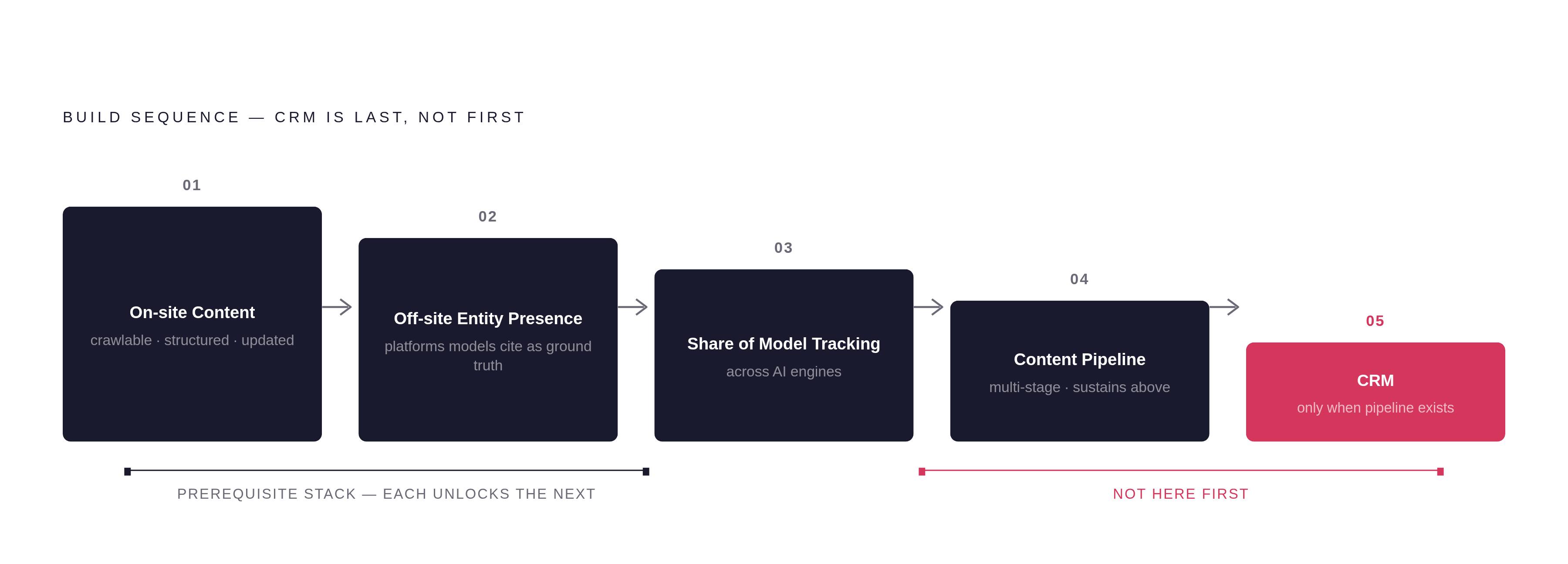
A CRM introduced after a working discovery layer has a different job to do. It records genuine demand rather than an aspirational pipeline, and reps have a reason to trust the contacts it contains. Buyers who arrive after seeing a brand cited in an AI answer they trust are warmer and faster to close than those reached through untargeted outreach. The relationship begins with some prior recognition. The CRM can then help the team progress it.
At that point, three foundational capabilities become useful. Deal intelligence uses engagement patterns to estimate how likely a deal is to close, process automation helps with the small share of activities that drive pipeline velocity, and data hygiene makes forecasts easier to trust. Each depends on real deal flow to learn from. Without it, the team is designing around imagined behavior.
For a founder deciding what to build next, the order is concrete. Start with crawlable, structured, frequently updated content on the company’s domain, entity presence on the platforms models cite as ground truth, and SoM tracking across the engines buyers use. A multi-stage content pipeline sustains that foundation. Add a CRM when pipeline exists, configured around the deal motion that has actually emerged. Add complexity only when the simpler stage reaches its breaking point.
The earliest CRM can therefore remain minimal rather than imitate a forecasting platform for a team of fifty. Its scope should follow ARR maturity. The site remains an asset, but it now needs to be legible to a machine that may decide whether to name the company before a buyer visits. Discovery infrastructure earns the chance for a relationship to begin. The CRM records what happens next.