What Google AI Overviews actually mean for technical marketing teams — and what to do about it
Technical marketers need to build machine-readable content, not just chase search placements.

Google AI Overviews pose a bigger question for technical marketing teams than how to protect search traffic. They expose whether a site is built for machines to read, extract, and cite. The useful response is not to chase each placement, but to build a content operation that makes the site legible, credible, and measurable across answer engines.
Why Google AI Overviews matter more in B2B Tech than almost anywhere else
B2B Technology has seen one of the sharpest expansions in AI Overviews among the industries tracked. That puts technical marketing teams close to the change, rather than watching it spread through other categories first. Their buyers are especially exposed. Longer, more specific queries are substantially more likely to trigger an overview, and those are the questions technical buyers use to investigate a problem or narrow their options. A site can therefore face this shift precisely where its content is most closely matched to a buyer’s needs.
The exposure also extends beyond introductory explanations. Informational queries still dominate, but commercial and navigational searches now trigger overviews at meaningful rates. What happens when a buyer moves from learning about a category to comparing possible solutions? The answer can still arrive before the visit. Comparison content is increasingly affected, so teams cannot treat this as a change confined to top-of-funnel education.
Nor is this a local experiment. Google said that AI Overviews are available in 200+ countries and 40+ languages. For technical marketers, the relevant question is which parts of the buyer’s research the format now mediates, and whether the company’s content contributes to the answer.
What actually happens to traffic when an AIO appears — cited versus uncited
An overview changes the traffic structure of a query. A high organic position without an overview, a citation inside one, and an organic listing beneath one are different situations. Ranking alone no longer describes the opportunity. Ahrefs’ April 2025 and December 2025 measurements show materially lower click-through rates for the top-ranking organic result when an overview appears, with the gap growing between those measurements.
Citation creates a separate route into the answer. Being absent from an overview is therefore not simply equivalent to ranking slightly lower, because the cited source participates in a surface the uncited page does not. That distinction means ranking and citation need separate measures, without promising a return to previous traffic levels.
The picture is not uniformly negative, however. Branded queries see a click-through-rate lift when overviews appear, and branded keywords now trigger them at a high rate. Brand search is no longer insulated from the change. Visitors referred through overviews can also arrive with more context and convert at higher rates on sites adapted to serve them. Performance reporting should therefore distinguish lost volume from the quality of the visits that remain, without assuming that better conversion automatically offsets fewer clicks.
Why reacting to AIOs as an SEO problem misreads what they expose
Traditional SEO focused on helping people find and click a page in a list of results. Citation requires a machine to read the page, extract useful information, and reason over it. Those are different demands on the same asset. A page built to win a click is not automatically built to support an answer.
The competitive field changes with that distinction. Overview citations come from a wider set of sources than the top organic results, so a modestly ranking page can still compete through well-structured content.
The site itself is now the core growth primitive. An overview is one place where machine legibility pays off, but Google AI Mode, Bing’s AI search, ChatGPT, Perplexity, Claude, and Gemini also draw from indexed content. The strategic unit is therefore not a placement on one interface. It is a body of content that multiple systems can understand and cite, supported by an operation capable of maintaining it.
The three distinct jobs that now make up search visibility — SEO, AEO, and GEO
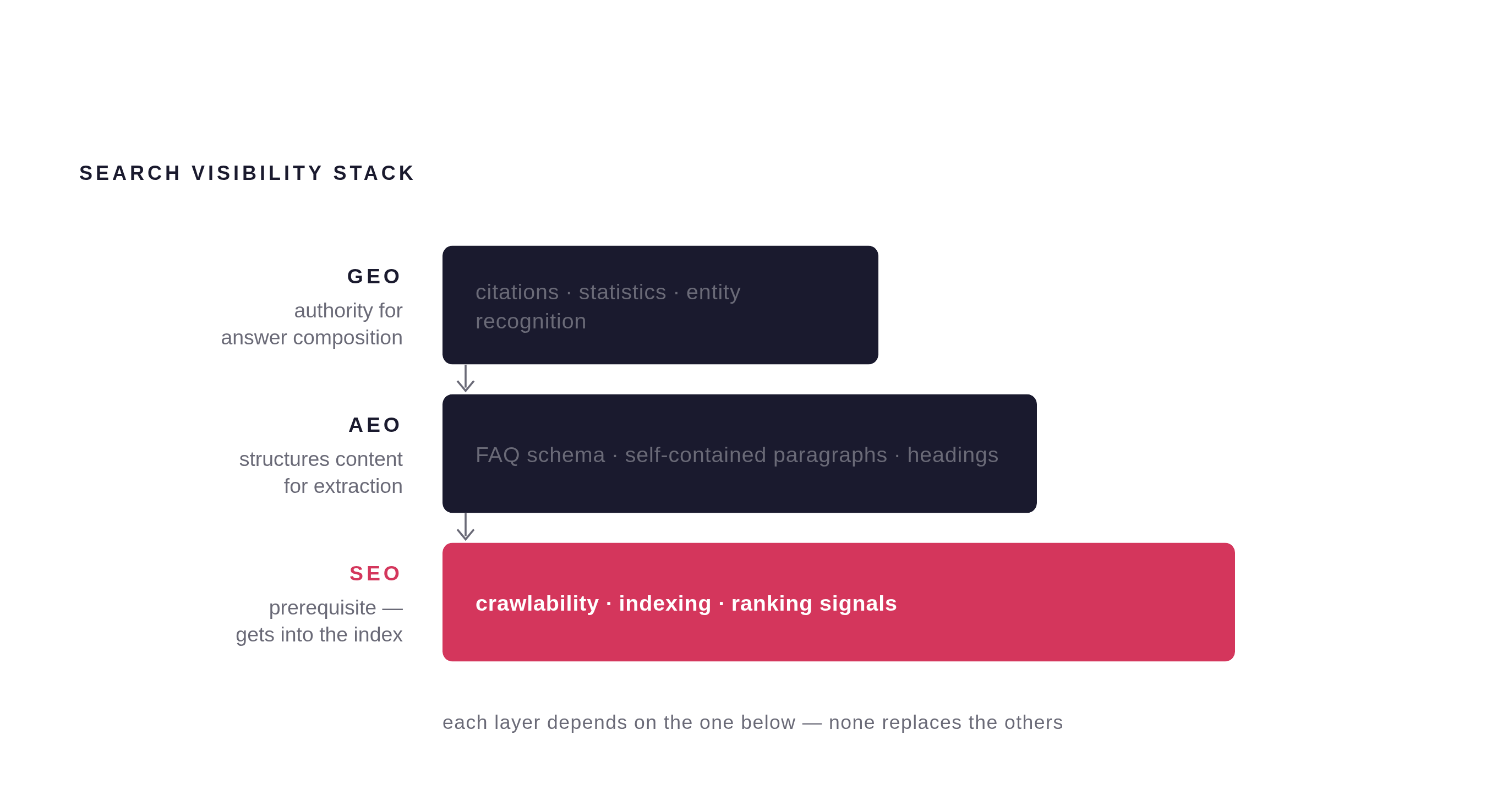
That broader job has three dependent layers. SEO gets content into the index, which is the first step toward having it appear in answers. Google AI Mode and Bing AI draw from their respective search indexes, so discoverability remains essential. The old work has not become irrelevant. It now covers only part of what a content team needs to do.
Answer Engine Optimization, or AEO, handles extraction. Self-contained opening paragraphs, direct definitions, FAQ schema, and hierarchical headings make information easier to pull into a direct answer. The distinction is one of purpose. A human may follow an explanation across several paragraphs, while an extraction system needs a usable answer in the portion it selects. AEO makes that portion intelligible on its own.
Generative Engine Optimization, or GEO, addresses authority and credibility when a system composes an answer. Quotations from credible sources, verifiable statistics, inline citations, and clear entity recognition help establish why a source deserves inclusion. Keyword repetition does not perform that job. The practical lesson for content planning is to specify which layer a piece primarily serves. An AEO brief that calls for a clear, extractable definition and a GEO brief that calls for original evidence are different briefs.
What machine-legible content actually requires at the page and site level
For writers and engineers, the framework becomes a set of build decisions. FAQPage and Article schema give machines information they can parse about a page, while a clear H1, H2, and H3 hierarchy shows how the parts of the page fit together. Structure gives the machine an explicit map. Clean semantic HTML and fast load times are upstream requirements because they affect whether AI crawlers can parse the page at all. Technical infrastructure is therefore part of citation strategy to address during writing.
Identity needs the same deliberate treatment. Entity grounding gives systems corroborating signals about who a brand is, including a Wikidata entry with the right properties and other machine-readable identity information. Without those signals, recognition can break down. A grounding page serves a related purpose through fact-focused, encyclopaedic prose, timestamps, and JSON-LD. Its one-fact-per-sentence format gives the model information it can retrieve and verify, rather than promotional instructions about how the brand would like to be described.
That page is distinct from an llms.txt manifest or a self-promotional /ai-instructions/ page. The wider site also needs coherent relationships. Interconnected articles that cover a subject comprehensively strengthen topical authority signals used in source selection. Meanwhile, freshness makes each page a perishable asset, so maintaining the architecture includes updating the information within it after publication.
Why AI citation sourcing varies sharply across engines — and what that means for content strategy
ChatGPT, Claude, Gemini, Perplexity, and Google AI Overviews do not choose sources interchangeably. A brand can be prominent in one and absent in another. Low domain overlap between ChatGPT and Perplexity citations makes that difference especially consequential, because success in one provides a weak basis for predicting success in the other.
Why does that change the content strategy? Each engine draws on a core set of sources it treats as authoritative within a subject, and the mix differs across platforms. Citation rates also depend on the query and category. There is no stable shortcut from one engine’s results to the whole market. Content built only to win Google’s overview placements may therefore get no citations in ChatGPT or Claude, even when it does well in Google.
The response is broader credibility. Teams should identify which publications occupy that trusted source set in their category and work to earn mentions there. Those mentions add to the site’s own structure and evidence. They do not remove the need for either. The strategic test is whether the brand can be recognized and supported across several reading systems, rather than whether a single platform currently favors one page.
How a continuous content operation — with human review built in — produces the freshness and volume citation requires
Freshness and multi-engine breadth turn citation into a production problem. Much of the content that gets cited is from roughly the past three months, and in active categories, the domains that get cited can change a lot from month to month. Content can lose citation relevance as it ages, and new work alone does not maintain the pages already published. The operation needs both a publishing cadence and a refresh cadence.
To meet that requirement, the pipeline needs defined stages. The sequence runs from brief to keyword research, outline, draft, optimization, review, and publication, with explicit inputs, outputs, and human owners at each gate. Teams can check accuracy, extraction, and structured-data as part of production before human review, and automated tools can schedule the work once it is approved. The purpose is repeatable throughput.
Grounding features reduce hallucination risk but do not eliminate it, so factual claims still need a human check before publication. Bad statistics and pricing errors can do harm once they appear under the company’s name. Editors also check brand voice, so the same team checks both the technical facts and how the writing sounds. Removing that gate would sacrifice the credibility the pipeline is meant to produce.
LangChain’s State of Agent Engineering reports that most organizations now run AI agents in production, and human review is still the main way they check agent output. Adoption does not imply full autonomy. For content teams, the useful model is a multi-stage system in which machines help produce and process work, while people remain accountable for what ships.
Measuring whether the site is actually being cited — and by which engines
The operation becomes accountable only when citation is measured. Teams that call AI visibility a core strategy but track little of it cannot tell whether they are making progress or just assuming they are. This is a prioritization gap before it is a tooling gap. Organic rankings and traffic remain useful, but neither directly answers whether an engine uses the brand as a source. That question needs its own measurement.
Citation Share provides the starting point. It is the number of responses citing the brand as a source divided by the total responses queried, expressed as a percentage. The measurement should cover ChatGPT and Claude across multiple model tiers, plus Perplexity, Gemini, and Google AI Overviews. Results that lump engines together can hide which ones cite the brand and which ones leave it out.
GA4 can group sessions whose referral source contains identifiable AI platform domains, so teams can see the traffic and conversions those platforms send. Citation and referral traffic answer different questions. The former shows inclusion in answers, while the latter shows visits that can be assessed for downstream performance. Teams need both to judge how the program is doing as a whole.
That measurement needs to be continuous. A snapshot may not describe the brand’s position four weeks later, particularly when model updates can reset citation patterns without warning. The discipline is to instrument the system, assess the evidence, and change the work in response.