AI Value Creation Frameworks for Private Equity Operating Partners
PE operating partners need to sequence AI deployments for measurable margin gains before exit.

AI value creation frameworks for private equity operating partners must solve a sequencing problem. The task is to turn selected deployments into measurable margin improvement before exit. That requires a portfolio-level investment discipline that connects readiness, deployment order and accountable results to the hold period, rather than allowing AI activity to become an end in itself.
Why AI experimentation rarely reaches the P&L in PE-backed companies
AI activity is widespread in portfolio companies, but AI value creation remains rare. Most companies are engaged in testing or pilot work, while only a small minority have operationalized use cases that move EBITDA measurably. Pilots are often selected, scoped and governed to demonstrate a capability.
The distinction matters because deployment and financial improvement are not interchangeable outcomes. Management can show that a tool works and employees use it without showing that it has improved margin. If the initiative has no clear income-statement target, work on the tool can move ahead without showing that margin has improved. In a corporate setting, a program that produces reports may be tolerated as capability building. In a PE-backed company, the same program consumes hold-period time without adding the earnings evidence needed to support exit value.
Why the hold period makes the sequencing problem distinct from a corporate AI strategy
A PE AI program must work backward from the exit EBITDA target. The hold period imposes a deadline on both operating improvement and the evidence needed to establish it. An initiative therefore needs more than an attractive eventual return. It needs a deployment sequence that leaves time for the business result to emerge and become measurable. Time-to-margin is part of the investment case.
The 100-day window immediately after acquisition is where the value agenda is set and the culture of value creation is established. That window does not reopen, which makes early prioritization consequential even when deployment takes longer. The argument for building capability during the hold and harvesting it at exit overlooks the buyer’s need for demonstrated improvement. Buyers pay less for capability that has yet to produce margin gains they can audit.
How operating partners are currently stretched and why that makes sequencing harder
Scattered experimentation is an understandable response from an overstretched operating team facing urgent requests. Leigh Coney’s PADF paper states that two-thirds of operating partners are already stretched across five or more portfolio companies. The AI mandate adds work to choose, deploy and govern AI on top of that load. Without a common intake process, the operating partner becomes a triage point for requests arriving company by company. Urgency then competes with readiness as the basis for allocating attention.
Fortium Partners describes an operating partner receiving ten AI requests in the first month after close, from sales, finance, operations and customer service. Each request arrives with urgency, a vendor and a promised return, so approving a shared tool feels like a practical response. Yet that response treats access as the constraint when the harder constraints are data quality, workflow maturity, executive ownership and measurable baselines. The AI operating partner seat addresses this capacity problem because simply adding the mandate to the existing bench risks further stretch or a handoff to junior staff without authority to shift portco-CEO behavior. The person with that authority still needs a framework to decide where to focus the limited time the operating team has.
What a structured sequencing framework looks like — the PADF and the readiness sprint
Leigh Coney’s Portfolio AI Deployment Framework, posted on SSRN in May 2026, organizes the response around three pillars, namely selection discipline, implementation architecture and cross-portfolio compounding. Selection discipline chooses the right portfolio companies and use cases. Implementation architecture makes deployment fit operating reality. Cross-portfolio compounding turns a successful deployment into a repeatable playbook. Their order matters because a portfolio-wide rollout cannot compensate for weak selection, and a deployment that does not survive daily operations has little value to replicate.
Fortium Partners’ AI Day-One Readiness Sprint gives the first pillar an operational form. For each candidate initiative, the operating partner identifies the workflow and baselines the outcome metric before changing anything. The next step assigns a named executive accountable for the result. The sprint then tests readiness across data, security and integration before placing the initiative in one of four categories, which are scale, redesign, defer or stop.
The baseline matters because use of a tool alone does not show that results have improved. A measure taken before the change gives the accountable executive and operating team a starting point to compare the result with. Fund-level standards for intake templates, value definitions, risk tiers, evidence packs and review cadence then make those judgments comparable across companies. Standardization requires each deployment to pass through the same evidence discipline before receiving more capital and attention.
Where AI moves margin fastest — applying the AI Operating Stack to the hold period
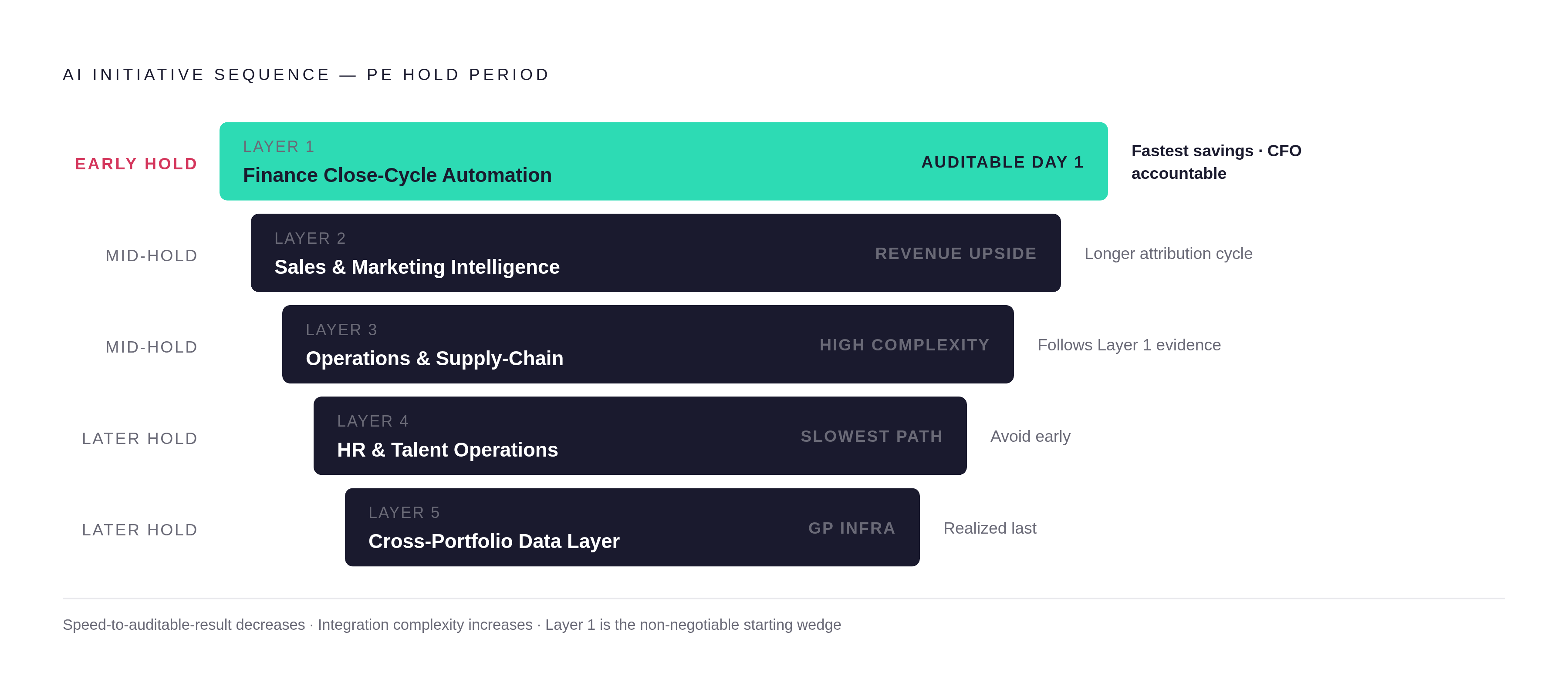
The AI Operating Stack translates selection discipline into deployment order by distinguishing layers with different ROI curves, integration costs and talent dependencies. Fortium Partners recommends naming the three workflows with the strongest connection to the investment thesis, focused on revenue growth, margin expansion, working capital, customer retention, cycle time or risk reduction. A use case needs a value-creation lever to get on the priority list. Within that shortlist, the stack helps distinguish an early proof point from an initiative that needs stronger foundations. The sequence begins with the workflow that can produce an auditable number in the first phase of the hold.
Layer 1 is finance close-cycle automation, the natural starting wedge because finance already has defined processes, measurable baselines and a CFO accountable for the number. RoboCFO structures its portfolio methodology around finance as that wedge. This layer offers the fastest path to auditable, quantifiable savings rather than requiring the operating team to establish a new measurement discipline from scratch. Its value is also evidential, since an early result can build internal credibility and board confidence. That proof point supports expansion without treating a successful pilot as permission for unrestricted deployment.
Layer 2 is sales and marketing intelligence, where the revenue upside is higher but attribution takes longer to establish. It fits mid-hold when the baseline commercial infrastructure is already instrumented. Layer 3 is operations and supply-chain optimization, which can improve margin by a meaningful amount but has the most complex integration work. It follows evidence from Layer 1 that the company’s data and governance can support AI workflows. The value of commercial or operational opportunities depends on conditions that an early deployment must not assume.
Layer 4 is HR and talent operations, which is valuable but rarely the fastest route to EBITDA and can distract early in the hold. Layer 5 is the cross-portfolio data layer, a GP-level capability that requires investment before the portfolio matures. Its place in the stack does not mean its funding should wait until every other layer is complete. Deployment at each company and infrastructure for the fund run on different clocks. Selecting the highest theoretical impact regardless of layer ignores integration risk, while disciplined sequencing treats a high-value opportunity with weak data foundations as a staged investment.
How fund-level AI infrastructure changes the compounding math across a portfolio
A repeatable deployment playbook changes the economics of the program because each company need not fund the same learning independently. Coney’s PADF makes that cross-portfolio compounding its third pillar. The return comes from turning a successful deployment into a playbook that can travel across companies at near-zero marginal cost. Shared capabilities, including a common vendor stack, standardized AI governance templates and a portfolio data layer, can cut the cost of later deployments and shorten time-to-value. Those capabilities require early fund-level investment rather than a decision to coordinate only after isolated wins accumulate.
Shared tools, however, do not compound in the same way as shared process infrastructure. Fortium Partners distinguishes the benefits of central purchasing from the requirements of a shared AI strategy. Central purchasing can improve security review, pricing and vendor control, but it cannot give different businesses the same workflows, data quality or leadership capacity. What travels more reliably is the discipline of intake, value definitions, baseline requirements, risk tiers, evidence packs and review cadence. Running finance automation separately in several companies becomes a portfolio program only when the learning and implementation method are made reusable.
AI visibility as a portco commercial asset operating partners undervalue
The sequencing framework also applies to the external commercial surface, where buyers use AI tools to research and compare products. A company can rank strongly on Google while remaining absent from answers in ChatGPT, Claude, Gemini or Perplexity. Search ranking and citation in an AI-generated answer are different outcomes and require different content strategies. With 93% of AI Mode sessions ending without a click, the answer itself is often the only impression a company gets.
The first constraint is measurement because most portfolio companies have no visibility into whether they appear in those answers. Share of Model makes that exposure something a team can audit by dividing brand mentions by total category brand mentions across a tracked query set. This KPI establishes whether visibility is changing, although it is not itself proof of EBITDA improvement. Structural content changes can lift citation rates, making the lever operable within a hold period.
Entity hygiene adds a governance requirement to that measurement task. When a brand’s core attributes are incorrect or absent in repositories AI systems treat as authoritative, those errors propagate into answers about the brand. For operating partners, this places AI visibility in the commercial section of the value creation plan with pricing and go-to-market. Treating it as a separate digital marketing workstream would detach it from the thesis and accountability discipline used to prioritize other commercial investments.
What the value bridge must show at exit and how to build it from day one
The exit value bridge is the cumulative record of operating decisions. It must connect the pre-intervention baseline to the measured outcome and the financial impact for each deployed workflow. Each line needs a source, a date and an accountable owner so that a buyer or LP can audit the claim. The measurement discipline therefore begins at entry, when the original operating condition can still be recorded.
Fortium Partners assigns accountability to the business result rather than placing the entire agenda under one title. The business-unit leader owns workflow adoption and performance, while the CFO validates the baseline and financial impact. The CIO owns data and integration, and the CISO owns security boundaries. Regular review then revisits whether an initiative should scale, be redesigned, be deferred or stop.
Every initiative must trace to a KPI that proves or disproves the investment thesis. When a leading indicator on a thesis KPI goes flat for two consecutive quarters, the issue may be a value-creation problem or a thesis problem, and those require different responses. An auditable bridge preserves that distinction instead of allowing deployment activity to stand in for investment progress. The sequencing problem is solvable, but only when operating partners treat AI as capital, sequenced against the thesis, governed through evidence and evaluated by the outcome it produces.