AI Impact on Revenue Operations in Private Equity Portfolio Companies
Linking AI revenue gains to exit multiples gives PE firms a path beyond cost-cutting returns.

AI’s most consequential impact on revenue operations in private equity portfolio companies comes from changing commercial performance. The firms separating from the field treat AI as a measured, embedded function tied to revenue and EBITDA. That difference matters throughout the hold period because proof of what the company can do helps it grow and gives the buyer a case for a higher exit multiple.
Why revenue operations became AI's most consequential battleground inside PE portfolios
The arithmetic that supported the previous decade’s deals no longer works. McKinsey’s June 2026 analysis finds that current deals require roughly twice the annual EBITDA growth to return the same capital. Cheap debt and multiple expansion are no longer enough to deliver returns. Growth therefore has to come from operations, particularly the commercial engine that generates and retains revenue.
That pressure puts revenue acceleration ahead of cost reduction in plans for AI. FTI Consulting’s 2026 Private Equity AI Radar survey of 200 fund and operating leaders found that 41% of PE respondents said revenue acceleration was their main goal for AI. The exit backlog makes that goal more urgent because sponsors cannot simply wait for better market conditions to lift valuations. The operating partner’s problem is to build the performance that supports the multiple before a sale begins.
The gap between fund-level AI conviction and portfolio-company daily reality
Most PE funds have committed to AI, while most of their portfolio companies are not yet using it in daily operations. A fund can appoint a chief AI officer and equip its deal team in months, but a mid-market company may have a controller, a two-person AP team, and nobody responsible for changing how that work gets done. Talent is the most cited constraint to scaling, ahead of data and technology concerns.
The second constraint is ownership of the financial result. High-performing funds are attaching AI more effectively than their peers to named revenue or EBITDA targets. That gives the program a place inside an existing value creation plan. When programs are handed to portfolio companies after they are designed, without operating partners helping to design them, they struggle to become part of daily work. The multiple is made inside the operating company, so a fund-level capability matters only when the company can use it.
Why productivity AI at the operating-model level produces modest multiple expansion while commercial AI at the product and business level produces dramatic gains
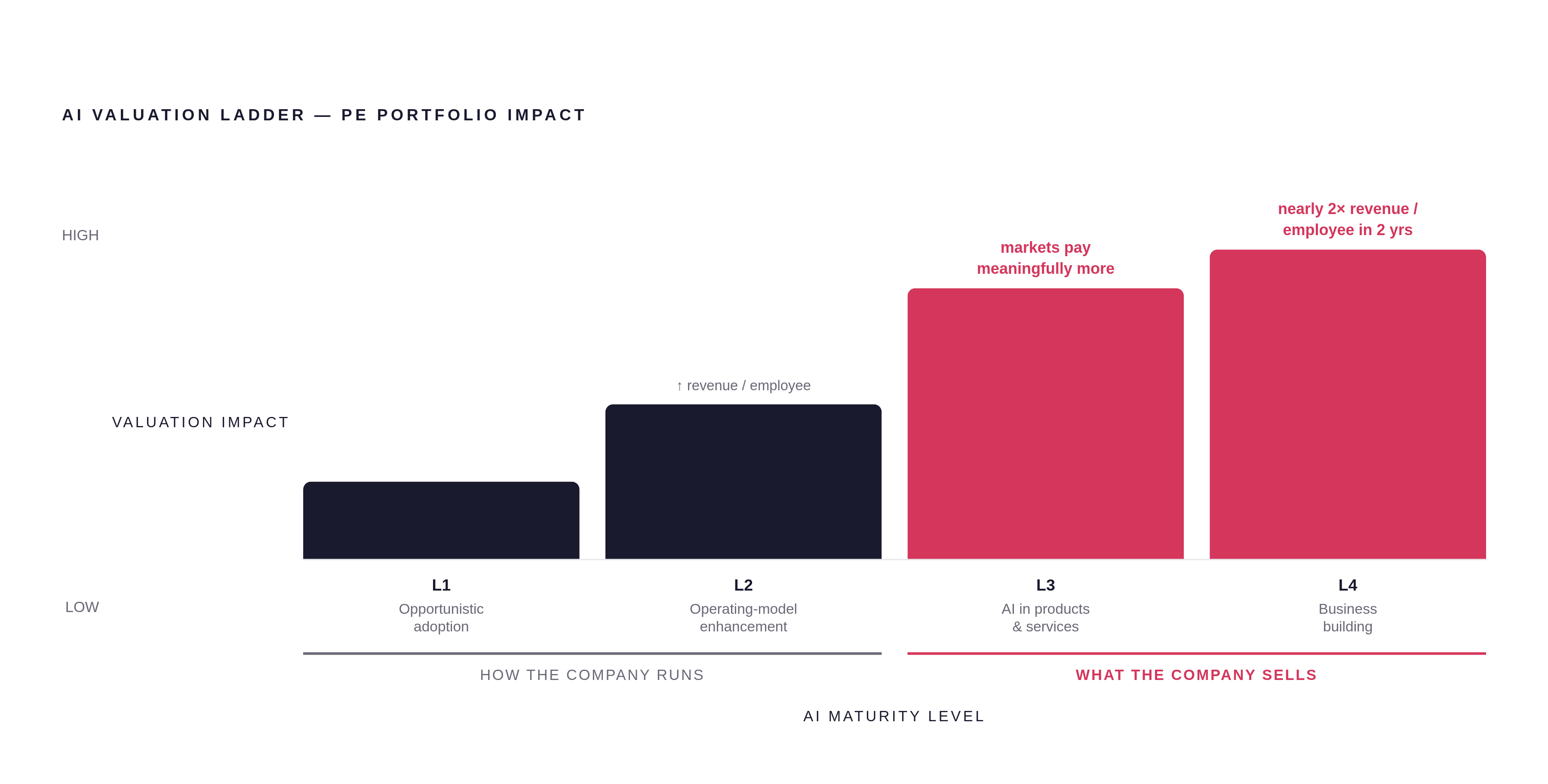
McKinsey’s June 2026 analysis places PE-backed companies on a valuation ladder with four AI maturity levels, namely opportunistic adoption, operating-model enhancement, embedding AI in products and services, and business building. The important distinction is between improving the existing operation and changing the commercial offer. Markets pay relatively little for AI that only changes how a company runs. They pay meaningfully more when AI changes what the company sells or creates new businesses.
That ladder creates a practical limit for much of the portfolio. A distributor, a contract manufacturer, or an insurance brokerage cannot readily embed AI in its product within a typical hold period. The dramatic multiple expansion associated with levels three and four is therefore largely unavailable to those businesses. McKinsey found inflation-adjusted revenue per employee measurably higher at level two than at level one, providing an operating contribution to the EBITDA growth required during the hold.
Productivity gains and a changed valuation story are different outcomes. For non-software businesses, commercial applications at level two offer a way to improve the existing revenue engine without rebuilding the product. When product-adjacent commercial AI also moves a company toward level three or four, even part of the way, it can change what the company can discuss with a buyer. Sponsors therefore have to distinguish between the earnings a deployment produces and the future business it makes possible.
Where revenue operations specifically captures the value that back-office automation leaves behind
Revenue operations is the organizational layer where that distinction becomes concrete. Invoice processing and AP automation improve the cost side of the operating model. Pricing intelligence, pipeline management, and customer operations also improve the operating model, but they act on revenue generation and retention. Both groups can sit at level two of the maturity ladder. Their commercial consequences are not interchangeable.
With pricing intelligence, dynamic pricing and margin optimization can expand from once a year to all year. Pipeline and revenue intelligence use lead scoring, churn prediction, and upsell sequencing to change revenue per customer without adding headcount. Customer operations extend the revenue relationship through AI-handled onboarding, renewal management, and reactive service. These applications work on revenue per customer, customer lifetime value, and retention, which back-office automation does not directly affect. RevOps provides a common home for those outcomes rather than treating each application as an isolated technology project.
McKinsey describes a case at a PE-owned global industrial-materials supplier. An AI-driven sales agent analyzed past purchasing behavior to reengage inactive accounts and achieved a 30% engagement rate during the pilot. In McKinsey’s PE-backed edtech case, AI-enhanced lead generation doubled average order value across an initial set of prospects. Those bounded results illustrate potential, with company-wide gains still unproven. In forward-leaning portfolio companies in 2026, RevOps also owns which agents run, what data they access, and how outputs are monitored because the commercial team bears the revenue consequence.
The exit multiple that commercial AI builds before the sale process begins
At exit, the buyer is assessing more than the earnings already recorded. Working commercial AI also informs expectations about what the business can produce after acquisition. A company with demonstrated pricing, customer-operations, and finance AI can therefore be worth more than an otherwise identical company with the same trailing EBITDA but none of those capabilities. The distinction is between an operating asset and a promised improvement.
That changes the sponsor’s timeline. Commercial AI has to begin early enough in the hold period for its capability to be demonstrable when the data room opens. A successful experiment is not equivalent to a system embedded in daily operations, even if both appear in an exit presentation. PwC’s US Deals 2026 Midyear Outlook also identifies the downside for legacy software assets, noting private credit managers’ discussion of “SaaS-pocalypse” scenarios in which AI-native alternatives erode recurring revenue models. For those assets, getting ready for exit means looking at the risk of disruption as well as proof of growth.
McKinsey’s level-four example shows the broader outcome that can support a premium valuation. An AI-native technology company grew beyond its core business with AI-enabled customer solutions and new digital services that brought in advertising, referral, and subscription revenue. Together with automation of legacy operations, that change nearly doubled revenue per employee within two years. That case is not a direct template for every portfolio company.
What separates PE funds that book AI revenue gains from those still running pilots
High performers place AI inside a value creation lever, such as revenue acceleration, pricing, or customer retention, with a named owner and financial target. Operating partners co-design it instead of receiving a finished initiative to implement.
Under that model, execution is the product. A pilot that works but never leaves its test environment has failed to deliver the intended operating result. This matters particularly in the mid-market, where most portfolio companies cannot hire their own AI team. A fund-level center of excellence closes that gap by building once and deploying across the portfolio without requiring every company to staff independently.
Embedded use does not mean unrestricted autonomy. An agent that recommends prices or scores leads needs a human decision point before its output affects a customer. Its actions must be reviewable and reversible at the operator level. Otherwise, the person accountable for the P&L lacks control over a system that can affect it. Governance is therefore part of the commercial operating model.
Why portfolio company brands are nearly invisible in the AI answer layer where buyers now research
A company can improve its commercial operations and still remain absent from the places where buyers research vendors. Most B2B buyers now use generative AI when deciding what to buy, which gives portfolio-company brands a separate challenge in being found. If the brand does not appear in those answers, its operational improvements do not resolve that absence. Commercial AI inside the company and visibility outside it address different parts of the revenue process. The second can remain unmeasured even when the first is well managed.
Google ranking is not a reliable proxy for that visibility. A company can rank first on Google yet remain consistently absent from ChatGPT, Claude, Gemini, and Perplexity answers to the same buyer questions. Platform differences also matter, with Perplexity emphasizing real-time retrieval, content freshness, and community sources such as Reddit.
For RevOps, the connection is the source of the pipeline. Where outbound activity depends on inbound discovery, absence from AI answers becomes a revenue input problem. Generative engine optimization and answer engine optimization address that discovery gap. The operating team needs to measure whether the company appears when buyers ask the questions that shape their consideration of vendors to know whether it reaches buyers across its addressable market.
Building and measuring AI visibility as a revenue operations function inside a portfolio company
AI visibility requires content architecture and continuous measurement rather than an assumption that good SEO will carry across. External brand mentions, publication beyond the primary domain, and third-party validation all matter to the citation environment. Publishing on sites outside the company gives AI systems more chances to find a brand in training data and retrieval indexes. Review sites and industry directories also contribute to the likelihood of citation by ChatGPT. The relevant task is therefore broader than producing more material on the company’s own website.
Measuring that activity gives RevOps a way to manage it. Share of Model, or SoM, is brand mentions divided by total brand mentions across a tracked query set. It makes visibility legible against a defined set of buyer questions rather than leaving success to occasional examples of favorable answers. The measurement layer also has to track ChatGPT, Claude, Gemini, and Perplexity separately. A single aggregate score can conceal a platform where the brand remains absent.
A Share of Model target gives the operating team a defined discovery input to manage and adjust on evidence. That is the same discipline that separates embedded commercial AI from pilots elsewhere in the portfolio. Over the hold period, measuring visibility can build a record of progress, while content work that goes unmeasured leaves nothing to verify at exit.