Content Localization Infrastructure for Global Marketing Teams
Localization must become infrastructure, not a final step in publishing.
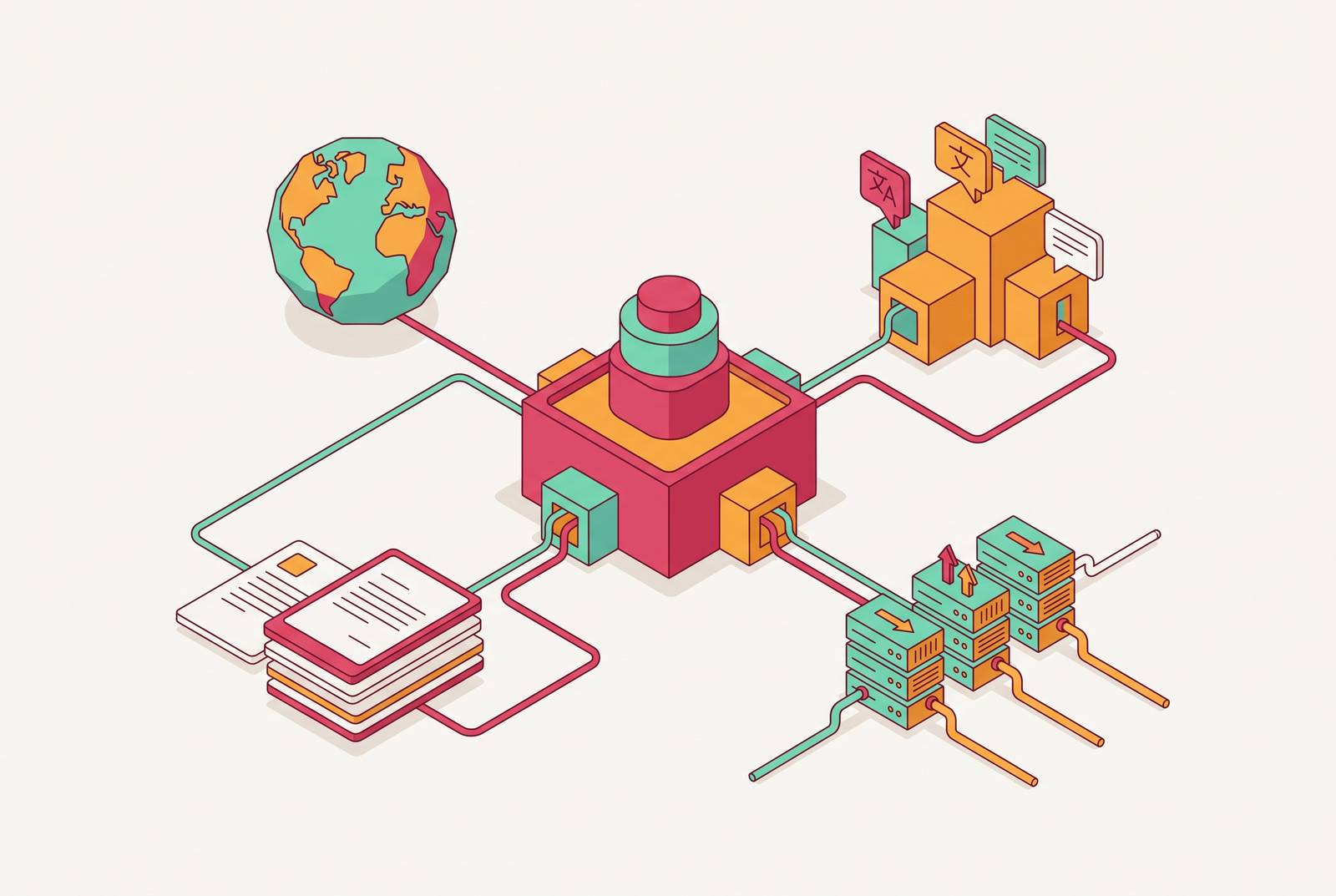
Localization used to be the last stop before publishing: translate the copy, test the page, ship it. That model is dead, and the reason is structural. Product updates ship continuously rather than quarterly, content now lives across a dozen disconnected systems at once, and a single campaign idea can fracture into a large number of assets that each need to make local sense. A decade ago, localization was a finishing step. Today, it begins at design, and the shift from workflow thinking to infrastructure thinking is the central story of how global marketing teams operate now.
What "infrastructure" means for localization: the components and how they connect
Localization technology in 2026 is a connected system, and treating it as anything less is how organizations end up rebuilding their entire process every time they enter a new market. It's a connected system, and treating it as anything less is how organizations end up rebuilding their entire process every time they enter a new market.
The system has several moving parts, and they only work when they're actually wired together: a platform that routes content (the translation management system, or TMS, acting as the orchestration layer), workflows that determine how work moves between people and systems, automation that strips friction out of repetitive tasks, linguistic assets like translation memory and glossaries that protect quality and consistency, machine translation and AI models that speed up the heavy lifting, QA systems that check the output before it ships, analytics that surface cost and quality and brand-consistency data, and the connectors and APIs that tie all of it into the rest of the business.
The useful comparison here is a conductor: it coordinates people, systems, automation, and AI models simultaneously, in real time, adjusting for what each piece needs fro... A workflow tracker just tells you where a file sits in a queue. A conductor coordinates people, systems, automation, and AI models simultaneously, in real time, adjusting for what each piece needs from the others. That's the role the TMS now plays, or should.
Different people in the organization see different slices of this same system, and none of them are wrong. A CTO looks at integrations and security. A localization leader looks at workflow design and quality control. A marketing director cares about speed and about whether the brand still sounds like itself in twelve languages. Developers want to know if continuous releases can happen without localization turning into the bottleneck that slows everything down. The infrastructure has to satisfy all four views at once, and the property that makes it work is flexibility: a well-designed ecosystem lets an organization adopt a new AI model, support a new channel, or enter a new market without tearing down what it already built.
Designing source content for adaptation rather than translation
The core discipline here happens upstream, at the point of authoring, not downstream at the point of handoff. Teams that scale well build master content assets designed for adaptation from the start, not text written for one market and then translated after the fact.
In practice that means modular content components that can be recombined depending on the market, visual templates with placeholder elements flexible enough to absorb text expansion or a right-to-left script without breaking the layout, and messaging frameworks that hold the brand line while still leaving room for local teams to adjust tone and reference points.
The technical constraints are real and specific. Some languages simply take more space to say the same thing. A button or headline built for one language can overflow the moment it's rendered in another. Reading direction changes the entire logic of a UI, not just the text alignment. Visual choices, colors, icons, photography, carry cultural weight that varies by market, and what reads as neutral in one place can read as a misstep in another.
For the assets that carry the most weight, campaign hero content, brand platforms, anything meant to move an audience emotionally, adaptation isn't enough. That tier calls for transcreation: rebuilding the message rather than translating it. Intel's "Sponsors of Tomorrow" campaign in Brazil is the clearest illustration of why. "Sponsor," translated directly, didn't land, because it implied a future promise rather than a present result, and audiences in that market respond to immediacy. The campaign became "Apaixonados pelo Futuro," or "In Love with the Future." It's a different message built to do the same job as the original line. It's a different message built to do the same job.
The leading TMS platforms in 2026 and where they differ
At its base, a TMS stores approved translations in memory so they don't need to be redone, enforces terminology and brand rules automatically, routes content through review chains, and connects directly to the systems where content actually gets created, so translation happens continuously instead of in batches.
Smartling has held the #1-rated TMS spot on G2 for 15 consecutive quarters, made Fast Company's Most Innovative Companies list for both 2025 and 2026, and took the #2 spot on G2's 2026 Best Software Awards for Content Management Systems. Customers report getting content to market up to 50% faster and cutting translation costs by as much as 70%.
Phrase fits organizations trying to unify software strings, marketing copy, support content, and multimedia localization on one platform, with shared translation memory and governed AI producing that unification instead of separate systems for each content type.
Crowdin runs an AI-powered platform that counts Microsoft and GitHub among its customers. It expanded into multimedia in 2025 with the launch of Crowdin Dubbing Studio, which pairs context-aware AI translation with voice dubbing, a sign that TMS platforms are no longer confining themselves to text.
Vaga.ai is at the early-stage end of the market, experimenting with an LLM-first architecture that moves past the segment-based translation model most TMS platforms still use. Vaga.ai is worth watching less for its current market share and more for what it signals: a possible future where the TMS paradigm gets restructured rather than incrementally improved.
The landscape is also consolidating. On May 14, 2025, MotionPoint introduced MarketFully as the parent organization for its portfolio, bringing translation, transcreation, and multilingual content creation under one framework. On December 2, 2025, MarketFully acquired Social Element, adding global social media operations and community management to that framework.
What separates a serious TMS from a basic one now comes down to three things: AI translation quality, agentic automation that catches and fixes errors before a human ever sees them, and real-time analytics that actually cover cost, quality, and brand consistency together rather than in separate reports.
Governance: the layer that keeps infrastructure from becoming chaos at scale
Infrastructure without governance just distributes the chaos more evenly. Governance's job is to clarify ownership, so translation requests stop bouncing between departments that each think someone else owns the process, and instead share one operating model with shared visibility into timelines, cost, and quality.
The model that tends to perform best is a centralized localization center of excellence: one group sets global standards for terminology, workflow design, and quality assurance, while regional teams own market adaptation and local channel decisions. Global teams hold brand strategy, core creative development, and compliance frameworks. Regional teams hold market adaptation, local channel optimization, and the on-the-ground cultural feedback that a global team simply can't generate from a distance. The center itself usually runs on global content strategists who protect brand consistency, project managers who coordinate across time zones, and QA specialists who catch what automation misses.
Governance also has to confront a specific, measurable AI quality problem. Model accuracy can drop sharply outside a widely used language and outside standard dialects, in tested cases, several leading models have shown meaningful accuracy drops when evaluated on a regional dialect instead of the standard form of a language. That's not a rounding error. With 87% of marketers now using generative AI in at least one recurring workflow, an accuracy gap of that size is a systemic risk that governance has to design controls around, the same way a finance team designs controls around currency exposure. It's a systemic risk that governance has to design controls around, the same way a finance team designs controls around currency exposure.
Team structure for localization at scale: who owns what across a global operation
Scaling past 100 markets forces a hybrid structure, centralized strategy paired with local expertise, and it's not really a choice between the two models so much as a recognition that neither one works alone.
Stakeholder coordination actually breaks most global content operations. It's stakeholder coordination. Without clear workflows defining who signs off on what, organizations end up with one of two failure modes: content so centrally controlled it stops resonating anywhere, or regional variations so loose they drift off-brand without anyone noticing until it's public.
Centralized teams can own brand standards, master content architecture, the technology stack itself, QA frameworks, and cost governance. What they cannot do is substitute for cultural expertise. The judgment needed to adapt a message with real sensitivity, to know that a phrase lands wrong or an image reads badly in a specific market, comes from people who live in that market.
That's what makes the regional team's role bigger than most org charts suggest. They're the market adaptation layer, the local channel optimization layer, and the early warning system that catches a brand misstep before it ever reaches production. They're the market adaptation layer, the local channel optimization layer, and the early warning system that catches a brand misstep before it ever reaches production.
AI visibility as a localization infrastructure concern: why GEO and AEO change the requirements
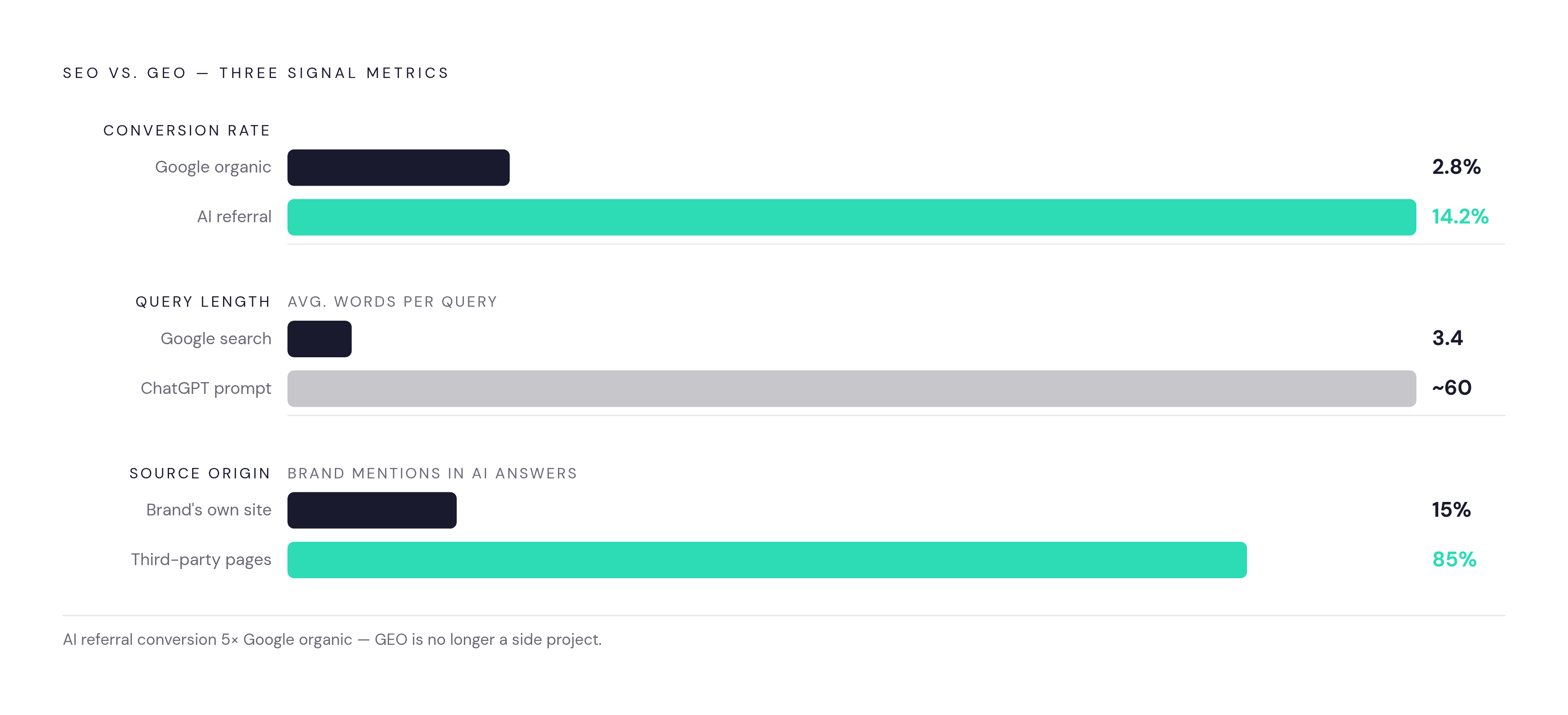
Search itself has changed shape, and localization infrastructure has to account for it. ChatGPT passed 900 million weekly active users as of March 2026. AI referral traffic converts at 14.2%, roughly five times the 2.8% conversion rate of Google organic search. According to Previsible's AI Traffic Report, AI-sourced traffic surged 527% year over year between early 2025 and early 2026. Google switched AI Overviews to Gemini 3, and roughly 42% of previously cited domains got replaced, with the overlap between top-10 organic rankings and AI Overview citations collapsing sharply.
Generative engine optimization, or GEO, is the practice built around this shift: structuring content and brand presence so AI systems actually cite and recommend a brand inside generated answers. It's distinct from SEO, which is about ranking a page, and distinct from AEO, which is about getting extracted as a direct answer.
The structural difference from traditional SEO work matters for localization specifically. SEO was mostly a first-party game, a team optimized its own site and controlled most of the levers. GEO runs mostly on third-party territory: around 85% of brand mentions inside AI search answers come from third-party pages, not from the brand's own site, and brands are far more likely to get cited through a third party than through their own domain. The content format differs too. ChatGPT prompts average around 60 words, compared to 3.4 words for a typical Google search query, a gap that reflects two fundamentally different jobs the content has to do.
For localization teams, that means GEO content can't just be translated the way a product page gets translated. It has to be structured, evidence-backed, and authoritative in every market language on its own terms, because AI systems evaluate credibility differently depending on the language and the sources available in that language context.
Measuring localization and AI visibility performance: the reporting gap most global teams have
Localization infrastructure should already be generating the basic metrics: cost, time to market broken out by region, quality scores by language pair, translation memory leverage rates, and brand consistency scores across markets. Leading TMS platforms increasingly surface these metrics in their dashboards, making robust reporting an expected capability rather than a differentiator.
What's missing from most global teams' reporting is any connection between that localization data and AI visibility performance in each market. A team can know its product pages in one language hit a strong quality score and still have no idea whether those pages, or any third-party page mentioning the brand in that language, are the ones an AI system actually cites when a user of that language asks a relevant question. Those are two different measurement systems right now, built for two different eras of search, and most organizations haven't built the bridge between them.
That gap is going to close, because the traffic numbers behind GEO are too large to keep treating as a side project. Until it does, localization teams that only measure the traditional five metrics are getting a partial picture of whether their content actually works in market, one that covers translation quality but says nothing about whether the content shows up where a growing share of discovery now happens.