"Pages that keep earning visits" is a claim you can test: three content marketing checks a technical B2B team can script instead of believing
Three scripted checks test whether your pages still earn visits.

A page that “keeps earning visits” makes a claim about performance that publication alone cannot secure. For a technical B2B team, three scheduled checks can test that claim and guide the work needed to sustain it. Measure organic decay, track AI-answer visibility, and make quality review a mandatory gate for whatever gets published in response.
Why "this page keeps earning visits" is a belief, not a measurement
Evergreen content does outperform time-sensitive posts over long horizons, with a small fraction of pages generating a disproportionate share of organic traffic. But that pattern says little about a particular page. A topic can still be useful even as the page that explains it loses visits. Most pages described internally as evergreen begin decaying well before the two-year mark without scheduled upkeep. Longevity is a maintenance outcome.
The distinction changes what a team needs to prove. Calling a page evergreen says how long the team expects it to be useful, while saying it keeps earning visits makes a claim the team can measure. Without regular checks, a team can mistake a page that did well yesterday for one that still earns visits today.
There is also a second curve to watch. A page can hold its Google position while AI answer engines stop citing it, because rankings and AI citations are separate mechanisms. Search Console alone cannot establish whether both remain healthy. The practical shift is therefore from assigning pages a durable label to testing which pages actually compound, which are losing ground, and which need work.
What content decay actually looks like in Search Console data, and how to script a detection rule
Content decay needs a definition that a script can apply without interpreting someone’s concern. A useful one is a trailing-period decline in organic clicks that persists across consecutive measurement windows. One bad month is not enough evidence. Two consecutive quarters moving in the same direction give the team a trend to investigate, while larger declines warrant closer attention.
To make that rule concrete, compare each page’s trailing-90-day click total with the same 90-day window one year earlier. Flag pages whose decline is meaningful, then test whether the negative direction persists across consecutive quarters. “Meaningful” must become an explicit threshold in the script. The notes do not supply a universal percentage, so the team must define that boundary for everyone reading the report. Otherwise, the script only moves an ambiguous judgment from an audit into a spreadsheet.
Is the page losing its search position, or are fewer people clicking despite its position holding steady? Those patterns call for different responses. When clicks and position both slide, the page is a candidate for a refresh. When position holds while clicks fall, structural displacement through an AI Overview absorbing the visit is the problem to investigate, rather than assuming the page needs the same ranking repair.
Each flagged URL therefore needs two outputs, its click trend and its position trend. Together, they route the investigation more usefully than a traffic-loss alert alone. The position check identifies the pattern that calls for looking beyond rankings, while the separate AI-answer check examines AI citations. That boundary prevents the team from asking Search Console to answer a question its data does not directly cover.
Search Console’s API exposes clicks, impressions, CTR, position, and date, so the inputs are accessible without a third-party tool. Authentication is an implementation detail for the API documentation. The operational choice is to run the check weekly or monthly. On that schedule, the script becomes a standing sensor rather than an audit that depends on someone remembering to request it.
High-stakes pages with persistent declines are refresh candidates, while low-stakes pages with the same direction may be candidates for deprioritization. Pairing the signal with the page’s importance keeps maintenance effort from being allocated simply to whichever URL shows the most conspicuous loss.
Why AI-citation visibility is now a separate signal to track, and how to script a Share of Model check
AI answer engines increasingly help B2B buyers form shortlists before they visit a vendor website. Visibility in ChatGPT, Claude, Gemini, and Perplexity is therefore a distinct acquisition channel. A stable search position cannot establish presence there. The team needs to ask whether its brand shows up when buyers ask the category questions that help them choose.
Share of Model, or SoM, gives that question a measurable form. It is the brand’s mention count divided by the total AI responses in a tracked query set. A brand present in only a minority of those responses has correspondingly low SoM for that set. The query set limits the result to visibility against those buyer questions.
Those prompts should mirror actual research questions, such as “What tools does a [category] team use for [problem]? Branded questions test a different condition. For each response, record whether the brand is mentioned, the cited URL, and competitor mentions, then calculate SoM per engine per week.
Using the same prompts lets the team compare one run with the next. Keeping the engines separate preserves a different kind of distinction, because strong citation visibility in one does not automatically transfer to another. A combined total could obscure that divergence. Competitor mentions show whether the brand appears in answers that discuss other choices in the category, giving the team more to go on than a mention count alone.
The cited URL is also more than supporting detail. AI citations draw heavily from third-party sources rather than brands’ own domains, so owned content cannot win this channel by itself. Off-site presence on Reddit, G2, industry publications, and reference sources belongs in the visibility work. Recording the source makes that work measurable. The team can check whether its third-party presence appears in the answers it tracks, giving off-site work a clearer purpose than a vague effort to build the brand.
This is why mention and citation should not be collapsed into one observation. The mention field answers whether the brand appeared, while the cited URL shows the source used in the response. Both are needed to interpret the result. A team trying to understand the contribution of its own pages needs that source information, especially when much of the channel draws on material it does not own.
Yet better measurement cannot rescue unchecked publishing. If the response to declining traffic or weak AI visibility is to produce inaccurate content faster, the team has made the underlying problem worse. Unreviewed output can reach production. AI assistance can expand a brief, pull SERP data, draft to an approved outline, and enforce formatting consistency, but those tasks do not settle whether the finished piece is true or useful.
For technical B2B SaaS content, human validation is not a small final polish. Topic selection, specific accuracy judgments, the strength of the argument, and the value to a buyer require review. API endpoints, configuration values, and software behavior need particular scrutiny. In technical documentation and integration guides, a clear, smooth explanation can still make a technical claim that fails validation.
An industrial B2B supplier’s documented pipeline between December 2025 and August 2026 shows how these gates can work. Before people reviewed the drafts, each went through an accuracy assertion suite, an AI-extraction gate, and a structured-data audit. The client approved every post before publication. None required retraction, and the articles were cited in Google AI Overviews.
The supplier’s safety-critical specifications made a wrong specification a safety problem. Scripts checked specific pass-or-fail questions, including whether there was a citation, whether schema was valid, and whether an assertion matched a reference file. Human review handled the judgment those matches could not supply. A claim matching a reference file still leaves the question of whether it remains accurate today.
The third check should make that division explicit in the publishing pipeline. Automated review asks whether a source is attached, the schema validates, and the assertion matches the reference file. Human review asks whether the claim is current, the argument holds, and the piece deserves a buyer’s time. Defining them in advance prevents “review” from becoming an unspecified task that disappears under deadline pressure.
Scripting the human gate means making the pipeline trigger a mandatory checkpoint. The script makes human judgment a required part of publication, as client approval was in the supplier’s pipeline. Neither the decay nor the SoM check can protect a program whose response to their signals is stale or inaccurate content.
How the three checks compose into a single instrumented system rather than three separate audits
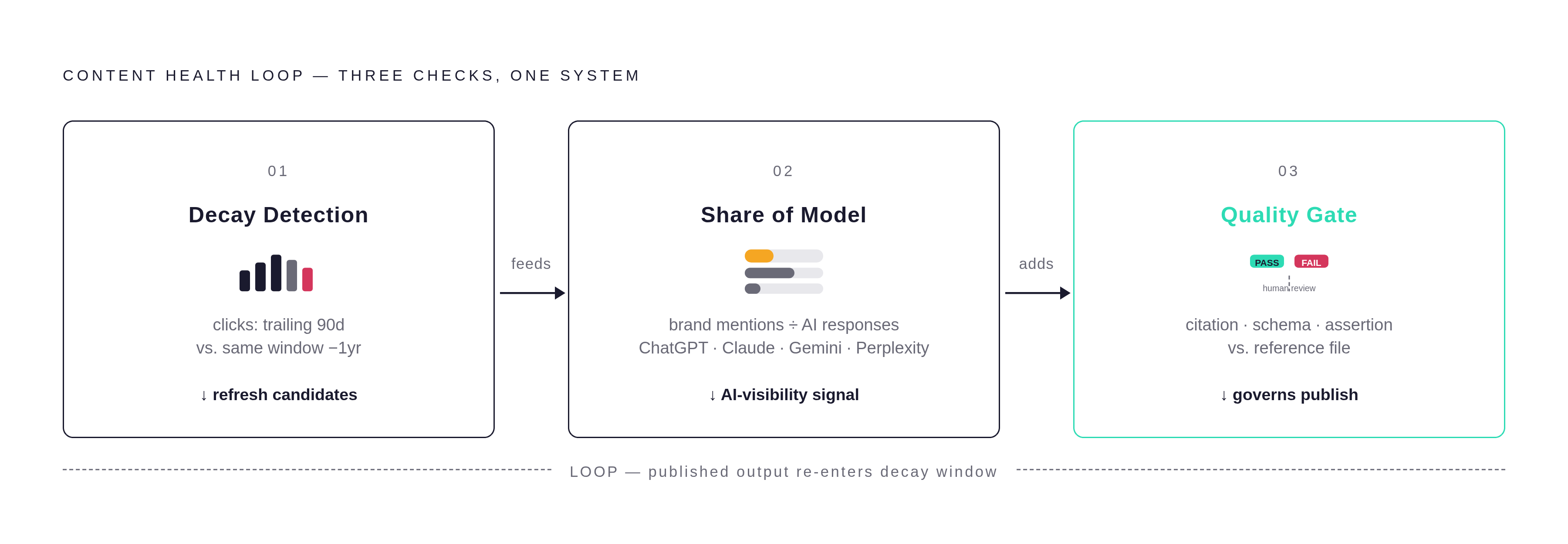
The decay script supplies candidates, the AI-answer check adds visibility evidence, and the quality gate governs the work produced in response. Their value depends on the handoff between them. A page that loses clicks and position needs a different investigation from one that holds its position but disappears from AI answers. The refresh decision can then address the observed problem instead of treating every decline as a request for more text.
Each check also limits a weakness in the others. Decay detection without a quality gate can lead to refreshes that introduce errors. AI visibility tracking without decay detection can miss the owned pages that need work most urgently, while a quality gate without either signal may apply standards to work on the wrong pages. These checks are inputs and controls for one maintenance loop.
Within that loop, a refresh becomes something the next measurements can test. The team can look for a change in organic performance and examine whether the refreshed material appears in tracked AI citations. Improvement remains a result to establish after editing. That is the useful sense of compounding here, because each pass supplies evidence for the next decision rather than requiring renewed faith in the page’s evergreen status.
Only a small minority of brands systematically track AI search performance, leaving most without visibility into that second curve. For a technical B2B team, the obstacle is chiefly prioritization. The data is accessible, the APIs exist, and the pipeline infrastructure is buildable or available. But that does not make every check equally easy to maintain, or require the complete system before any part becomes useful.
The practical sequence is to build one check this week and add the others over the next two sprints. For most teams, decay detection is the fastest starting point, followed by the more maintenance-intensive AI citation check once owned-content health has a baseline. There is an important exception to that order. If AI-assisted content is already reaching production without an explicit quality gate, making human approval mandatory is the first fix.
Otherwise, start this week with Search Console’s trailing-90-day click totals, compare them with the same window one year earlier, and attach the position trend to every URL the rule flags.