What a "SEO tools for B2B startups" comparison can't tell you: keyword volumes are estimates, so instrument your own search and AI-answer demand
Keyword volumes are guesses, so measure your own demand instead.

A comparison of “SEO tools for B2B startups” can help you choose software, but it cannot tell you how much demand your startup can reach. Keyword volumes are estimates, and they can differ 30-fold from one platform to another. The better foundation is your own instrumentation, combining actual search impressions, buyer language, and AI-answer visibility rather than treating a tool’s volume figure as a planning fact.
Why keyword volume numbers differ so much across tools
Ahrefs states in its documentation that “Search volume in any SEO tool, including Ahrefs, is always an estimation. Only Google has access to the exact data.” The differences begin with how those estimates are built. Google Keyword Planner groups related terms into buckets and rounds to ranges, while Ahrefs and Semrush blend clickstream panels, proprietary crawl signals, and licensed data.
The gap can reverse a content decision. Link-Assistant’s analysis found a 30-times difference between the lowest estimate, from Moz, and the highest, from Semrush, for the same keyword. Ahrefs’ own test against Google Search Console impressions found that even the tool that did better was roughly right for about six keywords in ten. Its study of tens of thousands of keywords also found that Keyword Planner overestimated the vast majority and drastically overestimated more than half. Switching tools leaves this uncertainty in place because of how the estimates are made.
What the comparison-page format is actually selling you
A comparison page usually resolves uncertainty by naming a winner. That can be useful when the question is about pricing, integrations, or the interface a team prefers. It does less to help when the question is whether a given volume figure is right. A larger database does not answer that question. Nor does a more detailed difficulty score show how many buyers search for your specific niche query.
A tool can outperform its peers and still give you a large overestimate. What happens when a startup treats that winning estimate as settled evidence? Its content calendar may rest on a figure that is off by an order of magnitude, particularly for low-volume, high-intent queries.
Why B2B niche queries make the accuracy problem worse
B2B startups often pursue the queries that tools handle least reliably. These long-tail phrases contain more words and more intent, but they are also where tools round and cluster most aggressively. Consider “best CRM for three-person real estate team with Zillow integration.” A tool may fold that phrase into a broader parent term or show zero volume, losing its distinct demand. Yet the buyer has already named a team size, a market, and a required integration.
That specificity changes what a low number means. It may reflect poor visibility into demand. Pages that answer such queries can bring in traffic that matters and converts well because the buyers have such a clear intent. For a startup with limited publishing resources, rejecting them on volume alone can mean rejecting a close fit with its buyers.
What Google Search Console gives you that no third-party tool can
The first corrective is Google Search Console, or GSC. It shows actual impressions for queries where your site appeared. That makes it the closest available ground truth for search demand on your own domain. Its scope is also its limit. It can anchor decisions about queries you already rank for, but it is not a complete view of searches your site has yet to reach.
Weight those impressions above third-party estimates where the two overlap. Treat an external volume figure as a band, potentially several times higher or lower. Within one tool, comparisons between keywords remain more trustworthy than comparisons across tools because the estimates are internally consistent.
For opportunities beyond your existing visibility, competitor gap analysis provides a different kind of evidence. Queries where several top-ranking competitors appear and your domain is missing offer a positional signal that sidesteps the need to believe an absolute volume figure.
The demand layer every SEO tool comparison leaves out entirely
Even well-anchored search data leaves another question unanswered. When a buyer asks ChatGPT, Gemini, or Perplexity about vendors, does the answer name your brand? Rank tracking cannot tell you that because it measures a position on a search results page. A brand can receive regular ChatGPT citations without corresponding GSC clicks. It can also rank at the top of Google while remaining invisible on Perplexity.
This requires separate measurement. In generative engine optimization, or GEO, the unit of competition is the passage rather than the page, and the outcome is often a citation without a click. Citation share against a prompt panel measures that outcome more directly than keyword rank does. A dashboard that tracks only search can look good while missing the answers buyers get as they research vendors. The missing signal is not merely another route to website traffic, but whether the brand enters the buyer’s consideration at all.
Why AI engines do not share sources and what that means for your measurement
AI-answer visibility is not a single channel with interchangeable sources. The domains cited by ChatGPT and Perplexity overlap only slightly, so strength on one can coexist with absence on the other. Their sourcing patterns differ as well. Perplexity leans heavily on community discussions, while Perplexity, Gemini, and Claude rely heavily on third-party corroboration. A view limited to one engine cannot stand in for the rest.
Perplexity cites sources in nearly every response, ChatGPT in the large majority, Gemini somewhat less, and Claude in only a small fraction. Claude’s implicit brand mentions therefore need attention separate from explicit citations. BrightEdge AI Catalyst tracker data also shows that ChatGPT mentions brands significantly more often than it links to them. Counting citations alone would understate brand presence there, even before the differences between platforms enter the picture.
Building first-party demand signals that exist nowhere in any tool
To see more of the picture, a startup should link search impressions to the words buyers already use in sales calls, support tickets, and CRM deal notes. These records capture how buyers describe problems at the moment of decision. Keyword databases cannot supply that same evidence. A phrase can appear in a sales conversation months before it has enough search history for a tool to track. Community threads on Reddit, in Slack groups, and in industry forums can extend that view beyond existing customers.
The AI measurement layer should begin with those buying questions. A fixed prompt set, run regularly against ChatGPT, Claude, Gemini, and Perplexity, provides a consistent basis for tracking visibility. Keep brand mentions and linked citations as separate metrics. The former records whether the brand is named, while the latter records whether it is linked as a source.
GSC shows where your site already meets Google searches, internal records reveal buyer language, and the prompt panel shows whether AI answers include the brand. None needs to impersonate a complete market count.
What content actually earns AI citations and why gated assets earn nothing
Can an engine read the relevant evidence, identify the company consistently, and find independent support for its claims? Quality alone cannot overcome a form wall. Crawlable original research can earn attribution, while the same research locked behind a form is unavailable to the engine.
On the company’s own site and profiles, entity consistency is another prerequisite. The name, description, founding year, and services should match exactly across the website, LinkedIn, industry directories, and, where applicable, Wikipedia and Wikidata. Conflicting details create “hallucination fuel” and can leave neither source cited. More publishing does not repair that conflict by itself.
Allowing OAI-SearchBot for real-time citation while blocking GPTBot for model training is a distinct strategic choice.
That choice makes robots.txt part of content architecture. The off-site layer then adds corroboration through independent reliable sources, review-site listings, relevant forum contributions, and placements in publications the engines frequently cite. This is especially relevant to Perplexity, Gemini, and Claude.
How a multi-stage pipeline produces content worth publishing at the cadence AI visibility requires
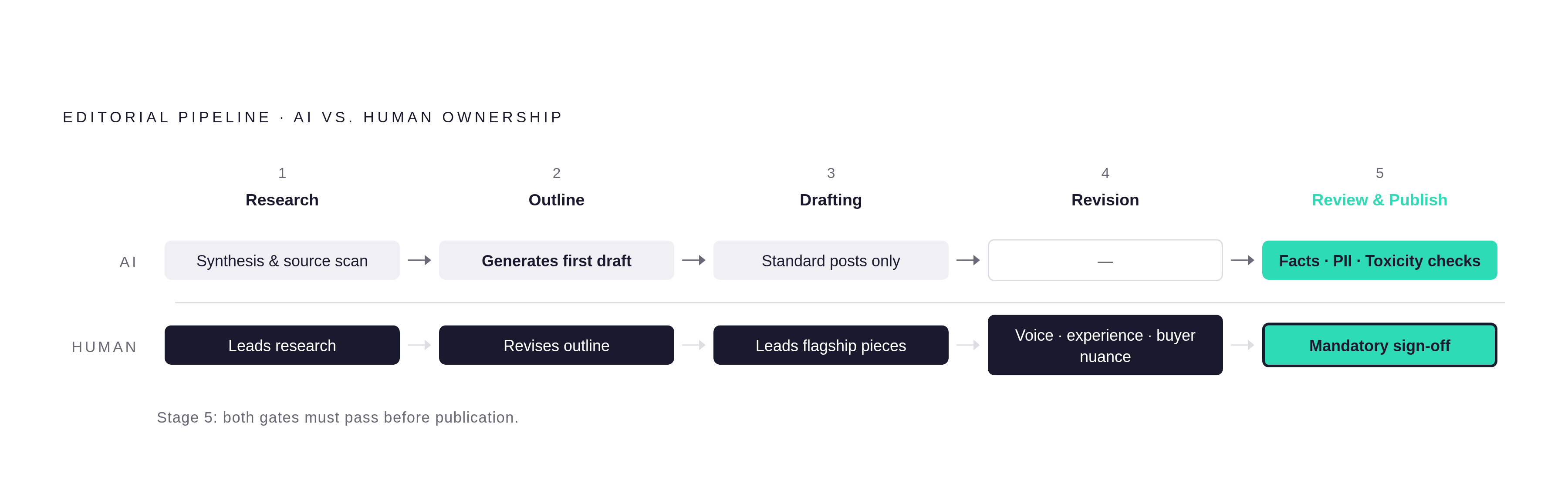
How can a small team publish regularly without replacing expertise with generic drafts? A multi-stage pipeline addresses the constraint by assigning human judgment where it changes the result. AI can help with synthesis and standard drafting, while people retain control over research, editorial direction, and claims. Review is built into the work instead of left to the hope that someone will check it at the end.
The five-stage workflow begins with human-led research supported by AI synthesis, followed by an AI-generated outline revised by an editor. Drafting is tiered, with AI drafts for standard posts and human-led work for flagship pieces. Human revision then adds experience and voice before automated and human review control entry to the publish queue. The structure separates speed from permission to publish. A draft being ready for review is not the same as being ready for readers.
The experience step is where the named author adds operator-specific knowledge, domain expertise, and buyer-specific nuance. What the author adds makes the piece credible in a way that an AI draft consistently falls short of. Automated checks cover factual consistency, PII, and toxicity, and a human must sign off on high-risk content. Both gates must pass before publication. Without that separation, a team can produce technically correct but strategically forgettable content that may rank briefly and earn no citations.
What to actually instrument and in what order
GSC comes first because it costs nothing and corrects the most common error, treating an estimate as an observed count. Once it is set up, use impressions to validate or override third-party volume figures for queries where your site already ranks. Then use competitor gaps to find opportunities beyond that footprint. Keep the distinction between the signals clear. Impressions show demand where your site already appears, while competitors’ positions point to queries to look into without having to trust their reported volumes.
The words buyers use with the company come next because they can show demand that the wider market cannot yet see. Pull a recent window of support tickets, sales call notes, and CRM deal language, then extract the phrases buyers use. Prioritize that evidence before dismissing a topic as zero-volume. The aim is to recognize a specific buying need before waiting for a keyword database to acknowledge it.
AI-answer tracking comes third because it requires more setup and covers a growing discovery channel that search metrics miss. Build the fixed panel from actual buying questions and track both mentions and citations across the four engines. With that baseline, check whether AI bots can crawl the relevant pages, whether entity details match, and whether gated research could be made into crawlable pages.
Third-party tools still belong in this system. Use them for relative comparisons within one tool, competitive gaps, and directional prioritization. The decision rule is to give observed evidence more weight than modeled precision. A B2B startup’s demand picture should be built from what buyers ask and where its brand appears.