Why AI visibility is becoming a board-level priority in Asia Pacific — and what it means for how you build your marketing stack
AI agents are changing how brands need to be discovered and evaluated in Asia Pacific.

AI answer engines are changing how buyers in Asia Pacific find brands and weigh them up. The response needs to go deeper than another SEO campaign. AI visibility is becoming a board-level priority because it connects acquisition economics to a technical requirement, namely a marketing stack that machines can read, assess and recommend, with measurement built in from the start.
How AI answer engines are restructuring brand discovery in Asia Pacific
A search results page gives buyers a set of places to look. An AI answer engine increasingly does part of the comparison for them, selecting which brands to include in its response. That changes the terms of discovery. In traditional search, a brand that ranks eighth can still get impressions. When a brand is left out of a generated answer, it gets no exposure in that answer, and standard website analytics cannot show the chance it missed.
Asia Pacific is already part of this shift, with no need to wait for people to adopt habits from elsewhere. Stanford HAI’s AI Index ranks Singapore as the second-largest AI adopter in the world. That makes it a leading indicator of commercial AI behaviour across the region, though not a substitute for understanding each market. Internal data from a sample of accounts shows a 23% rise in commercial AI conversations across ChatGPT and Gemini in Singapore from January through September 2026. These conversations concern researching, comparing and buying.
When buyers ask an engine to compare alternatives, the answer becomes part of the commercial decision. A brand therefore needs more than a page that ranks for the right query. It needs evidence that an answer engine can use to decide which options to include.
Why this shift has climbed from marketing dashboards to board agendas
Customer acquisition cost and revenue put that change within the board’s remit. Buyers who arrive after an AI system has synthesized options and compared alternatives are already partway through their evaluation. AI-referred sessions convert at materially higher rates than conventional organic sessions, making this more than a question of traffic volume. The economics pull the conversation upward. If acquisition costs are rising while a source of qualified demand remains invisible in reporting, leadership has an incomplete view of how the business acquires customers.
That does not make every AI mention revenue. A mention can happen without a visit, and a visit alone does not explain what the engine told the buyer before they arrived. Finance must therefore ask whether the business can understand a channel that helps shape buyer choice, including the parts that take place outside its own site, rather than asking only whether AI traffic has increased. A marketing dashboard built only around arrivals cannot answer that question.
Enterprise software activity reflects this widening demand. PR Newswire expanded its AEO & GEO Brand Report to APAC after its April 2026 launch and July expansion to Europe, the Middle East, India and Africa. Adobe’s June 17, 2026 announcement introduced Adobe Brand Visibility, a generative-engine-optimization platform combining Semrush’s AI Optimization data with Adobe’s LLM Optimizer. These are signals of mainstream enterprise interest, rather than proof that measurement is settled. They show why leadership can no longer treat the subject as a specialist experiment.
What agentic AI commerce means for the discovery mechanic itself
In the earlier discovery pattern, a buyer asks a question, reads an AI-generated answer and decides whether to visit a brand’s site. The brand still controls the final conversion environment. With agentic AI, the buyer can instead give a system a task, such as “find and shortlist vendors for X”. The system reads multiple sites, evaluates them against criteria derived from the brief and returns a recommendation.
The buyer may never see the rejected options. That makes the site’s job different from attracting a curious visitor and persuading them to explore. It must also support a machine reading with a specific decision to make. The agent needs to extract claims, compare them with corroborating sources and assess whether the information is current and authoritative. Content can be engaging for a person yet leave those evaluative questions unanswered.
What would an agent need to establish before recommending a brand? That question moves the discussion beyond appearing in answers and into the design of the marketing stack. The site must make its evidence available in a form the evaluator can use, while other readable sources must support the same account of the business. “AI as the new front door for brands” describes this decision layer between buyer intent and the conversion environment. A brand can lose consideration there before a human sees its name.
Why most marketing stacks were not built to be legible to an AI agent
Most existing marketing stacks were designed for human readers and search crawlers. They were not wrong for their time. Their content, publishing workflows and reporting reflected an environment in which ranking brought people to a site and the site did the persuading. An evaluating agent asks something different of that infrastructure. A page optimized for a query may still lack specific answers to the criteria an agent is applying on a buyer’s behalf.
If a brand describes itself with different attributes across its website, press releases and third-party sources, the agent encounters conflicting evidence about the same business. This is not merely untidy wording. The corroboration gap can count against the brand when the system assesses its claims. Consistency across the surfaces a model can read is therefore a legibility requirement.
A similar mismatch affects authority and reporting. A stack organized around acquiring backlinks does not necessarily build the readable, corroborating mentions an AI evaluator needs. Links and mentions serve different purposes here. Meanwhile, an AI answer can give a brand visibility without sending anyone to its website, so visit-based analytics cannot show that exposure. Familiar practices address only part of the new information environment.
What actually makes a site machine-legible to an evaluating AI agent
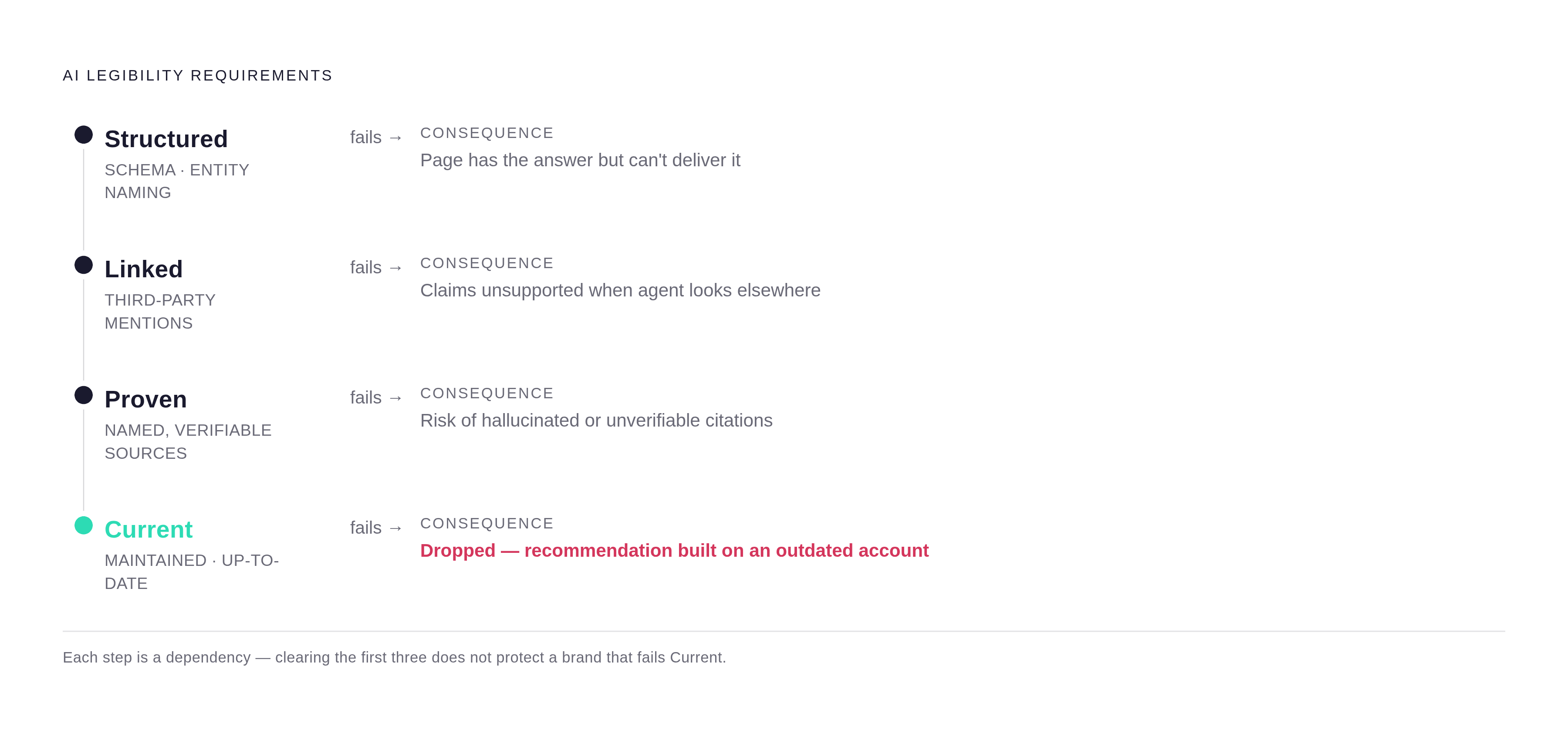
Structured means that an agent can extract a specific claim without having to interpret the whole page. Structured data, consistent entity naming and answer-shaped content all help the agent do that. The practical requirement is precision at the point of extraction. A fact should be identifiable as a fact about the same business described elsewhere. Without that structure, the page may have the answer but fail to give it in a form the agent can use to evaluate the brand.
Linked means that third-party evidence supports the site’s claims. An agent can encounter mentions in sources its training data or retrieval layers treat as credible, giving it evidence beyond the vendor’s own account. Independent editorial presence therefore has a structural role in discovery. Without it, a brand can offer clear claims that remain unsupported when the agent looks elsewhere.
The notes’ phantom-site mechanic relies on this difference between marketing that the vendor owns and editorial sources that seem independent. For evaluative and brand-reputation queries, AI systems tend to discount brand-owned content relative to apparently independent sources, though that preference depends on query intent and is not universal. Apparent independence is not proof of accuracy.
Proven means using specific, verifiable claims with named sources. An evaluating agent has more to work with when a fact is checkable than when a vendor calls itself exceptional. Unsupported claims create a different risk from invisibility. Microsoft’s July 2026 preprint “Phantom References: Hallucinated Citations That Survive Peer Review at Top-Tier Conferences,” arXiv:2607.00738, documented hallucinated citations surviving review even at top-tier academic venues. The relevant warning for brand content is that a convincing citation can still be false, and a buyer may act on it without checking.
Current means making it clear that the information is maintained. AI systems weigh how recent information is, but can still present an old claim as current when a site gives no clear sign that it is kept up to date. Publishing in bursts does not solve that problem. A site that then goes quiet presents a stale information environment to an agent evaluating it today. The consequence is not only reduced visibility, but the possibility of a recommendation based on an account of the business that is no longer current.
Why AI visibility has to be measured before it can be managed
Teams need a feedback loop to make these properties part of how they build and improve the site. Without a defined measurement method and a fixed baseline, a team cannot tell whether changes improve visibility or which engine is most relevant in a given market. Measurement comes before optimization for that reason. Mention rate, citation frequency, answer-share, sentiment and accuracy rate provide a working set of signals. They need to be tracked against a fixed prompt panel so that results can be compared over time and across engines.
Citation volume alone cannot explain commercial value. Leadership also needs to know whether sentiment is drifting and whether the intended message survives in the generated answer. Is the engine describing the brand accurately, or merely naming it? Does the answer convey the claims relevant to the buyer’s decision? Share of voice without sentiment and accuracy cannot answer those questions, while message pull-through helps show how work on technical visibility shapes what buyers are told.
Those omissions limit what a reader can infer from the output alone. A team that adopts any measurement tool should therefore check how it works, since a polished report alone does not show that results can be compared. Otherwise, a change in the reported score may be difficult to interpret.
With a stable method, the measurement loop gives leadership a way to assess the infrastructure work. The team can then check the effect of a changed claim, a corrected entity description or new corroborating evidence. That makes uncertainty in AI responses part of the system being managed.
Why building this as infrastructure beats hiring a regional AI visibility team
Hiring people to manage a new channel is understandable, especially when its tools and methods are unfamiliar. But manual work scales with headcount. If measurement, publishing and correction depend on people navigating separate interfaces, more activity requires more coordination, and staff turnover can break the process. With an engineered system, each piece of structured, corroborated and current content adds to the site’s citation surface through a workflow already in place, with no need to set up a new process.
That changes what the budget is buying. The infrastructure is a build whose value can accumulate, rather than a succession of campaigns that each need to restart the work. This is not an argument for removing human judgment. Multi-stage AI pipelines can handle structure and coverage while people review claims and voice. A hard publishing gate then blocks pages that fail any of the four legibility properties, keeping speed subordinate to evidence.
The review gate has a specific purpose. In this model, most rejected drafts fail because they offer “nothing new” or contain something “unverifiable”, while almost none fail on fluency. The bottleneck is substance, so people need to check that drafts have it as well as fix the grammar. The durable workflow drafts quickly, reviews carefully and publishes nothing it cannot substantiate.
For that workflow to operate at the speed of the channel, every capability needs to be reachable through an API. Measurement, publishing, monitoring and correction need to work without relying only on a person using a user interface. This makes the API-first requirement part of the operating design. People are still responsible for judgment, while agents can use the capabilities they need to carry out the process.
A team that instruments this in 2026 can develop an advantage over time by accumulating months of citation data, consistent entity descriptions and third-party corroboration while refining its review process. A competitor that waits can fund a build, but cannot buy back that elapsed learning. The durable advantage in AI visibility is structural.