Hybrid Search Architecture for RAG Answer Quality
Pairing keyword, vector, and reranking layers fixes RAG's retrieval failures.
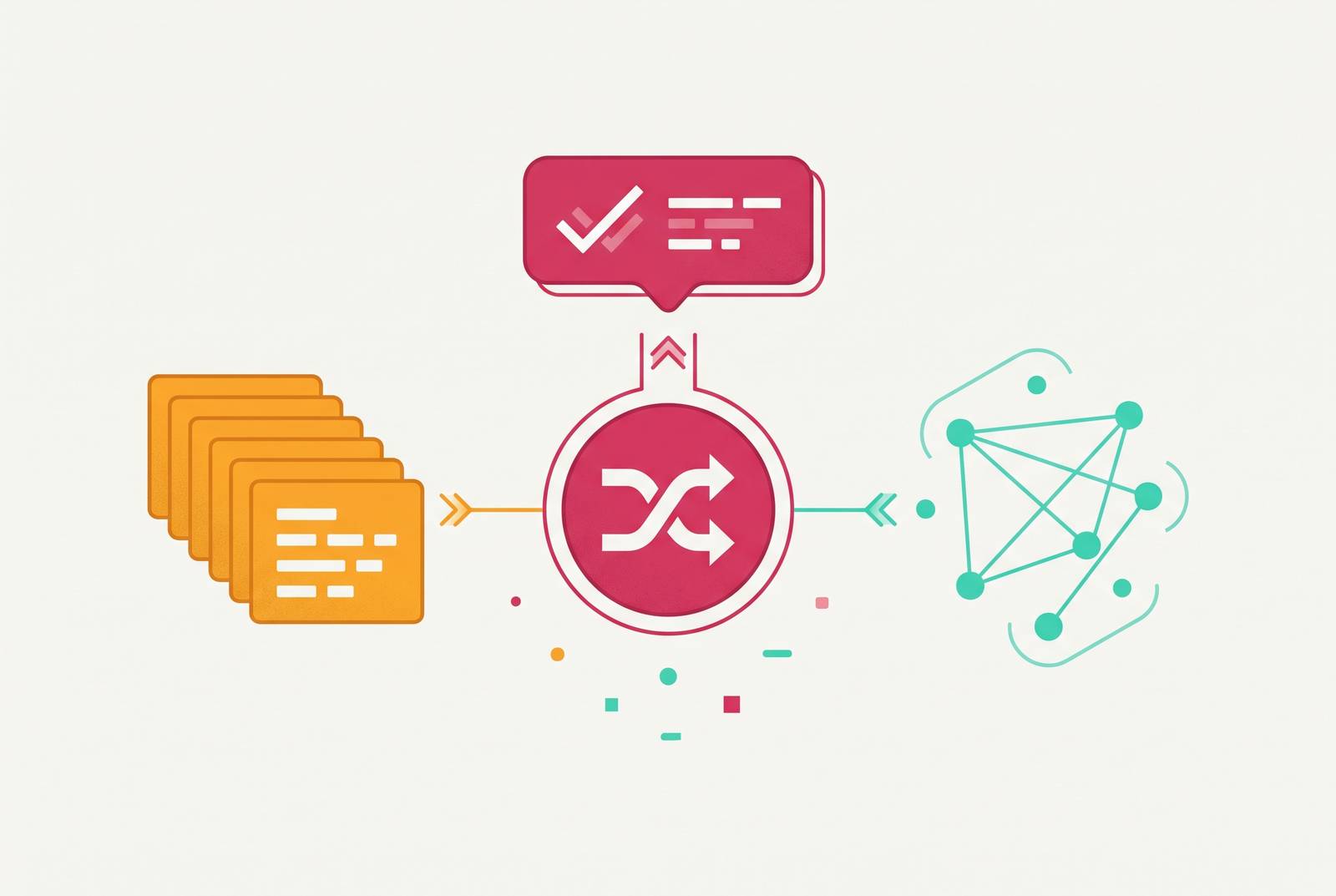
Hybrid search architecture improves RAG answer quality by combining keyword precision, semantic recall, and cross-encoder reranking. Each retrieval layer fixes a different weakness, so engineers get the largest gains by measuring where the pipeline fails and targeting added complexity there.
Why naive RAG fails in production and what hybrid retrieval solves
A request for a specific invoice number can return passages about invoicing in general when a RAG system relies on vector search alone. A naive pipeline embeds the question, retrieves similar chunks, and hands them to an LLM, leaving generation to work with whatever similarity found. Even a well-written answer cannot draw the missing invoice from a passage about invoicing in general.
Keyword search has the opposite weakness. BM25 can find an exact identifier, but it may not retrieve passages about stress management programs for a question about employee burnout. The words differ even though the ideas are linked. Combining sparse keyword retrieval with dense vector search addresses these complementary blind spots, while reranking helps separate genuinely useful evidence from loose matches. In production, retrieval is therefore both a step before generation and the main bottleneck.
Instead of asking only whether a more capable LLM would answer better, the team must ask whether the current model received the right evidence. LLMs synthesize well from correct context. Hybrid retrieval improves the supply of that context, reducing the conditions in which a model must answer from irrelevant or incomplete material.
How the three layers of hybrid search work together
Dense retrieval uses transformer-based embeddings to capture semantic similarity between a query and document chunks. It excels at conceptual connections but struggles with out-of-vocabulary terms. Sparse retrieval, using BM25 or SPLADE, contributes precise lexical matching where semantic similarity can blur an exact request. Neither method replaces the other’s role in this architecture. Their results must be combined before a more expensive model checks how well they match the query.
Reciprocal Rank Fusion, or RRF, merges the two ranked lists by summing reciprocal ranks. Documents near the top of both searches move up the list. This creates one candidate list even when the retrievers’ raw scores mean different things. RRF is unsupervised and hyperparameter-light, making it a practical bridge between the two retrieval methods.
The cross-encoder then scores each query and document together. Unlike bi-encoder similarity, scoring the query and document together lets the model judge more accurately how well the document matches the query. That accuracy has a computational cost, however, which makes cross-encoding too slow for the full corpus. The architecture confines it to the shortlist from hybrid search, then passes the top-5 to the LLM.
The underlying retrieval components are available in established databases. Pinecone, Qdrant, Weaviate, and Milvus support hybrid search natively, with fusion methods varying by platform, including RRF, Relative Score Fusion, and alpha-weighted scoring. PostgreSQL users can pair full-text search with pgvector similarity. These options support the same architectural separation even when their fusion controls differ.
What the benchmark evidence says about each layer's contribution
The WANDS e-commerce benchmark puts numbers behind the complementary-retrieval argument. A tuned hybrid setup reaches NDCG of 0.7497, compared with 0.6983 for BM25 alone and 0.6953 for pure vector search. The combined result exceeds both single-method baselines. That finding supports fusion rather than merely choosing whichever standalone retriever looks slightly stronger on a particular dataset.
Hybrid Retrieval for Hallucination Mitigation in Large Language Models: A Comparative Analysis connects retrieval quality with the goal of reducing hallucinations. The study combines dense and sparse methods through dynamically weighted RRF and finds that hybrid retrieval outperforms the individual retrievers. Its relevance to answer quality is direct. Better retrieval gives generation stronger evidence for grounding, so it has less need to make up for a poor candidate set.
Sifei et al., SemEval-2026 report a training-free hybrid pipeline reaching 0.5453 nDCG@5, ranking third and outperforming the strongest single-method baseline at 0.4795. Their ablations identify SPLADE-v3 as the strongest sparse component and reranking as a major contributor to final ranking quality. RRF with a BGE reranker and α-rescoring produces their best nDCG@5. The result supports the layered design, although the full pipeline’s score should not be mistaken for the isolated gain from any one component.
Trokhymovych et al., UNLP 2026 place second in the shared task with a two-stage hybrid retrieval system running on a single P100 GPU. Could these gains still be benchmark-specific? The consistent direction across e-commerce, multilingual question answering, and multi-turn conversation is stronger evidence than any single score, though it does not promise a fixed gain on every corpus.
Where chunking fits in the pipeline and why it determines retrieval's ceiling
Retrieval methods operate on the pieces that chunking preserves. If a split severs the relationship needed to answer a question, neither fusion nor a cross-encoder can reconstruct that relationship merely by ranking the fragments. Chunking is therefore the most consequential upstream decision. It shapes both which candidates are chosen and what context is passed to generation.
Recursive chunking is the practical starting point for most uses. It splits by heading hierarchy, then paragraphs, then sentences, using moderate token lengths and a small overlap. The approach is fast and predictable. Semantic chunking instead uses embedding similarity to detect topic shifts, which can produce better chunks for transcripts and long-form prose. That benefit comes with more processing and complexity, so the choice depends on whether the simpler splits are actually failing.
Contextual chunking addresses a different loss, namely a fragment’s connection to its source. It prepends a 1–2 sentence summary explaining what the chunk covers and where it sits in the document. Trokhymovych et al. note that chunking can strip segments of their thematic connection and that contextual embeddings can preserve document-wide intent. The summary also adds searchable terms for BM25.
Sentence window and parent-child retrieval separate matching precision from generation context. They index small chunks but retrieve the surrounding window or parent chunk, and the ARAGOG benchmark ranks this approach first in retrieval precision. That does not establish a universal winner among chunking strategies. The practical rule is to start with recursive chunking and let measurement trigger an upgrade to semantic or contextual chunking only when RAGAS Context Precision falls below a meaningful threshold.
Query-side techniques that make hybrid retrieval more robust before a single document is fetched
Document chunks are only one side of the match. The query entering hybrid search is also a design choice, especially when a conversation’s latest turn depends on earlier context that the retriever cannot see. Query rewriting turns that dependent request into a standalone question. Without it, even strong RAG systems can degrade on later turns. Sifei et al. find that concatenating the last turn with a controlled standalone rewrite consistently improves retrieval and generation without additional training.
Single-turn questions can need shaping for a different reason. Hypothetical Document Embedding, or HyDE, generates a hypothetical answer document and embeds that document. The aim is to search from language closer to the real answer documents. The generated text serves as retrieval input. The hybrid architecture stays the same when the query takes this new form.
RAG Fusion tackles ambiguity through multiple query variants. It runs hybrid search for each variant and combines the results with RRF, increasing recall without requiring a change to reranking. The distinction from ordinary hybrid fusion is the source of the lists being merged. Hybrid fusion combines retrieval methods, whereas RAG Fusion combines results from different formulations of the question.
Adaptive RAG adds a decision about retrieval effort. A lightweight classifier routes a query to no retrieval, single-step retrieval, or multi-step retrieval according to complexity. Simple questions can skip reranking work they do not need, while complex questions can use more than one retrieval pass. Teams can start with HyDE or RAG Fusion to improve recall in single-turn systems without making them much more complex. In multi-turn systems, conversational rewriting is the highest-leverage first intervention because it repairs the question before any retriever tries to answer it.
Post-retrieval techniques that filter and compress context before the LLM sees it
Hybrid search narrows the candidates and reranking orders them, but neither guarantees that every sentence in the selected context helps answer the question. Context compression provides a final filter by extracting or summarizing only the relevant portions. This cuts token cost and keeps the model from being distracted by the irrelevant parts of a passage. Selection and compression solve different problems.
Self-RAG extends that assessment into generation itself. The LLM decides when retrieval is needed, then generates reflection tokens to grade retrieved evidence and its own output. This can catch hallucinations that better retrieval alone cannot prevent. Corrective RAG, or CRAG, instead uses an evaluator to grade retrieved documents and trigger a response when their quality is insufficient. It can fall back to web search through keyword-style query rewrites or refine documents with a decompose-then-recompose algorithm before regenerating.
These safeguards are not free additions to the pipeline. Self-RAG and CRAG add latency through extra LLM calls, so their strongest use is where factuality is high-stakes, including legal, medical, and financial applications. They are not the default answer to every retrieval weakness. If the evidence is poor because the wrong chunks were selected, improving that selection remains a different intervention from checking generated output.
RAPTOR recursively clusters chunks and builds abstractive summaries at multiple levels of a tree, then uses traversal at query time to surface detailed passages and high-level summaries. Although its tree is prepared upstream, it changes the context available for final generation. This helps answer questions that need reasoning across several sections, where finding one passage is not enough. RAPTOR is therefore a targeted upgrade for long-document corpora that retains the final filtering step.
How to diagnose which layer to fix first rather than optimizing blindly
The diagnostic principle is to separate retrieval failure from generation failure before changing either. They can fail independently and need different fixes. For engineers applying that principle, the first measurements are RAGAS Context Precision and Context Recall, before adjusting generation. Low Context Precision points toward the reranker or chunking strategy. It also supplies the evidence needed to justify moving beyond recursive chunking.
Wrong documents suggest a problem with hybrid search weights or chunking, while the right documents in the wrong order point toward reranking. If the documents and their order are right but the answer is wrong, generation becomes the bottleneck, with compression or Self-RAG among the possible responses. Query rewriting may help when answers get worse on later turns, while RAPTOR may help when reasoning across long documents falls short.
End-to-end measurement also has a content-side parallel. Letterstory, an AI content and visibility platform, is one option for tracking whether AI assistants actually retrieve, name, and cite a brand’s published pages rather than treating optimized publication as proof of visibility. The parallel concerns observed outcomes. A pipeline’s intended behavior is not enough to establish that its evidence reaches the final answer.
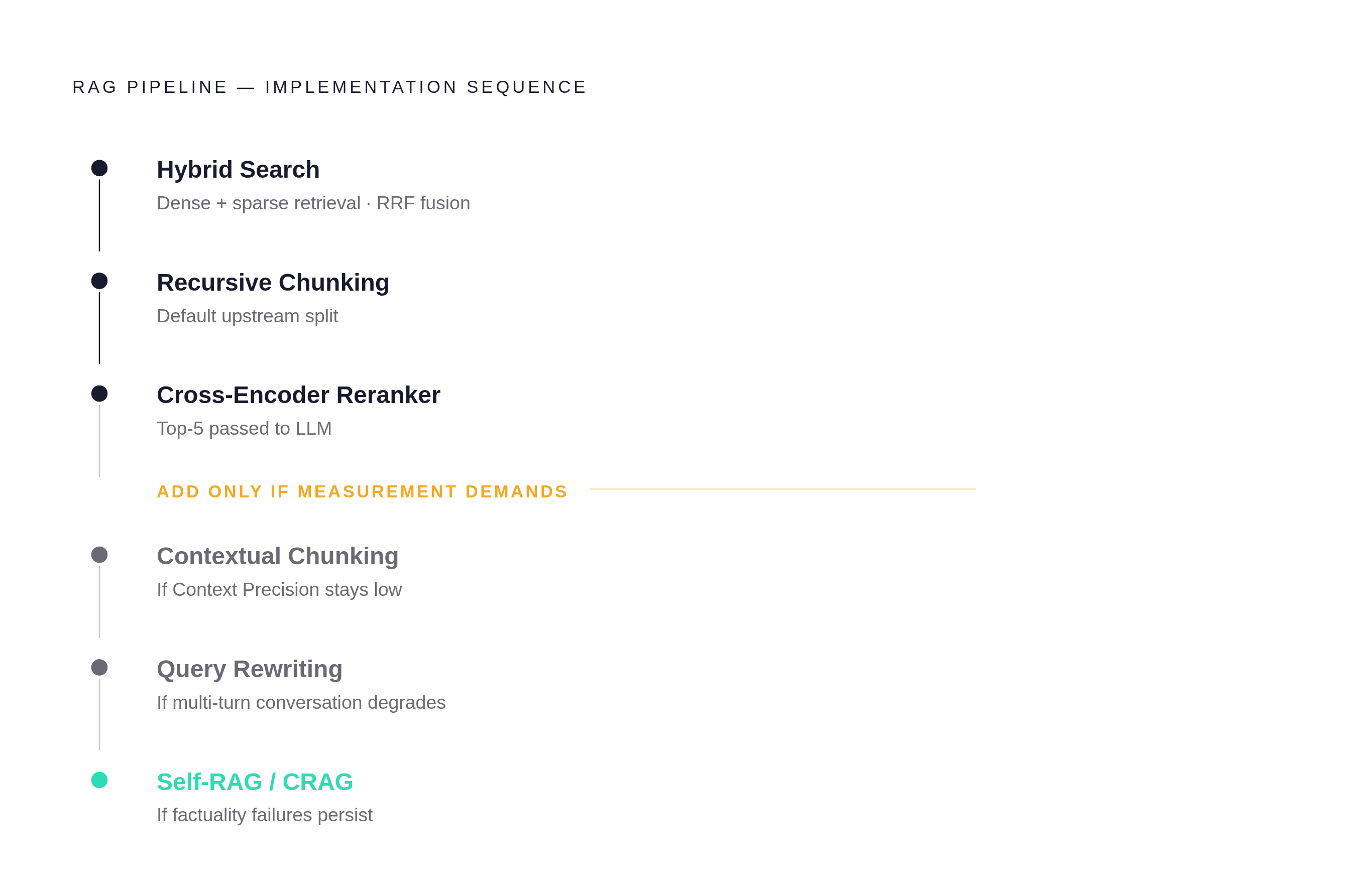
The resulting build order starts with hybrid search and recursive chunking. A cross-encoder reranker comes next to improve the ordering of the candidate set. Contextual chunking follows if precision remains low, and query rewriting addresses multi-turn use. Self-RAG or CRAG comes after those retrieval improvements if factuality failures persist despite clean evidence.
Sources
- Sifei at SemEval-2026 Task 8: Hybrid Retrieval and Query Rewriting for Multi-Turn RAG
- An End-to-End Ukrainian RAG for Local Deployment. Optimized Hybrid Search and Lightweight Generation
- Hybrid Retrieval for Hallucination Mitigation in Large Language Models: A Comparative Analysis
- Engineering the RAG Stack: A Comprehensive Review of the Architecture and Trust Frameworks for Retrieval-Augmented Generation Systems
- Retrieval-Augmented Generation: A Comprehensive Survey of Architectures, Enhancements, and Robustness Frontiers