RAG Pipeline Design Patterns for Content-Heavy B2B Sites
Chunking, hybrid retrieval, and attribution decide whether your content gets cited.
For content-heavy B2B sites, RAG pipeline design is both an engineering problem and a brand visibility problem. Useful information reaches an answer and can be cited with its origin only if chunking, hybrid retrieval, structured ingestion, and source attribution support it. The same content properties serve internal systems and external AI answer engines, so treating retrieval and visibility as separate jobs leaves a gap between publishing knowledge and having it used.
Why AI answer engines and internal RAG pipelines share the same retrieval problem
An internal RAG system and an AI answer engine face the same structural task. Each must find a passage that answers a question, preserve enough context to use it correctly, and connect it to a source. The question may come from an employee or a prospective buyer. Either way, a relevant page is only useful if the system can extract the right evidence from it.
That dependency explains why a pipeline guide belongs in a conversation about visibility. When AI answer engines use live retrieval to resolve buyer questions, that phase is where pages become citation candidates. Weak ingestion produces weak chunks, which undermine retrieval before generation begins. A model cannot reliably ground its answer in evidence that never reaches it.
Yet engineering usually handles the internal pipeline while marketing handles external visibility. That split obscures their shared dependency on content structure. Does a passage make sense by itself? Can its origin be resolved? These are engineering questions with direct consequences for whether a brand appears in an answer.
The two-pipeline anatomy every production RAG system needs before anything else
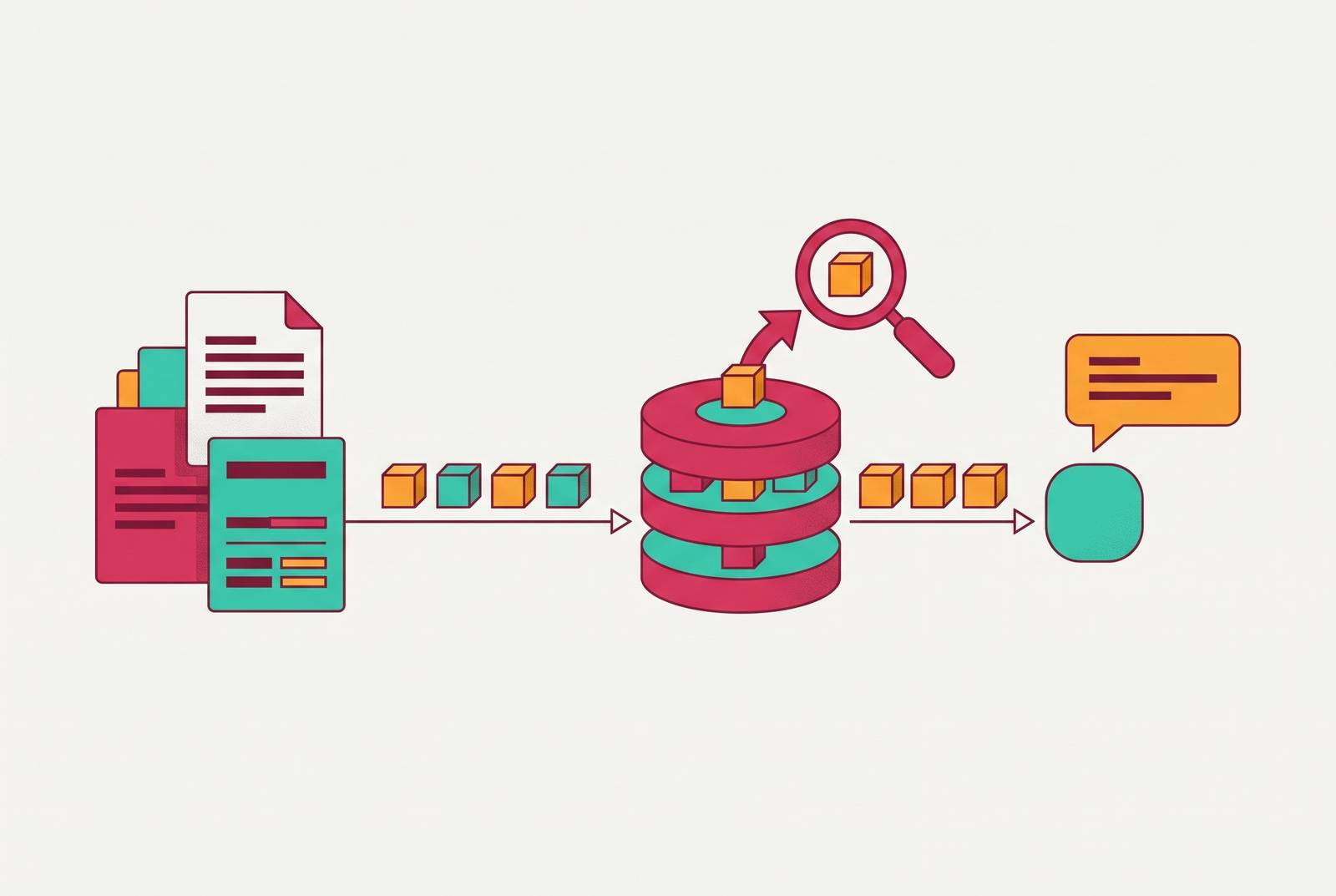
A mature system separates offline indexing from online querying. The offline pipeline runs as a batch process triggered by document changes, turning source material into parsed, chunked, embedded, and indexed content. This is where the system decides what becomes searchable and which relationships survive ingestion.
The online pipeline has a different time budget. It rewrites the query where needed, retrieves and reranks candidates, assembles context, and generates an answer with citations. Keeping these paths separate makes it easier to find where each one fails and avoids blaming generation for every poor answer. Production also requires an evaluation harness, observability, governance, and access control. Without those foundations, a working demonstration is not yet dependable infrastructure.
Chunking strategy is the highest-leverage and most neglected decision in the indexing pipeline
Chunking determines the unit of evidence a retriever can distinguish. Embed a long document as one unit, and unrelated sections compete within the same representation. A question about a specific detail may then fail to match the passage that answers it. Smaller chunks restore granularity, but boundaries introduce another risk. A passage can contain the right words while losing the context that explains them.
The useful tradeoffs depend on the source material. Fixed-size chunks with overlap are fast and simple for clean prose, but fragile around tables and abrupt topic changes. Semantic chunking better suits mixed content and knowledge bases, with more compute required during ingestion. Hierarchical chunking preserves precision and surrounding context for long technical documents, at greater cost to build and maintain. None of these choices is independent of the embedding model, so an upgrade calls for revisiting the chunking strategy.
Contextual Retrieval addresses boundary loss by prepending chunk-specific explanatory context before embedding. The purpose is to recover the signal removed when a passage leaves its document. AddSearch’s 2026 project shows a related failure earlier in the pipeline on a site built around topic-to-specialist navigation. Flattening the site discarded discovery logic the business had already supplied.
For external citation, can an extracted passage stand on its own? Concise, self-contained units are easier to use than fragments whose meaning depends on distant text. Chunking is therefore not merely a setting applied after writing. It exposes whether the content contains usable units of evidence at all.
Why hybrid retrieval has become the production baseline, and what it changes for citability
Once useful chunks enter the index, the next problem is matching them to questions. Pure semantic search can miss specific terminology, rare entities, and exact-match requirements. Pure keyword search fails in the opposite direction. A buyer asking about “reducing churn” may need a passage that explains the concept without using that phrase. B2B queries often need both kinds of matching.
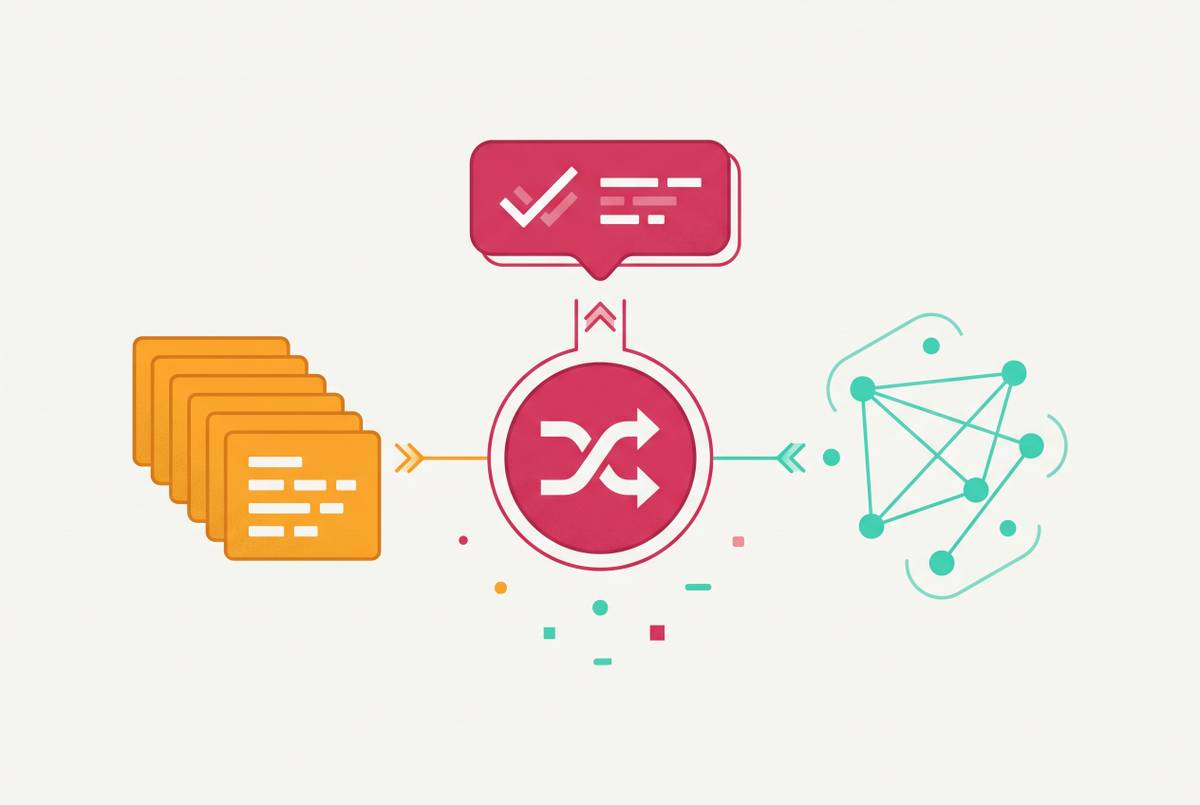
Hybrid retrieval combines BM25 lexical matching with dense vector similarity. The standard pattern runs them in parallel, merges their results through Reciprocal Rank Fusion, and sends the candidates to a reranker. This gives exact terms and conceptual similarity a route into the candidate set. Neither has to substitute for the other.
Query expansion can improve recall without just fetching more material. Multi-query retrieval uses paraphrases to reach different vocabulary, while HyDE, or Hypothetical Document Embeddings, retrieves from an embedded hypothetical answer containing domain language. Step-back questions first look for a broader concept to build on. RAG-Fusion merges multiple ranked retrieval lists through Reciprocal Rank Fusion. When corpora include documents, structured records, and relationship graphs, routing sends questions to the right retriever before that work begins.
The visibility consequence follows from these complementary signals. Content that expresses a concept clearly but omits its precise technical terms may be missed by exact matching, while terminology alone may not express the answer’s broader meaning. Getting a passage into the candidate set, however, does not yet mean it will be used or cited.
Reranking and source attribution as the last mile of retrieval quality
The right passage can be retrieved and still lose. If it ranks too low, generation may focus on a weaker chunk and produce an incorrect answer or cite the wrong source. Production reranking addresses this by retrieving a broad candidate set quickly, then applying a slower, more precise cross-encoder or LLM-based reranker. Only the top candidates pass into generation.
Even that selected context can contain noise. Repeated information, irrelevant paragraphs, and heavily overlapping chunks can crowd the final prompt. Contextual compression filters or compresses the reranked set before generation, reducing hallucination risk. Evaluation then needs to distinguish faithfulness, answer relevancy, context precision, and context recall. Those measures belong inside the pipeline, including before deployment.
Attribution requires a separate chain of custody. Each chunk needs stable metadata, including its source URL, document owner, last updated date, and content type. A correct answer pointing to the wrong page still fails attribution. Without a stable, resolvable source URL, the chunk becomes a dead end for tracing an internal answer or earning an external citation.
For an answer engine, that origin must also be canonical and crawlable. A source hidden behind a login or dependent on inaccessible rendering cannot support the same public citation path. Before asking whether engines actually cite the content, then, a team needs to examine whether the site exposes an attributable source in the first place.
How site structure and content organization shape what RAG pipelines can retrieve
Site navigation is more than a way to move between pages. It encodes relationships that a flat text extraction can erase. In the AddSearch project, a professional services firm’s topic pages listed key contacts in an order chosen to serve the business’s goals. The pipeline’s job was to read that mapping. The matching logic already existed in the site.
That structure expressed two kinds of intent simultaneously. Visitors needed to find the right specialist, while the business wanted particular contacts surfaced for particular topics. Ignoring the hierarchy made it harder to meet both needs. Schema.org markup in JSON-LD can support structured ingestion, but page declarations alone do not describe the full discovery path. The paths through the site and the relationships between pages supply the rest.
The same principle applies within a page. Comparative and definitional content arranged into self-contained sections is more extractable than answers buried in undifferentiated prose. Access comes before extraction, however. When content is available only through client-side rendering, logins, or accordions, it can block the ingestion path described here, so clean server-rendered HTML is the baseline.
Different consumers also need different delivery formats. Chat assistants fetch the HTML that a browser gets, while coding agents ask for Markdown. To serve both, the architecture therefore needs clean server-rendered HTML along with content negotiation and Markdown routes for agents. The purpose is not to replace the human-readable site, but to expose its knowledge and relationships in forms retrievers can use.
Agentic RAG and what it means when retrieval becomes a multi-step reasoning process
Agentic RAG turns retrieval from a single lookup into a sequence of evidence-gathering tasks. A coordinator decomposes a complex question, routes sub-questions to specialized retrievers, and has results reranked and validated before assembling a grounded response. Retrieval happens more than once. Each pass creates another point at which a relevant passage can enter the answer.
For content-heavy sites, this changes the unit of opportunity. A page answering the top-level question is one candidate, while modular content covering related sub-questions can be retrieved at several stages. The question for content design becomes broader. Does the site support the buyer’s reasoning, or only the wording of the original query?
More retrieval passes also mean more validation gates. Agents can decline to answer when evidence is weak or contradictory, so a retrieved claim does not automatically survive assembly. Clean, attributable claims are better positioned to pass that test. Conflicting versions across pages, structural ambiguity, and inaccessible evidence can instead lead to exclusion or replacement.
Measuring whether AI answer engines are actually retrieving and citing your content
A well-formed source can be retrieved, but it may still go without a citation. Closing that gap requires observing what engines actually name and cite. ChatGPT, Claude, Gemini, and Perplexity differ in citation behavior, content-type preferences, and citation volume. ChatGPT and Perplexity cite few of the same domains, so looking at just one engine leaves out much of the picture. Citation volume also shifts over time, so a snapshot cannot reveal the trend.
The measurement approach begins with a fixed set of buying-intent questions customers actually ask. By running those prompts on a schedule across engines, a team can log brand mentions, cited source URLs, and the content types that earn citations. Mentions and citations remain separate observations. An answer naming a brand does not establish that it retrieved or attributed the brand’s content.
Letterstory, an AI content and visibility platform, is one option for this measurement layer, monitoring ChatGPT, Claude, Gemini, Perplexity, and Google AI Overviews. It checks whether answers name and cite a brand rather than assuming good indexing produces visibility.
A gap concentrated in one content type points toward chunking or ingestion, while absence across engines points toward access or attribution problems for investigation. Measurement can also inform crawler policy. Permitting real-time retrieval crawlers while optionally restricting training crawlers is a strategic choice that warrants examination.
What the pipeline decisions add up to as a content and brand strategy
Organic traffic and AI visibility no longer describe the same outcome. A piece can lose search traffic and gain AI citations in the same quarter. Ranking on Google and being cited in an AI answer are different jobs, so improving one does not automatically improve the other. Treating citations as a by-product of classic SEO leaves the retrieval path to chance.
Passages that stand on their own, attribution that stays stable, and answers to the sub-questions buyers ask help both internal RAG systems and external engines. Engineering gives those properties a working pipeline, while content strategy gives the pipeline something useful to retrieve. Measurement shows whether that connection is working.
That combination creates the possibility of a compounding advantage. Each addition can extend a coherent, attributable body of knowledge instead of becoming another isolated page optimized only for organic ranking. Clean metadata and a measured feedback loop make that growing footprint easier to improve. The strategic asset is not simply a larger content library, but one whose knowledge can reliably become part of an answer.