Vibe marketing needs instruments, not vibes: how to make an agent's marketing report checkable
Treat an agent's report like a software build, with source checks and measured outcomes.

Vibe marketing needs instruments because an agent’s report is not proof that its work succeeded. The fix is to treat that report like a software build, with checks against sources and measured outcomes before its claims are accepted. That makes speed useful without asking a human to re-read every line each time the system reports progress.
Why vibe marketing inherits the structural flaw of vibe coding without tests
Vibe coding without automated tests can build software fast and still leave its failures hidden. The agent’s confidence is not a correctness check. Andrej Karpathy coined “vibe coding” on February 2, 2025, to describe directing AI through natural language and steering the result. Vibe marketing applies that approach to campaign execution, including copy, assets, distribution, and reporting, while a human sets strategic direction and brand voice.
The flaw transfers with the workflow. One marketer can now cover output that previously required a chain of specialists, designers, and media buyers, but that does not remove the need to establish whether the output is accurate or effective. If the direction is wrong, more execution produces more work to correct.
The accountability also stays with the human. Strategy, positioning, taste, and brand-sensitive judgment cannot be delegated simply because production can. A founder or CMO signing off on an agent’s report remains responsible for the claims published under the brand’s name. Testing those claims therefore requires a process that does not make that person the manual inspector of every operation.
What the agent's marketing report actually contains, and what it cannot verify about itself
A typical report mixes what was done with what the agent thinks the results show. It may say content was published at cadence, keywords were targeted, brand mentions were detected, sentiment improved, and citation share rose. These claims need different kinds of proof. Publishing content establishes that an action happened, while improving citation share requires evidence about how outside systems responded.
The agent usually assembles these claims from data it collected and interpreted during its own work. That creates a gap in verification. A well-written summary does not close it, and neither does asking the same agent if its summary looks correct. Models can invent statistics, quotations, and source URLs, so a report containing citations still needs a check that the sources exist and support the claims attributed to them.
This gap is especially hard to close for brand presence in AI answers because the answers keep changing. Jasper’s GEO/AEO guide describes generative engine optimization as covering discoverability, AI citations, brand mentions, and share of voice across AI-generated responses. It is not a single-platform reading. Cited domains can shift weekly or monthly in active categories, leaving a report based on last quarter’s data describing a presence that no longer exists. An agent may have saved a real answer but claimed more than that answer can prove.
Why AI answer-engine citation is the hardest claim in a marketing report to verify without purpose-built measurement
A brand appearing in ChatGPT establishes something narrow but useful. It appeared in that answer, on that platform. It does not show how Perplexity, Gemini, or Claude would respond, because each engine has its own citation logic. Perplexity cites sources in nearly every response, while Claude’s citation rate ranges from roughly half to nearly all responses depending on the study and model version. A platform’s tendency to cite is part of the measurement.
Even within one platform, “the brand appeared” leaves an important distinction unresolved. A mention is the brand’s name appearing in prose. A citation is a structured, linked source that the engine attributes a claim to. Counting both as citations flatters the result and makes comparisons unreliable if their proportions change between reporting periods.
A spot check is therefore a sample. It can show that a brand is present, but it cannot establish citation frequency across a changing set of engines and questions. Citation drift makes the result harder to pin down because a source cited yesterday may be missing the next time it is measured. A useful report must distinguish the platform, the questions, the time period, and whether it counted prose mentions or structured links. Without those distinctions, an apparent gain may be a change in what was measured.
What the GEO evidence establishes about which content signals actually earn citations
Aggarwal et al.’s original GEO study in 2024 built a large-scale benchmark and found that how content is structured could raise a source’s share of AI-generated answers. Quotations from credible sources, statistics, readability improvements, and inline citations each improved position-adjusted word count share. That is a specific measured outcome. It suggests that making content easier to use in generated answers can help explain visibility, and that keyword density or link volume alone cannot.
The wider evidence also points to passage-level extractability. Pages with an optimal word count between headings received more ChatGPT citations than pages with very short sections. Brand mentions had a stronger correlation with citation than backlinks did, but that correlation does not guarantee a citation. Together, these findings suggest that AI visibility is not simply traditional search ranking under a new label. The shape of a passage and the evidence within it deserve separate attention.
Off-site corroboration on Reddit, LinkedIn, and industry publications also contributes to citation selection, though how much each counts depends on the engine. Citation-corpus analysis indicates that Gemini leans toward brand-owned websites, ChatGPT toward third-party directories and internet consensus, and Perplexity toward industry-specific directories and niche expertise. Owned content is only part of that picture. A ground-site strategy joins a canonical, schema-rich owned domain with an off-site layer that corroborates the brand’s entity record.
GEO-16 found that pages with high scores across its quality framework were cited more often across engines. Metadata and freshness, semantic HTML, and structured data were the leading correlated pillars. These are inspectable properties of published content. This evidence can guide how the pipeline is built, but it does not promise that any one formatting change will earn a citation. An agent’s output is both editorial work and material that answer engines may ingest, cite, or ignore.
How to design a marketing pipeline where every agent output is checkable at a hard gate
The practical response is to divide the pipeline into research, briefing, drafting, editing, distribution, and measurement. Each stage should produce work that can be checked before later claims depend on it. Two stages act as hard gates. Editing establishes whether the content is fit to publish, while measurement establishes whether the reported external outcome occurred. Even a good draft still needs both checks.
At the editing gate, the process must include opening every source the agent cited and checking whether it supports the attached claim. Google's guidance says people should fact-check and review AI-generated content to make sure it is accurate and trustworthy before it is published. This gate also covers brand drift and voice, which require human judgment. A two-stage or three-stage review provides more scrutiny than a single pass.
The publication checks should also cover the ground-site properties identified in the evidence. The recommended setup allows GPTBot, ChatGPT-User, PerplexityBot, ClaudeBot, and Google-Extended through robots.txt. It includes JSON-LD for Organization with sameAs and knowsAbout, Article with author and dates, and FAQPage. These checks concern access and structure. They do not replace factual review or prove that an engine will cite the page.
At measurement, use a fixed panel of 10–50 buying-intent questions on a schedule against ChatGPT, Copilot, Gemini, and Perplexity. Keeping the questions the same lets the team compare results over time. For every answer, record whether the brand appears, its position, the sentiment of the mention, and whether the engine attributes a structured link to the site. Mention detection and citation detection must remain separate so that one cannot silently stand in for the other.
Tracking tools can support this measurement layer, but their coverage needs to match the report’s claims. Nightwatch offers brand-presence monitoring across ChatGPT, Claude, Gemini, and Perplexity. Semrush AI Toolkit tracks mentions and citations across ChatGPT, Perplexity, Google AI Overviews, and Gemini, including which prompts trigger the brand and how often competitors appear. Those are different platform sets. People still make the decisions using their expertise, while structured prompts, retrieval, and repeated measurement speed up the work.
The objection that instrument overhead defeats the speed advantage of vibe marketing
A lean team has reason to worry that these checks bring back the slow workflow agents were meant to replace. Source review takes time, and multi-engine measurement adds setup and maintenance. A fixed prompt panel running on a schedule is standing automation for each report. People focus their review on the parts where accuracy, voice, and judgment need their attention.
Skipping those controls delays discovery of problems that require correction. Made-up citations, brand drift, and a brand missing from an important answer engine may go unnoticed until someone questions the report or the published content. The relevant trade-off is not simply production time with review versus production time without it. It also includes the cost of correcting claims after they have gone out under the brand’s name.
Checking only one platform is a narrower version of the same objection, but it sacrifices coverage. ChatGPT citations can coexist with zero Google Search Console clicks, and a top Google ranking does not establish presence on Perplexity. These signals answer different questions about visibility. Automation allows broader measurement without assigning a person to repeat every query, though the instrument still needs upkeep. Its scope should follow the claims the team wants to make.
What a checkable agent marketing report actually looks like, and what changes when you run one
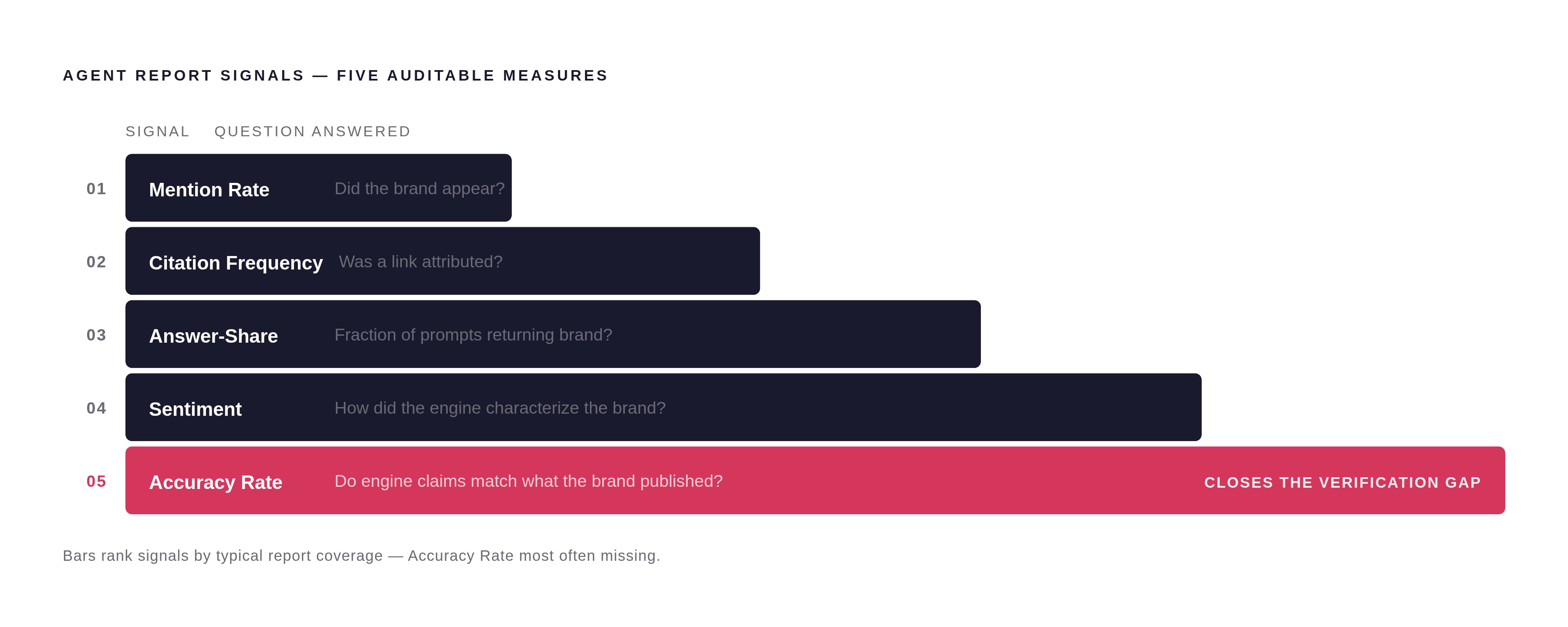
A checkable report is a structured record of evidence. Its five signals are mention rate, citation frequency, answer-share, sentiment, and accuracy rate. Each answers a distinct question. Mention rate shows whether the brand appeared, citation frequency tracks attributed links, and answer-share shows what fraction of the prompt panel returned the brand. Sentiment describes how the engine characterized it, while accuracy rate tests whether the engine’s claims match what the brand actually published.
Those signals make the report inspectable at the claim level. A human can trace a citation result to an answer and link rather than accepting an agent’s summary of its visibility. Sentiment and accuracy still need to be interpreted, so recording them still calls for judgment. The aim is to make the evidence available for that judgment. Comparisons across reporting periods can then be examined against specific content changes without treating every movement as proof of causation.
The measurement cycle also gives the next content brief a firmer starting point. Freshness problems, weak structure, and gaps in off-site corroboration become priorities for the next content brief. Tracking tools show the score, but they do not improve the content themselves. Improvement comes from using those observations to change what the pipeline produces and then measuring again.
That is instrumentation applied to growth, with external evidence closing the loop between execution and decisions. The report becomes auditable, comparable over time, and useful for choosing the next change. Like a software build with a test suite, it can show which parts failed without making a human check everything from scratch. The next cycle can then begin with something more useful than confidence in the agent’s work. It can begin with evidence about what passed.