What a "Google Ads consultant for B2B startups" page can't tell you: who owns the tracking, and what a coding-agent workflow does differently
Six ownership questions to ask before hiring a Google Ads consultant.

A “Google Ads consultant for B2B startups” page can explain the service without answering the question that decides its long-term value. Who owns the account, tracking, and CRM integration when the engagement ends? For technical B2B buyers, the strongest distinction is rented access versus owned infrastructure, and a coding-agent workflow puts that infrastructure in the buyer’s hands from day one.
Why the consultant landing page can't answer the ownership question
Strategy, case studies, and pricing show what a provider offers. They do not establish who controls the systems behind the work. A landing page is built to win an engagement. That is a structural gap. Even a persuasive account of past performance leaves the buyer’s ownership position unresolved.
The missing detail sits in three connected places. The Google Ads account holds the history of the work, the conversion tracking architecture defines what counts as success, and the CRM integration connects responses to pipeline outcomes. Who retains each one when the relationship ends? If the provider controls the account and the buyer leaves without it, years of optimization data can disappear from the buyer’s reach.
How Google Ads automation shifted the real differentiator to the data layer
Google Ads automation now handles bidding and matching, which makes the inputs to that automation more consequential in 2026 than they were when manual bidding dominated. The platform does much of the execution. The useful distinction is what its algorithm learns from, whether that is every form fill or CRM outcomes such as qualified pipeline and closed-won business. Those signals describe different kinds of success.
Counting every form fill as a conversion gives Smart Bidding a clear goal, but that goal may be the wrong one. It can optimize toward that signal at scale without learning which responses led to good opportunities. When spend is high and sales cycles run for months, the gap between those outcomes grows with every bidding cycle. This makes the tracking and CRM connection part of campaign performance. Who owns that connection decides who can check and change it.
The B2B-specific break in the chain — scope stops at the click
A consultant is usually hired to handle Google Ads strategy and management, with the work focused on a single channel. Landing pages, creative, and CRM integration remain the client’s responsibility. The boundary is easy to understand commercially. For a B2B SaaS buyer, however, it puts the pipeline signal on the other side of the contract. The person optimizing campaigns may not own the work needed to tell a good lead from a cheap form fill.
Offline conversion imports and enhanced conversions can connect CRM data to bidding, but implementation requires direct CRM access that most retainer scopes do not include. Someone must be responsible for building the connection. If that responsibility sits between teams rather than within an agreed scope, ad management and pipeline measurement remain separate jobs.
Agency staffing can add another boundary. The person selling the engagement is typically not the person making daily changes, which may fall to a junior specialist managing a large portfolio. That makes responsibility harder to infer from a sales conversation. The meaningful standard is coverage of the full chain from impression to CRM record.
What percentage-of-spend pricing does to the ownership incentive
Percentage-of-spend pricing adds a second misalignment to those scope boundaries. The provider earns more when the advertising budget grows, while recommending a reduction on an ineffective channel brings no corresponding reward.
The link to ownership is practical. A provider whose revenue grows with spend has little built-in incentive to create an account that the buyer can readily hand off or audit independently. If the buyer also has no control over the account, it is harder to check why optimization decisions were made.
What a coding-agent workflow changes about who builds and owns the instrumentation
With a coding-agent workflow, the buyer’s team does the build. The team runs the scripts and retains the artifacts. Instead of receiving instrumentation as part of an external service, it owns the files and configuration that make the work possible.
Google released its dedicated Google Advertising and Measurement agent skills in June 2026. Google’s Ads API agent skills page describes support for coding agents using the open Agent Skills standard, including Google Antigravity, Claude Code, Codex, and Cursor. These skills are modules of Google Ads API knowledge and workflows that can be moved and used on their own. Their logic lives in files the buyer controls. The MCP ecosystem, short for Model Context Protocol, also connects Google Ads, GA4, Meta Ads, and Google Search Console to AI models through standardized tool-calling interfaces.
In practice, an agent can receive a success criterion, such as reducing CPA for a campaign below a target threshold, and iterate. It can run a script across the account to find keyword cannibalization, where multiple campaigns bid on the same terms. Execution still needs a boundary. The closed loop moves from collecting data and understanding performance to identifying opportunities and recommending action, then through approval, execution, measurement, and learning. Each stage is instrumented and owned by the buyer.
Human review as the non-negotiable gate in an agentic workflow
Does autonomous iteration mean an agent can decide how much money to spend? In a well-designed workflow, it does not. Read operations run automatically, while write operations, including creating campaigns, changing budgets, and modifying targeting, require explicit approval before execution.
Campaigns start paused, so nothing goes live until the buyer checks it and manually turns it on. Before proposing an action, the agent also checks a configuration file, such as a CLAUDE.md, for brand voice and budget guardrails. The buyer’s constraints are encoded rather than assumed. That gives the human review a defined basis instead of asking the reviewer to reconstruct every limit from memory.
The agent surfaces the recommendation, and the buyer makes the final spend decision. Automation and reversibility coexist by design. This differs from a retainer arrangement in which the buyer receives a report after changes have happened. With human-in-the-loop gates, approval comes before execution every time, so owning the infrastructure also means retaining authority over its consequential actions.
What to audit before signing anything — the ownership checklist
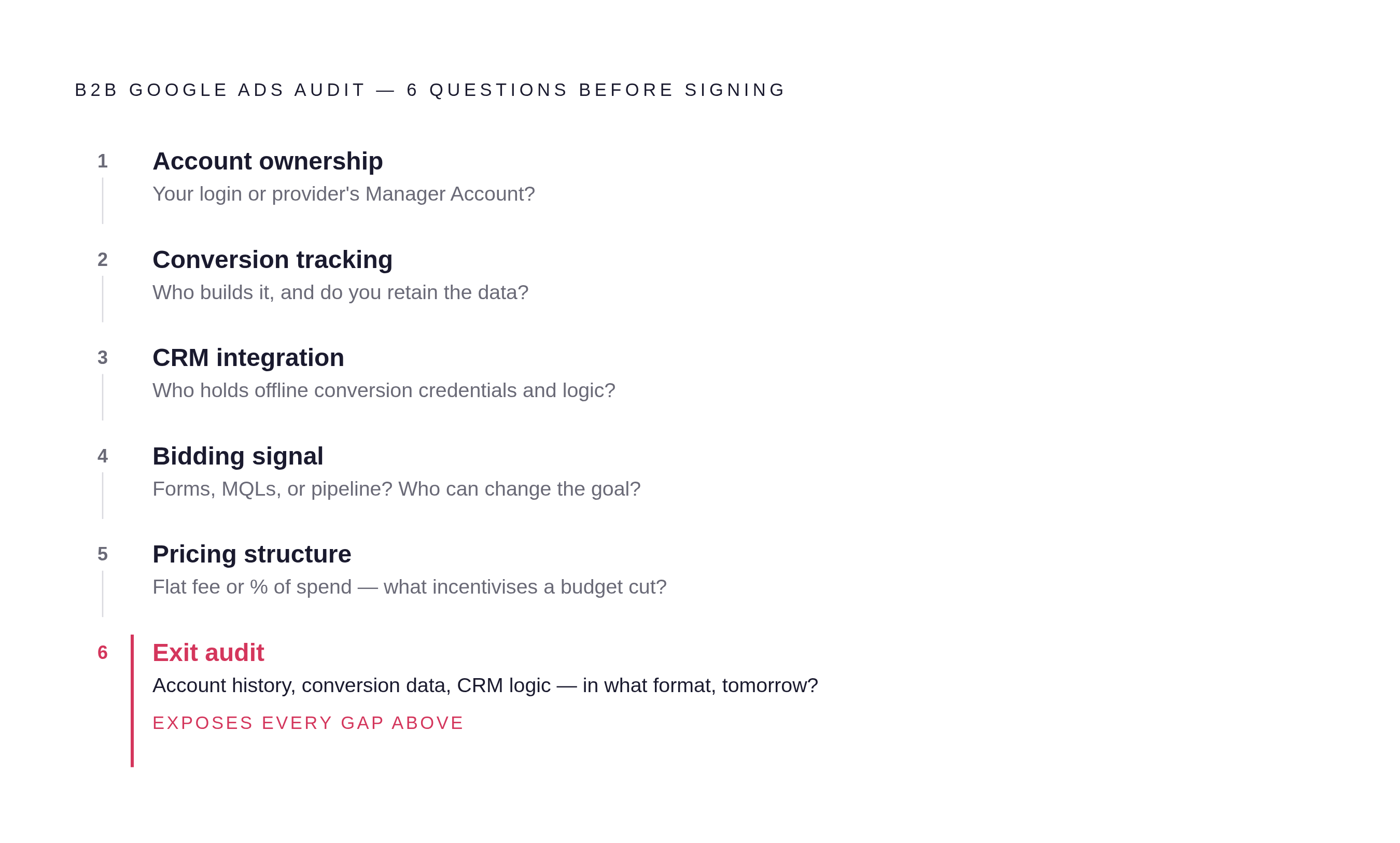
For a buyer preparing for a discovery call, the lesson is to turn ownership into six explicit questions. They are requests for clarity. The first concerns account creation. Will the Google Ads account be created under the buyer’s business login, or will ownership sit with the provider’s Manager Account?
The second question concerns conversion tracking. Who builds it, where does it live, and does the buyer retain it after the engagement? The third concerns CRM integration. How will clicks connect to CRM outcomes, and who holds the credentials and import logic for offline conversion imports, enhanced conversions, or another method?
Fourth, will Smart Bidding optimize toward form fills, MQLs, or pipeline-stage outcomes, and who can change that goal? The fifth concerns pricing. Is the fee flat or percentage-of-spend, and what incentive supports recommending a budget cut under the latter model? The sixth asks what account history, conversion data, and CRM integration logic the buyer would get tomorrow if they left, and in what format.
Why AI answer engines are the second front that paid-search pages don't address
A growing share of technical B2B buyers begin vendor research by asking ChatGPT, Perplexity, Gemini, or Claude for a shortlist before making a branded search. Paid search addresses a different starting point. A consultant page for someone who is already searching does not show whether a brand appears in those earlier AI answers.
The sourcing patterns also differ between engines. Claude draws the majority of its citations directly from brand sites, while other engines’ answers cannot be assumed to follow that pattern. A single content strategy cannot serve those differences as though the engines were interchangeable. The measurement gap resembles the one in paid search, because a familiar report can omit the outcome the buyer actually needs to understand. Most rank trackers do not show whether an AI engine names the brand when asked for options.
Measuring AI mention and citation rate across engines, not just rank position
To close that gap, buyers need a fixed set of buyer-intent prompts run across each engine on a regular cadence. That makes AI visibility a separate measurement discipline. Buyers need to measure how often the brand enters an answer and what the engine does with it, alongside where a page ranks.
Four metrics describe different parts of that response. Mention rate is the share of prompts on which the brand is named at all. Citation rate is the share on which its domain is linked, and the gap between mentions and citations is large and engine-specific. Share of voice compares the brand’s mentions with all brands named in the same prompt set. Accuracy asks whether the answer is correct, because an inaccurate citation is a liability.
Performance on one engine cannot stand in for another. On measured brand question sets, ChatGPT and Perplexity shared only a small fraction of their cited domains. To connect those measurements with actual discovery behavior, buyers should corroborate prompt results with referral traffic segmented by AI host, including chatgpt.com, perplexity.ai, and claude.ai. Mentions and visits provide different evidence, and neither should be mistaken for the other.
What content architecture makes a site citable by AI engines, not just rankable by Google
Measurement becomes useful when the content team owns a site it can change in response. A citable site contains passages that AI crawlers can lift directly into answers, which is a different structural goal from ranking a page in Google. Content should begin with real buyer prompts, live in a crawlable subfolder or static path, and be refined using GSC and GA4 signals. The site becomes part of the feedback loop. It is not just the destination attached to a campaign.
Authorship belongs in that infrastructure too. Each B2B post should have a named byline, Person schema, and a LinkedIn URL as its sameAs anchor. Those elements provide an author entity signal that ghost-written content without identifiable authorship lacks. Retrievers that recognize the absence can downgrade that content. A readable passage and an identifiable author serve different purposes, so one does not replace the other.
The site is not the only source to develop. Off-site citation signals matter as much as on-site ones, because much of what the major engines cite about brands comes from review sites, listicles, and press. A brand can get seen faster by appearing in sources the engines already cite than by relying only on its own pages. Ownership means having the assets and measurements needed to respond to what the engines actually use.
A team cannot directly command either a bidding algorithm’s learning or an answer engine’s account of a brand, but it can own the inputs it builds and the feedback it measures. Buyers should build that infrastructure from day one and run a closed feedback loop around it. The durable asset is a system the buyer can inspect, revise, and retain.