C# developer blogs and what the "best blogs" list format reveals about how technical content still works in 2025
Human curators and AI engines both reward depth, clarity, and proven expertise.

“Best C# blogs” lists reveal how technical content earns trust in 2025. Their lasting appeal is not just about finding something to read. Human curators use them to identify expertise worth returning to, and AI answer engines now make a related judgment when choosing sources to cite. The connection is useful, but incomplete. A blog can keep its readers’ trust for years without knowing whether AI answers give it any credit.
Why "best C# blogs" lists keep getting published, and what that persistence signals
The “best blogs” format has outlasted RSS readers, social media feeds, and early AI summarizers. Why does it keep coming back when each new way of finding information promises to make discovery easier? Writing on C# and.NET is spread across personal blogs, official Microsoft sites, blogs run by tool vendors, and community platforms. Finding an answer in that spread is different from finding an author worth trusting over time.
A curated shortlist addresses the second problem. It gives a reader a starting point whose value extends beyond one search or one coding question. For technical buyers, that distinction is important because a useful explanation today does not automatically establish a dependable source for the next decision. A list built around stated criteria makes its judgment open to inspection. Readers can ask whether the curator values the same things they do.
The recurring criteria are writing quality, consistency, longevity, technical depth, and usefulness. Together, they test whether a source has accumulated expertise and made it available in a form other people can use. When independent curators keep using those criteria, it suggests that finding sources to trust is still hard, even with search and AI. The list is a small piece of trust infrastructure.
The blogs that appear on every list, and what they have in common
The Microsoft.NET Blog has a distinctive claim to authority because it records the platform’s development at its source. Its 2025 coverage followed.NET 10, the latest Long Term Support release, from early previews starting in January to the full launch in November. Its year-in-review covered performance, AI tooling, Aspire, and tooling changes. The AI coverage included the Microsoft Agent Framework preview, Model Context Protocol server in C#, NuGet MCP Server Preview, and a.NET AI Template. These are subjects where proximity to the work gives the official source an authority an aggregator cannot match.
Andrew Lock –.NET Escapades explains ASP.NET Core internals in detail, with a focus on code, and engineers in the community and at Microsoft often refer to these posts. Lock is also the author of “ASP.NET Core in Action,” a developer, educator, and long-time Microsoft MVP. Jimmy Bogard writes about AutoMapper and MediatR as their creator, while also explaining the design principles behind them. Their expertise has an identifiable object and origin.
Jon Skeet brings a long record as the number-one Stack Overflow contributor in.NET and C# to writing on the language’s deepest subjects. Eric Lippert – Fabulous Adventures in Coding uses what he learned as a former member of the C# language design team to write about language design, data structures, algorithms, and C#. Nick Chapsas offers concise, practical, often advanced tutorials on ASP.NET Core, C#, and backend development, and founded Dometrain for premium courses on specific.NET technologies and architectural patterns. The JetBrains.NET Tools Blog shows how a company can do this too, with posts that help even people who do not use its tools. Different sources earn trust through different work.
A named author or institution stakes its credibility on each post, and a long publishing record gives readers evidence beyond a single strong article. Their scope is also narrow enough for expertise to be inspected. These traits help explain why curators weigh how well posts are written and how useful they are alongside longevity, consistency, and depth. The prose is only one part of the record.
Why the five criteria curators use are actually proxies for citation-worthiness
A citation asks a source to support a claim. That requires more than a familiar name or an engaging introduction. The source needs to be attributable, understandable, and specific enough for the claim to be checked against it. Seen this way, the five curator criteria describe much of what makes technical writing worth citing. They connect reputation to usable evidence.
Longevity and consistency suggest that a publication is a continuing body of work. They offer limited evidence of correctness. Technical depth supplies claims precise enough to examine, unlike a broad summary that could have been assembled from other summaries. When a post is well written, its clear definitions, headings, and code examples make those claims easier to find. Usefulness connects the explanation to a question a developer would actually ask.
That last connection is where human curation meets AI retrieval. A useful post answers a real question, while a well-structured post makes it easier to pull out the answer and name its source. An answer engine does not have to share a curator’s taste to benefit from those properties. Both are selecting material that can support someone else’s understanding. Their judgments overlap without being identical.
The strongest objection is that curator scores remain subjective. Perhaps repeated appearances reflect shared taste. Yet independent curators using the same criteria have converged on the same set of C# sources, which is evidence worth taking seriously. This suggests that the lists identify qualities beyond popularity.
How AI answer engines have learned to replicate curatorial judgment — and where they diverge from it
AI answer engines perform a selection task structurally similar to curation when they choose sources for an answer. The resemblance does not imply a shared scoring system. A place on a human-curated list does not translate automatically into equal citation across ChatGPT, Claude, Gemini, and Perplexity. Which sources get seen varies from one engine to the next. That makes platform differences part of the evidence.
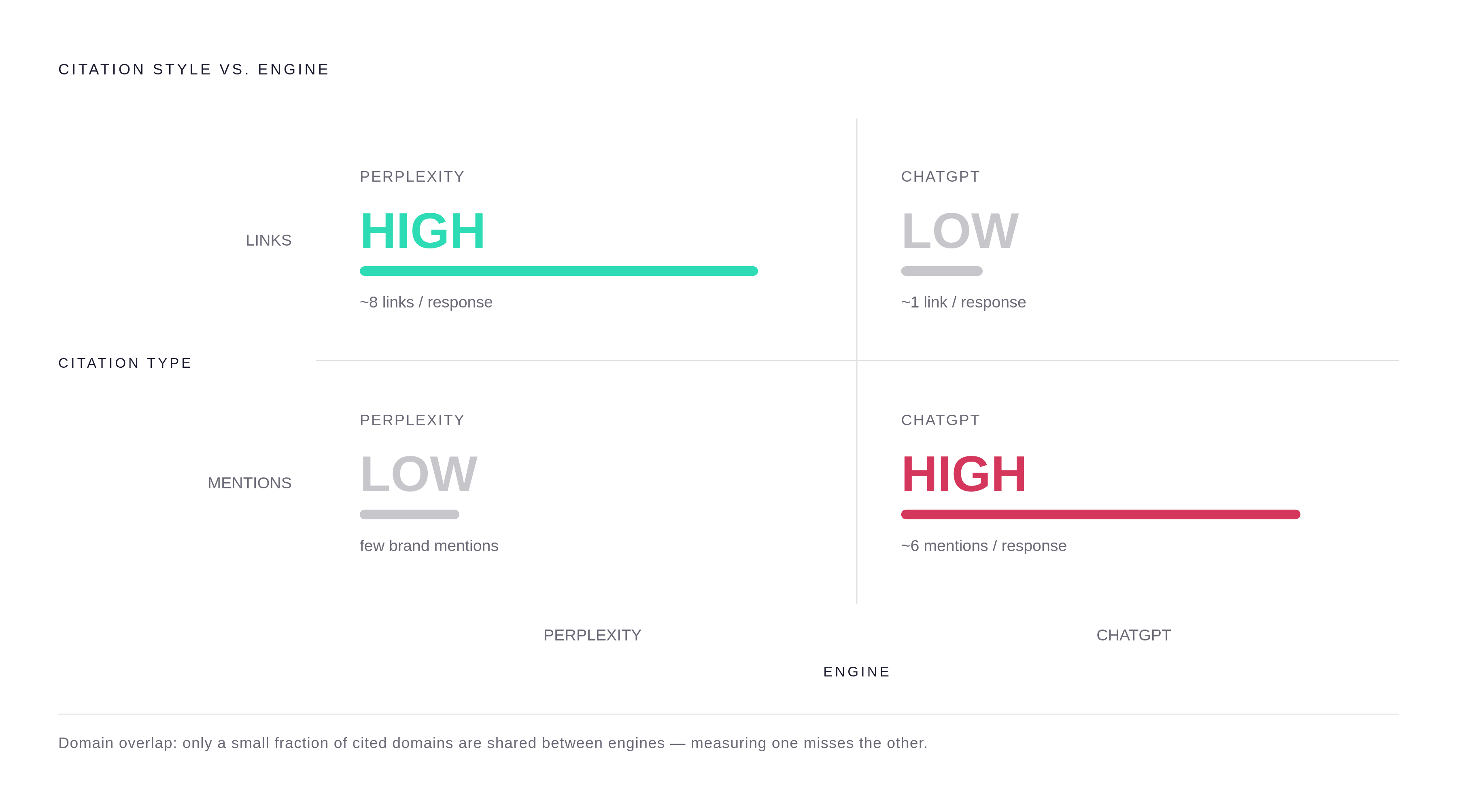
ChatGPT and Perplexity show how large that difference can be. Only a small fraction of the domains cited by ChatGPT overlap with those cited by Perplexity. Strong visibility in one can therefore coexist with little visibility in the other. For a technical publisher, the practical distinction is between being recognized somewhere and being surfaced where a particular reader asks a question. Those are different outcomes.
BrightEdge AI Catalyst data also shows a difference between links and mentions. Perplexity generates many more website links than brand-name mentions, while ChatGPT shows the inverse pattern. Perplexity also gives far more citations per response on average. A publisher looking only for its name could therefore miss part of its citation performance. A publisher counting only links would be measuring a different part of the answer.
None of this establishes that one engine makes better judgments. It establishes that “AI visibility” is not one uniform result. Human curation offers evidence about a source’s standing, but attribution in a particular answer depends on engine-specific behavior. Each engine’s ability to surface a blog’s authority for relevant questions matters.
What content structure earns citations, and why the blog format already gets it half right
The Princeton GEO study by Aggarwal et al. found that citations, quotations, and statistics help content gain more visibility in AI-generated answers. These features give an answer more explicit support. A quotation identifies whose words are being used, while a statistic with a primary source ties a factual claim to evidence. This is where generative engine optimization, or GEO, connects with familiar editorial work.
The strongest C# blogs already supply much of that foundation. They publish under identifiable authorship, refer to sources such as RFC specs and.NET runtime source, and use benchmark output to support technical explanations. Many organize a post around one specific question. That gives both the reader and a retrieval system a clear subject to work with. Good technical blogging has already solved part of the structural problem.
BLUF, meaning “Bottom Line Up Front,” makes another part explicit. It puts the direct answer first and the supporting evidence after it, rather than making the reader reconstruct the answer from the whole discussion. For a technical publisher applying this approach, the lesson is to make the answer and its support easy to distinguish. Clear statistics with primary-source attribution and credible quotations strengthen that support where they belong. Their value depends on evidence.
The.NET Blog’s 2025 top-posts roundup illustrates several of these properties. It links to primary Microsoft sources, groups material by concrete outcome category, and identifies releases with verifiable dates. Other well-regarded blogs may have deep expertise without equally explicit attribution or statistical grounding. They may also lack a cross-platform presence or any measurement of AI citations. Quality gives an engine something worth citing, but does not by itself show that the engine will find and use it.
The reflexive problem: AI-assisted content pipelines producing content about content that AI will cite
The curated list is increasingly part of an AI-assisted production pipeline itself. That creates a loop in which AI helps produce content about human-authored content, with the resulting article intended to become a source for AI answers. The loop’s value depends on whether the original expertise survives the aggregation and drafting.
AI is useful for formatting, restructuring, and adapting existing material. It can help aggregate research and turn it into a structural draft. But that is different from originating insight grounded in a company’s own data, client conversations, or market experience. Those inputs have to come from people with access to the work. Pattern matching alone does not create the accumulated experience that makes a technical author distinctive.
This distinction helps explain the curators’ emphasis on longevity and technical depth. A long record of explaining a narrow subject contains more than a repeatable prose style. It reflects the underlying expertise that gives the explanations their value. An AI-assisted article can organize that record without replacing it. In production, reporting an expert’s conclusion and generating a plausible one must remain distinct.
AI handles research aggregation, structural drafting, and formatting, while a human technical editor verifies claims, adds proprietary or experiential data, rewrites for narrative coherence, and signs off on accuracy. The review is a point of accountability. If an answer engine cites an inaccurate technical claim, the citation leads back to the publishing brand.
Measuring whether your content is actually being cited, not just ranking
Citation-friendly structure is an input. Search rankings cannot show whether a blog is used as evidence in an AI answer. Nor can inclusion on a respected shortlist establish that an engine attributes a relevant explanation to its author. Those are separate questions with separate observations. Publishers need a way to see the answers.
Tools can now measure this, though they cover different platforms. Semrush’s AI Visibility Index launched in September 2025 with coverage limited to ChatGPT and Google AI Mode data. SE Visible, Ahrefs Brand Radar, Foglift, and Finseo are also among the tools that track a brand’s AI visibility or citations. Across the available tools, monitoring extends to surfaces including ChatGPT, Perplexity, Gemini, Claude, and Google AI Overviews. The distinction between the market’s combined coverage and any one product’s coverage is important when choosing what to measure.
For a publisher establishing a baseline, the free starting point is a manual audit. The approach is to ask ChatGPT, Perplexity, and Google the top questions the audience actually asks, then log whether the brand or its content appears. This makes the first measurement concrete before any tool investment. Publishers need to keep checking against the baseline because the domains cited change from month to month in subjects where new content keeps appearing.
Google AI Overviews appear in a growing share of searches, so the surface where attribution counts is expanding. That makes the gap especially striking for respected C# blogs that have no visibility into whether engines cite them for relevant developer questions. These are among the sources most worth instrumenting. What remains invisible is whether AI answers are giving that earned authority a place in the response.