Competition research tools: the computational marketing take
Agents monitor competitors continuously, turning insights into faster strategic decisions.

Competition research tools are becoming parts of a continuous marketing system. For technical teams, the useful architecture is a programmatic signal layer where agents monitor competitor changes, classify their significance, and route them into content, positioning, and AI-visibility decisions. Its value comes from connecting evidence to action, with human judgment at the points where automation cannot establish what is true.
Why competitor research is becoming infrastructure, not a periodic task
A PMM spends three days building a competitor profile, only for it to be outdated at publication. A pricing page changes, the messaging shifts, and the finished spreadsheet describes a position the competitor has already left behind. Quarterly audits, feature spreadsheets, and SWOT templates assume that a snapshot will stay useful long enough to guide a decision.
Two pressures have broken that assumption. Competitors change pricing, messaging, hiring, and content faster than a manual research cycle can reliably follow. Meanwhile, buyers increasingly encounter brands through a synthesized AI answer. Research now has to track both what competitors are doing and whether those actions are changing how buyers discover them. Neither surface waits for the next audit.
Klue’s 2026 analysis describes how quickly manual research becomes stale. “Manual research gives you a snapshot. By the time you finish building that competitive spreadsheet, half of it is stale.” Can a website change, pricing update, or new AI citation enter a system as an event that prompts a response?
How the competitive intelligence category has fractured into four distinct workflow layers
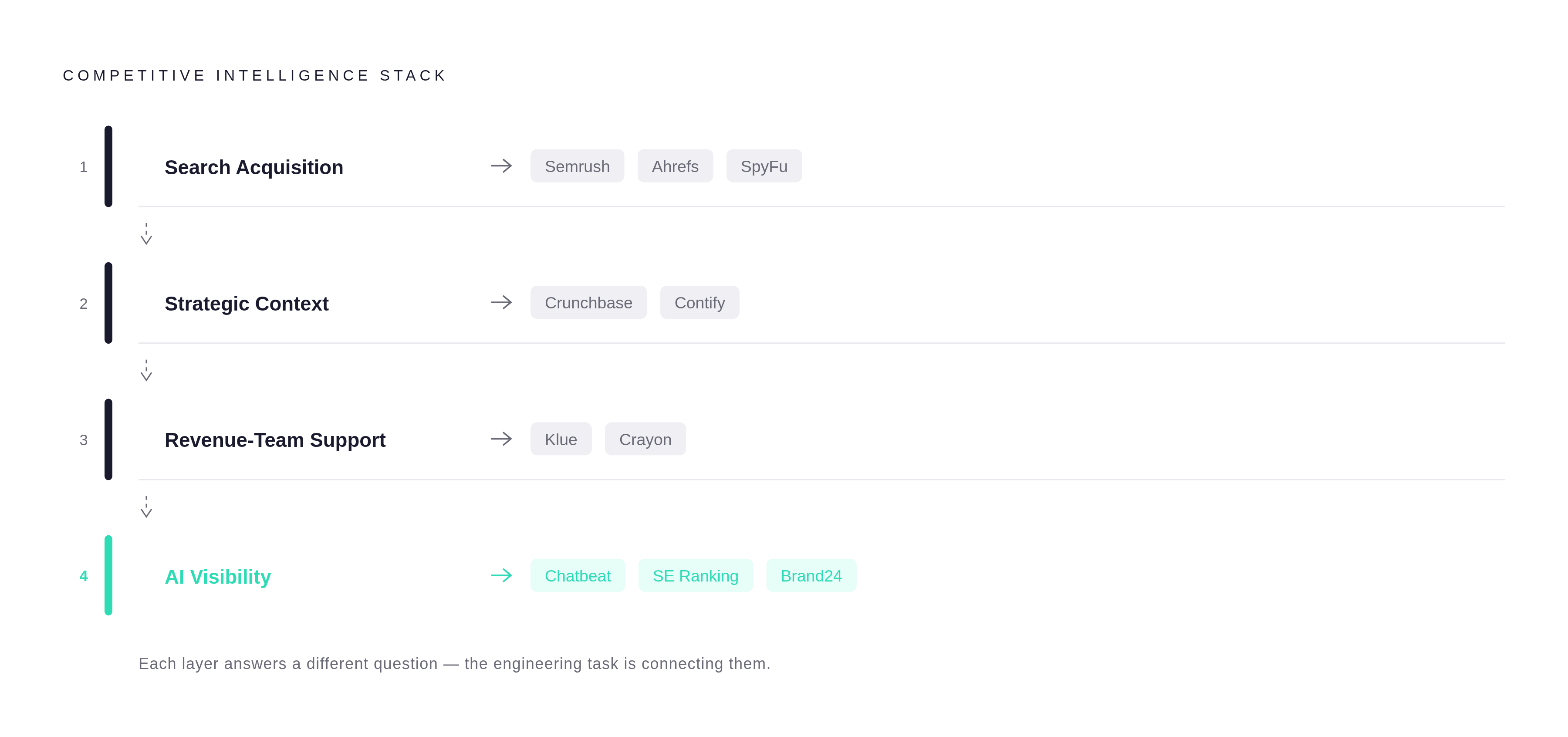
These tools do different jobs as well as compete with one another. Keyword gaps, funding signals, live-deal objections, and AI recommendations each call for their own kinds of evidence. No single view answers all those questions well. It helps to map the four workflow layers before looking at how to connect them.
The first layer is SEO and search intelligence. Semrush covers SEO and paid-search competitive intelligence, while Ahrefs has a narrower, deeper focus on backlinks and organic search. SpyFu adds paid-search intelligence that goes back over 18 years in its ad history. These tools help explain how competitors acquire search visibility. They do not, by themselves, explain the business decisions behind that visibility.
The second layer supplies that strategic context. Crunchbase uses live data to track funding signals and new trends and help with market research. Contify tracks competitors, customers, and industry segments using machine-learning to collect data that people then curate. Funding, hiring patterns, and market entry moves can precede a public campaign. This layer is therefore about direction as much as current performance.
The third layer turns intelligence into revenue-team support. Klue and Crayon convert competitor signals into battlecards, deal support, and win-loss analysis for sellers. Klue’s Compete Agent builds and updates battlecard libraries, while Crayon tracks changes including pricing, product launches, and hiring. The fourth layer watches AI visibility itself. Chatbeat brings Brand Score, share of voice, sentiment, and Key Sources into a dashboard, while SE Visible focuses on multi-brand reporting.
Brand24 also has brand-mention tracking and AI search visibility, along with competitor benchmarking through its Comparison Tab. The questions still differ. Fragmentation is structural, so the engineering task is to connect useful evidence across tools rather than expect one larger platform to make every distinction disappear.
Why AI answer engines have added a fifth competitive surface that most teams are not watching
The fourth workflow layer exists because AI answers have created another competitive surface beyond the established signals teams monitor. Teams must now ask both “Where does the brand rank?” and “Does an AI name, cite, or recommend the brand when it composes an answer? Those are different outcomes with largely independent mechanisms. Search position cannot stand in for both.
AI Overviews now appear in a large and fast-growing share of searches, making that distinction harder to ignore. A brand can have a strong organic position without an equivalent presence in generated answers. The reverse can also occur. Competitive research that watches rankings but not citations leaves part of the buyer’s discovery experience unmeasured.
Even an AI-visibility score can conceal the problem if it combines engines too quickly. The same brand can receive very different citation volumes on Grok and Claude. Visibility on one does not establish visibility on the other.
What evidence would explain such a gap? The sources cited for a tracked prompt can reveal where a competitor’s presence comes from, while the answer itself shows whether that presence is favorable, neutral, or negative. A team watching SEO rank and paid-search share alone has incomplete evidence about which brands buyers encounter at the moment an answer is formed.
What a programmatic competitive signal layer actually looks like in practice
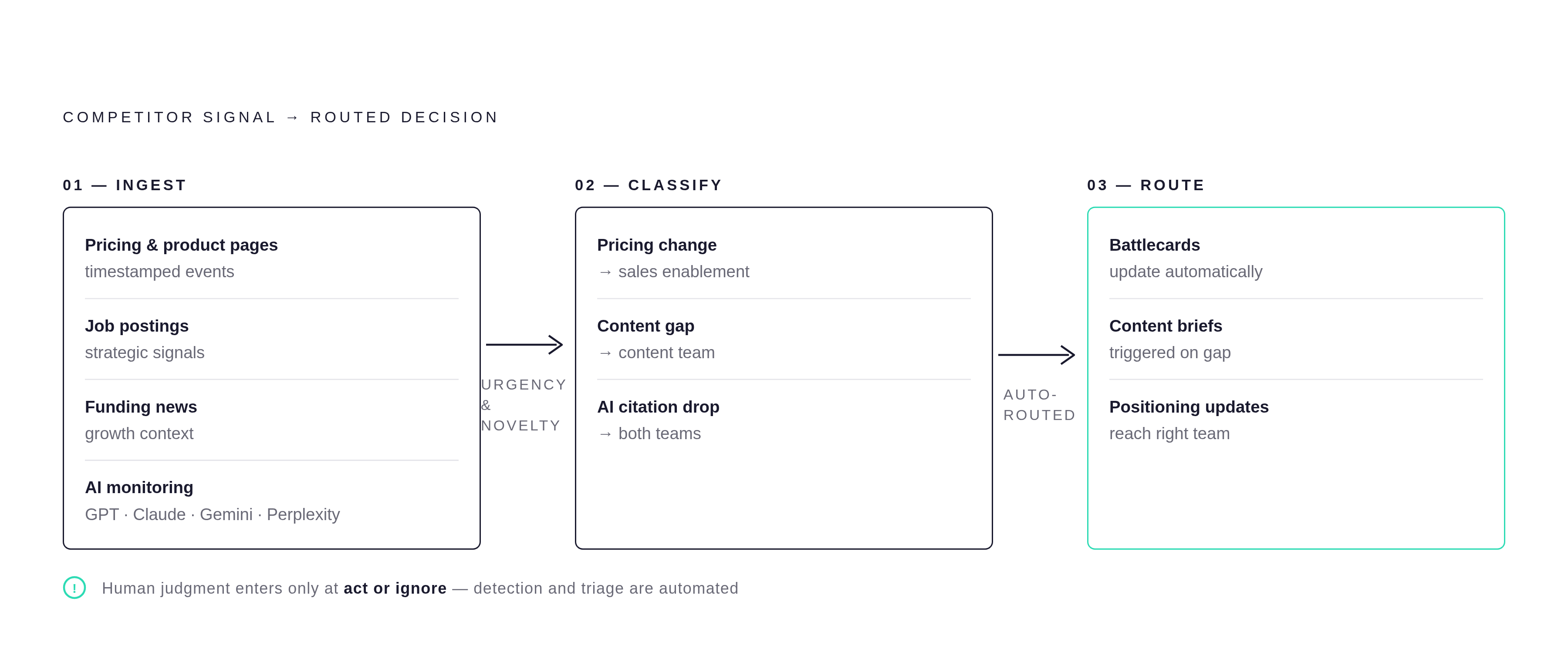
A programmatic architecture separates ingestion, classification, and routing. Agents ingest competitor events, classify them by type and urgency, and send them to the downstream system that can act. Each stage has a distinct job. Collection establishes what changed, classification establishes its relevance, and routing connects it to a decision.
At ingestion, competitor pricing pages, product pages, and messaging changes become timestamped events. Job postings add leading indicators of strategic direction, such as hiring for a capability a competitor does not yet have. Funding and business news help explain decisions about how much to grow. AI monitoring adds repeated observations across ChatGPT, Claude, Gemini, and Perplexity using the same prompts on a cadence. That repetition makes share-of-model measurable over time.
Classification then separates urgency from mere novelty. A pricing change belongs with sales enablement, while a content gap belongs with the content team. A drop in AI citation share may need both content and SEO attention. Crayon uses AI to pick out changes that matter to strategy from a wide range of signals. This illustrates the purpose of classification at scale, which is to reduce manual triage without treating every change as equally important.
Routing is where the architecture becomes operational. Battlecards update when underlying competitor data changes, content gaps trigger briefs, and positioning updates reach the team with the change that prompted them. The human decision becomes whether to act. It no longer depends on whether someone happened to notice.
Klue’s Compete Agent illustrates this pattern by building an updated battlecard library for PMMs to vet and push to reps. Its Win-Loss Story Agent generates material from CRM data and call recordings when a deal closes, without a manual trigger. These are examples of connected workflow stages rather than reasons to choose a particular vendor. The same pattern can turn a competitor’s new AI citations into content and visibility work.
How competitive signals feed directly into content and AI-visibility decisions
A competitor appearing in answers where a brand is absent creates a question for content production. Is the gap in subject coverage, content structure, or the sources from which the engine retrieves evidence? Monitoring alone cannot close it. The useful output is a brief tied to the competitive gap.
Wix Studio AI Search Lab found that listicle-format ranking pages were the leading cited format, accounting for roughly 22% of all citations overall. That share, a minority of citations, gives content teams evidence about format. BLUF-structured sections, with the bottom line up front, statistics supported by primary sources, and dedicated schema markup also increase citation probability. The implication is practical. A competitive brief needs to address how an answer is presented as well as what it says.
The next distinction is between the ground site and phantom sites. The ground site is the owned domain, which AI crawlers evaluate for brand entity recognition. Its machine-readable structure includes robots.txt open to AI crawlers, answer-first paragraphs, and consistently applied schema markup. These features make the site legible to machines. They do not account for every source an answer engine may use.
Phantom-site presence goes beyond the owned domain to Reddit, YouTube, industry forums, and publications for a specific category that engines trust and retrieve from on their own. A competitor may get citations from those sources even when its own domain is no stronger. Citation-source monitoring helps distinguish those possibilities. It shows whether to put content on the owned site or build a presence elsewhere to close the competitive gap.
Measurement then checks whether the response worked after the content was published. Running the tracked prompts again builds a time series of brand mention share, citation sources, and sentiment. That record links decisions about content to how visible the brand is afterward. It also gives teams a reason to check quality before they produce more.
Why human review remains a hard gate in an otherwise automated pipeline
The strongest objection to automated content production is substantive. A draft can read smoothly while containing an unverifiable claim, a phantom citation, or a conclusion its evidence cannot support. Fluency does not establish truth. Faster production can therefore increase the amount of convincing material that still needs scrutiny.
Microsoft’s July 2026 preprint by Mark Russinovich, Ram Shankar Siva Kumar and Ahmed Salem audited accepted papers from four of computing’s most selective venues. The preprint found hallucinated citations in the permanent scholarly record, including references to nonexistent work or to the wrong authors. Those references had survived peer review. Marketing copy and scholarly research share a failure mode: a well-formed claim can reach a reader without anyone establishing that its supporting evidence fits.
Retrieval-augmented generation addresses part of that problem by querying real databases during drafting. It reduces the opportunity to invent a source. But source existence is only the first test. A citation-checking tool can establish that a work exists without establishing that it says what the draft claims.
Human review remains the gate for that judgment of fit. Automated quality gates can assess readability, fact-checking confidence, brand voice consistency, and citation accuracy, with failed pieces routed to people and passing pieces allowed to publish. The design depends on directing unresolved questions of substance to reviewers rather than treating fluent prose as sufficient evidence.
That makes review more targeted while preserving automation’s speed benefit. Reviewers can focus on unsupported claims, weak conclusions, and drafts with nothing original to contribute. These are the substantive reasons drafts fail in a well-designed pipeline. Generating another polished paragraph does not resolve them.
How to instrument competitive intelligence so it compounds rather than stagnates
A signal layer needs measurements that expose whether its responses are improving competitive visibility. AI share of voice records how often a brand is named against competitors across a defined prompt set. Citation source distribution shows which domains engines use when they name those brands. Sentiment distinguishes favorable, neutral, and negative contexts. Each metric answers a different question about the result.
Platform-level disaggregation keeps those answers useful. Combining ChatGPT, Claude, Gemini, and Perplexity into one score can hide the gap that should drive the next content decision. A rise on one platform does not resolve an absence on another. The time series needs enough detail to show where a response is needed and which citation sources are associated with visibility.
Chatbeat’s AI share of voice, LLM ranking position, and Key Sources are examples of what this layer measures. SE Ranking brings localized SEO tracking and AI Overviews monitoring together, so it measures both established search and the newer surface. Neither example changes the underlying discipline. Competitive visibility needs a target, a current value, a time series, and an owner, just as a conversion rate or pipeline coverage ratio does.
The feedback loop is what makes the system improve. A measured citation gap informs content production, subsequent observations show how visibility changes, and that evidence makes the next decision more targeted. Citation-source distribution can also show where phantom-site investment is producing citations and where it is not. Without that return path, the system collects changes but cannot use its own history to guide a response.
Over time, a team running this loop accumulates more than reports. It builds a proprietary record of competitive changes, content responses, and platform-specific visibility outcomes. A quarterly audit cannot bring back what teams missed between reviews. Teams that instrument this continuous record gain a structural advantage because their next decision can draw on evidence that no commodity snapshot contains.