Earned Media Reporting Templates for Content Marketing Teams
Add AI citation fields to your PR report to see coverage's second life.

Earned media reporting templates for content marketing teams need to show more than who covered a brand and who clicked through. They also need to show whether AI answer engines cite that coverage. The strongest template keeps traditional PR measures and adds engine-level visibility to link the coverage a team earns to the answers people see when they research a purchase.
Why earned media reporting templates are showing a gap right now
Press mentions, referral traffic, share of voice, and sentiment are the familiar core of earned media reporting. Tier-1 outlet counts show where coverage appeared, while estimated reach, key message pickup, backlinks, and social shares describe its exposure and reception. These fields track how people find a brand through search results, publications, and links. They record activity on surfaces the team can monitor. But what happens when someone encounters that coverage inside an AI answer instead?
Swydo’s earned media report template connects coverage to business outcomes through referral traffic, search visibility, engagement, and conversion. AgencyAnalytics’ template includes audience growth, shares, comments, reviews, organic search, social traffic, and backlinks. Both templates lack a field for AI-cited appearances. A Tier-1 mention could inform a ChatGPT answer used by thousands of people researching a purchase without generating a visit to the brand’s site. The coverage is still reaching potential buyers, but no existing field captures that second use.
How AI answer engines decide what to cite — and why earned media feeds that process
Independent coverage gives AI engines something a brand’s own claims cannot provide by themselves, which is corroboration across sources. A statement on an owned website establishes what the brand says about itself. A journalist’s independent account gives the engine a basis for including that statement in an answer through independent corroboration. It explains why earned media can influence discovery beyond the publication where it first appeared.
Earned media accounts for an overwhelming share of cited links, with journalism making up a substantial portion. Paid or advertorial content has little presence in that citation mix. Format also shapes what gets selected. Ranked “best-of” articles are especially prominent, while deeper, recently updated pages earn citations more readily than thin or stale material. These patterns make earned placement, useful detail, and freshness relevant to both media exposure and AI inclusion.
An earned story can be a PR result and an input to an engine’s answer synthesis. Measuring only its original publication leaves the downstream use unexamined. Teams therefore need to connect AI answers in marketing reporting back to the coverage that helped produce them.
What the standard earned media template currently covers — and what each field actually measures
Commswith.ai’s template is a useful way to build the traditional report. Its executive summary records period-over-period changes in coverage volume, Tier-1 outlet count, positive, neutral, and negative tone, key message pickup, and estimated reach. The executive summary gives decision-makers a snapshot, while the coverage detail section supplies the full record through outlet name, story, tier, tone, reach, and the messages each story included. Those entries support the summary’s sentiment trends and message pickup rates.
Referral traffic then connects publication to site behavior. It measures sessions arriving through links in earned coverage, while the backlinks and SEO section records links from other domains to owned content as a proxy for authority and search discoverability. Share of voice answers a different question. It compares how often the brand and named competitors are mentioned within the scope the team has chosen to monitor. AgencyAnalytics broadens the picture with social engagement, customer reviews, and audience growth.
A recommendations section uses those findings to suggest work to do next. Its entries name an outlet, journalist, or story angle rather than offering a general request for more awareness. Together, these sections distinguish exposure, response, competitive presence, and next steps. That division gives the AI layer a place to fit without changing what the existing fields mean.
Why AI citation tracking belongs inside the earned media report, not in a separate tool silo
AI monitoring can look like a technical SEO or demand-generation task because it involves prompts, engines, and analytics. That is a reasonable ownership question. Yet assigning the work to a specialist does not require separating its results from earned media reporting. When independent coverage supplies the corroboration behind an answer, the report needs to preserve that connection. Otherwise, the team producing coverage loses feedback about where it is being reused.
Engine differences make that feedback more useful. A brand’s visibility in Grok can diverge from its visibility in Claude, so a single combined measure can hide uneven performance. AI search traffic converts at a meaningfully higher rate than standard organic search traffic, but someone may read an answer and later search for the brand directly. The citation then disappears from direct referral attribution.
An integrated report can place citation activity beside share of voice, referral traffic and changes in branded search so that stakeholders can see how they relate. AI visibility becomes another performance dimension of the same coverage activity, rather than an isolated score with no connection to the work that feeds it.
The AI citation metrics that belong in a modern earned media template
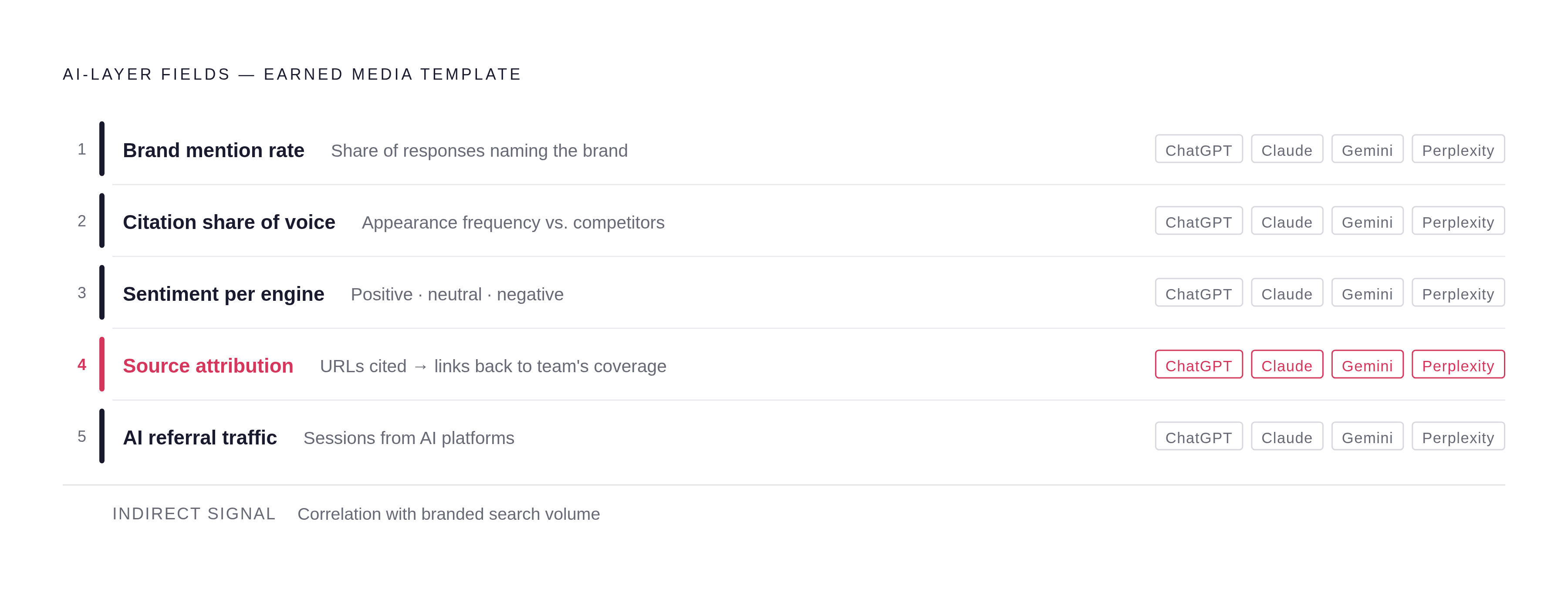
The new layer needs five main fields, with a branded search measure to help interpret them. Keep the engines separate throughout. Each metric should have a row for each relevant engine, with columns for this period, previous period, and directional change. That mirrors the existing executive summary rather than introducing a different reporting language.
Brand mention rate per engine records the share of responses in a defined prompt set that name the brand. Report ChatGPT, Claude, Gemini, and Perplexity separately. Citation share of voice vs. competitors records how often the brand appears relative to named competitors in those answers. The first field shows presence across the tested questions, while the second gives that presence a competitive context.
Sentiment per engine classifies the brand’s description as positive, neutral, or negative. Use the same tone categories as the coverage detail section. Source attribution records the URLs or publications cited when the engine mentions the brand. This is the link back to production.
AI referral traffic counts sessions that come straight from AI platforms. Prioritize Perplexity for this field because its brand visibility has a relatively direct connection to trackable referrals in GA4, while ChatGPT generates significantly more AI referral traffic overall. Correlation with branded search volume provides the supporting indirect signal. It records whether higher citation frequency coincides with more brand-name searches. That association is useful, but it is not proof that a particular citation caused a particular search.
How to run the manual baseline before investing in tracking tools
Start with a structured manual prompt cycle across ChatGPT, Gemini, and Perplexity before buying dedicated monitoring software. Run the same defined queries about the brand’s core category and decision-stage questions in each engine. For every response, log whether the brand appeared, its position in any ranked list, its sentiment, and the external sources or URLs cited. Keep the same prompt set from one reporting period to the next as a consistent measuring instrument.
The first cycle can expose a useful contrast. One engine may leave the brand out, another may cite competitors, and another may use coverage the team helped earn. These results give the team a starting point to compare against, but citation counts from small prompt samples are noisy, and how engines retrieve sources changes often. A single month provides a directional signal. Two consecutive quarters is the minimum for meaningful trend analysis.
This baseline also helps frame the tooling decision. If the brand rarely appears across engines, a more sophisticated monitor does not solve the underlying content and earned media problem. The immediate constraint is upstream. Referral traffic and branded search data from analytics can complement the response log without pretending that prompts alone populate every field.
Tools that can automate AI citation tracking at scale
Once the baseline establishes a reason for systematic tracking, tools can replace the repeated manual prompt cycle. The choice depends on the report’s required scope. Different products cover different engines and signals, so automation is useful only where it supplies the fields the team needs. Which engines a tool covers matters especially when the template needs results for each engine.
Semrush AI Visibility Toolkit tracks brand appearances across ChatGPT, Gemini, Google AI Overviews, AI Mode, and Perplexity. Its Prompt Research feature uses a large database of prompts and responses to estimate AI demand for each topic through the AI Topic Volume metric. That adds context to mention tracking. It helps distinguish the question of whether a brand appears from the question of how much interest surrounds the topic being measured.
Ahrefs Brand Radar launched in March 2025 and tracks Google AI Overviews, Google AI Mode, ChatGPT, Perplexity, Gemini, Microsoft Copilot, and Grok. It derives prompts from real search behavior. It connects to the separate Bot Analytics tool to add crawl information for the pages engines cite. That gives teams another signal to examine when investigating source selection.
A person can read an answer, leave without visiting, and sign up a week later. Current analytics cannot cleanly assign that outcome to the earlier citation. Tooling can expand observation, but it should not turn an incomplete path into a claim of certainty.
What the content behind the citations needs to look like — and how to build it at reporting cadence
The reporting layer becomes useful when it changes production. Earned journalism, comparisons, “best-of” formats, and deep-domain reference material give the team relevant forms to work with. These are already part of an earned media strategy. The new task is to use citation data to see which topics, sources, and competitive comparisons need attention, rather than treating every mention as an isolated win.
Consistency across surfaces is part of that work. The description of what a brand does and whom it serves should match across its website, third-party review profiles, and earned coverage. Contradictory descriptions can leave engines uncertain about the brand. Source attribution and the wording of AI responses help reveal those discrepancies. Producing more material without addressing the contradiction would leave the underlying problem in place.
Speed also limits what a team can do with reporting. If an engine begins citing a competitor in a category the brand serves, a production process that takes weeks for one piece may not respond within the monthly reporting cycle. Multi-stage AI pipelines can support a faster cadence. Research synthesis, outlining, first drafts, and repurposing can be automated, while strategy, angle selection, factual verification, and final editorial judgment remain human.
Human review is an essential safeguard. It lets the team respond quickly without treating an automated draft as publication-ready. The resulting cycle connects measurement to production, production to potential citation, and citation back to the next reporting period. Each pass gives the team more evidence for its next editorial decision.
How to present the expanded template to stakeholders who still think in traditional PR terms
The executive summary should show whether AI visibility moved up, stayed flat, or moved down, with engine-level detail behind it. This is familiar reporting logic. It follows the same pattern as a Tier-1 outlet count, where the headline movement comes before the underlying coverage record.
Then map the new fields to questions stakeholders already ask. Brand mention rate shows presence in a new discovery channel, while citation share of voice supplies the competitive comparison. Source attribution plays the role of coverage detail by naming the publications or pages behind that presence. AI referral conversion asks the familiar business question of whether exposure led to a result. Commswith.ai’s human review checklist is a model for making judgments the same way each time, used here for prompt sets, engine scope, and sentiment classification.
The strongest objection remains fair. If someone never clicked, how can the report claim that an AI answer drove business? Branded search correlation offers a measurable connection to examine, while direct attribution remains unresolved. Presenting that distinction plainly makes the expanded report more credible than promising a complete customer journey.
Building the baseline now gives future reporting something to compare against. As the discovery channel develops, the team will have a record of which engines included the brand, which coverage they cited, and how those patterns changed. That history compounds with each production cycle, giving stakeholders a stronger basis for decisions than a visibility score collected only after the channel becomes impossible to ignore.