Influencer Media Value Calculation for Niche B2B Audiences
Pricing creators by buyer fit and lead cost beats follower counts.

Calculating influencer media value for niche B2B audiences starts with a different question from consumer advertising. Which people can a creator reach, and how closely do they match the buyer? A defensible valuation prices that ideal-customer-profile fit, or ICP fit, rather than follower count alone, then tests the resulting fee against the cost of generating sales-qualified leads.
Why standard influencer media value formulas break down in B2B
A nano creator can charge more than a micro creator with many times the audience. Favikon’s client collaboration data shows this inversion among small LinkedIn accounts, where CEOs, founders, and senior practitioners command premiums. Their reach is smaller, but their professional access is scarce. A formula that applies a flat cost per thousand impressions, or CPM, to follower count cannot explain that price.
The problem starts with the market the formula assumes. Consumer-market logic prices impressions at a platform CPM, with volume as the goal. B2B sponsorship instead buys access to a small, professionally identifiable audience. The same number of followers can therefore represent very different commercial opportunities, depending on their roles and industries.
Margo Laz’s dataset of ~200 B2B LinkedIn collaborations, compiled through Kudos Narratives in 2025, shows FinTech, banking and crypto audiences priced at roughly 3× the CPM of marketing audiences. That difference exists at identical follower counts. Treating followers as the main valuation input therefore underprices executive nano accounts while overpricing generalists whose larger audiences contain fewer relevant buyers.
What B2B buyers actually purchase when they sponsor a niche creator
The underlying asset is access to a particular kind of decision-maker. A sponsor is paying to enter a professional audience that would otherwise be difficult to reach with the same concentration. How many people in that audience could actually sign a contract? That question shifts the unit of value from a follower to a potential qualified buyer.
This explains why seniority and purchase intent shape LinkedIn pricing. A creator followed by VPs of Marketing can offer more valuable access than one followed by a larger population of junior practitioners. The distinction is whether the audience holds the roles and budgets relevant to the sponsor’s offer.
The 851-follower SaaS customer-success expert illustrates the point. If that audience closely matches the buying committee, a premium fee is a price for concentrated access. A single qualified B2B lead can bring enough annual contract value to make the creator fee look small. Cost-per-qualified-lead is therefore a more useful comparison than generic CPM, although audience fit alone does not establish that a qualified lead has been produced.
The variables that actually move B2B influencer pricing
Composition describes the share of followers matching the ICP, while seniority describes their authority within that target group. These are related, but they are not interchangeable. An audience in the sponsor’s market may still have few people who hold budgets, while an audience of senior people may fall outside that market.
Vertical specificity then changes the price of that access. Janney AI’s data from real negotiations shows tech creators quoting a substantial median premium over the all-niche average. Industry is the largest CPM mover in the supplied benchmarks. An average for the whole platform hides price differences between professional niches that buyers need to weigh on their own.
Format changes the asset being purchased, geography changes the audience market, and engagement quality distinguishes useful professional response from a large count of light reactions. A like and a share are different signals. The supplied format data places text posts at the baseline, with higher premiums for carousels, video, newsletter co-authorship, and speaking engagements.
Usage rights also affect the price, apart from who is in the audience. Paid amplification through Thought Leader Ads, whitelisting, and category exclusivity each require their own premium. They change what the buyer may do with the partnership. These rights belong in the upfront negotiation rather than being treated as included in the posting fee.
A three-component fair-rate formula that weights ICP fit
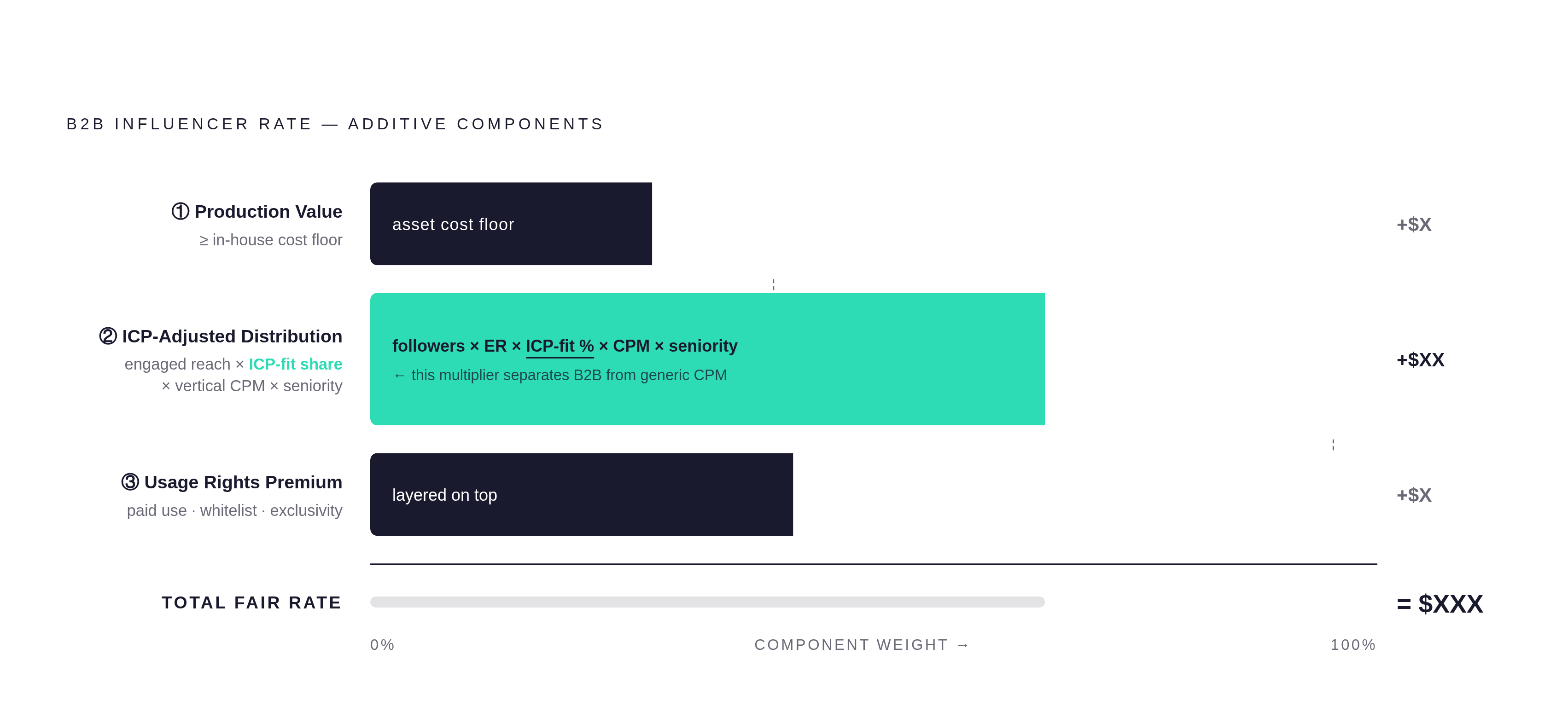
A fair rate adds together the value of content production, the value of ICP-adjusted distribution, and a usage rights premium. Production comes first because the asset has value before anyone sees it. The relevant floor is what producing the same asset in-house would cost. If the creator produces better work than the internal team, those production savings belong in the valuation rather than disappearing behind a follower-based rate.
Distribution starts with the engaged audience, which is the number of followers multiplied by the average engagement rate. Raw follower count is only the starting input. A mid-sized creator with a strong engagement rate can deliver more engaged viewers than a much larger creator with a weak rate.
The next step is to apply the ICP-fit share to that engaged audience. What proportion matches the buyer’s target by role, seniority, and vertical? Distribution is worth more when a large share of followers are VPs or C-suite in the target industry than when engagement comes from people across unrelated roles and markets. The applicable vertical CPM then prices that access, with a seniority adjustment reflecting decision-making authority. B2B professional CPMs should replace generic consumer benchmarks here.
Usage rights complete the rate while leaving the audience estimate unchanged. Short-term paid usage calls for a meaningful uplift, whitelisting for a larger one, and category exclusivity for a moderate fee. These terms need agreement upfront. With all three components visible, a difference between the creator’s quote and the buyer’s estimate becomes a discussion about production, audience fit, or rights, rather than an argument over an unexplained sticker price.
Earned media value benchmarks calibrated to B2B professional audiences
When impressions are multiplied by a generic CPM on LinkedIn, earned media value, or EMV, has the same weakness as a follower-based rate card. It prices professional exposure as though the identity of the audience were incidental. Calculations based only on impressions also leave out engagement quality, while those based only on engagement miss total reach. Neither view is complete on its own.
A hybrid calculation adds the value of reach to the value of engagement after it has been adjusted for sentiment. Its formula is EMV = ((Impressions / 1,000) × CPM) + (Total Engagement Value × Sentiment Multiplier). In this model, positive sentiment has a 1.2× multiplier. The CPM still needs calibration to the professional audience, because adding engagement cannot repair an unsuitable reach benchmark.
Engagement value also needs to distinguish the response. Saves and shares offer stronger signals than likes because they can indicate purchase intent and extend distribution into professional networks. A share through a VP’s feed can reach a second-degree audience beyond the people who first saw the post. Counting every interaction equally loses that distinction and weakens the comparison between posts.
Even a calibrated EMV remains an estimate of media value. It helps buyers compare creators or campaigns, track growth in earned media, and explain social activity in terms that people in finance can understand. It does not forecast revenue. A post can earn a high comparative media value without demonstrating that it generated a sales-qualified opportunity. The commercial test must sit outside the EMV calculation.
Why cost-per-SQL is the ceiling check on any B2B influencer valuation
Cost-per-sales-qualified-lead, or cost-per-SQL, provides that commercial test. The relevant comparison is what a creator program costs per SQL against what LinkedIn Ads or another paid demand-generation program costs per SQL. A high CPM need not mean poor value. If the creator generates qualified outcomes at a meaningfully lower cost, the rate can be justified despite looking expensive on an impression basis.
ICP density explains why those two measures can disagree. An audience concentrated in the right roles, seniority levels, and vertical can convert more effectively than an equally large audience spread across unrelated professions. Fewer impressions can thus lead to better qualified outcomes. The fee is being evaluated as a lead-generation cost.
That makes cost-per-SQL a check on both enthusiasm and skepticism. A small creator should not be rejected just because the CPM exceeds a broad benchmark, but a strong audience profile is not permission to pay any price. The resulting qualified outcomes must support the economics.
How AI answer engines are adding an invisible layer to B2B influencer reach
Qualified outcomes remain the test, but the route to those outcomes is becoming harder to see. A creator’s direct post reach captures only part of that exposure. The rest can influence discovery without appearing neatly in a campaign dashboard.
This extends the valuation argument beyond the original audience. ICP-fit placements that generate commentary, shares, and secondary coverage build off-site mentions in publications, analyst notes, and community forums. Those mentions contribute to the brand’s probability of appearing in AI-generated answers.
That downstream effect connects to vendor selection. Brands appearing in AI answers increase their probability of entering the “Day One” shortlists buyers form before contacting sales. Discovery is shifting from reliance on a ranked page of links toward a synthesized conversational response. This adds a dimension to media value, but the supplied framework does not assign it a fixed monetary multiplier. Observable secondary distribution is the basis for assessing the potential, rather than assuming every creator mention becomes an AI citation.
Applying the framework: an ICP-fit media value scorecard
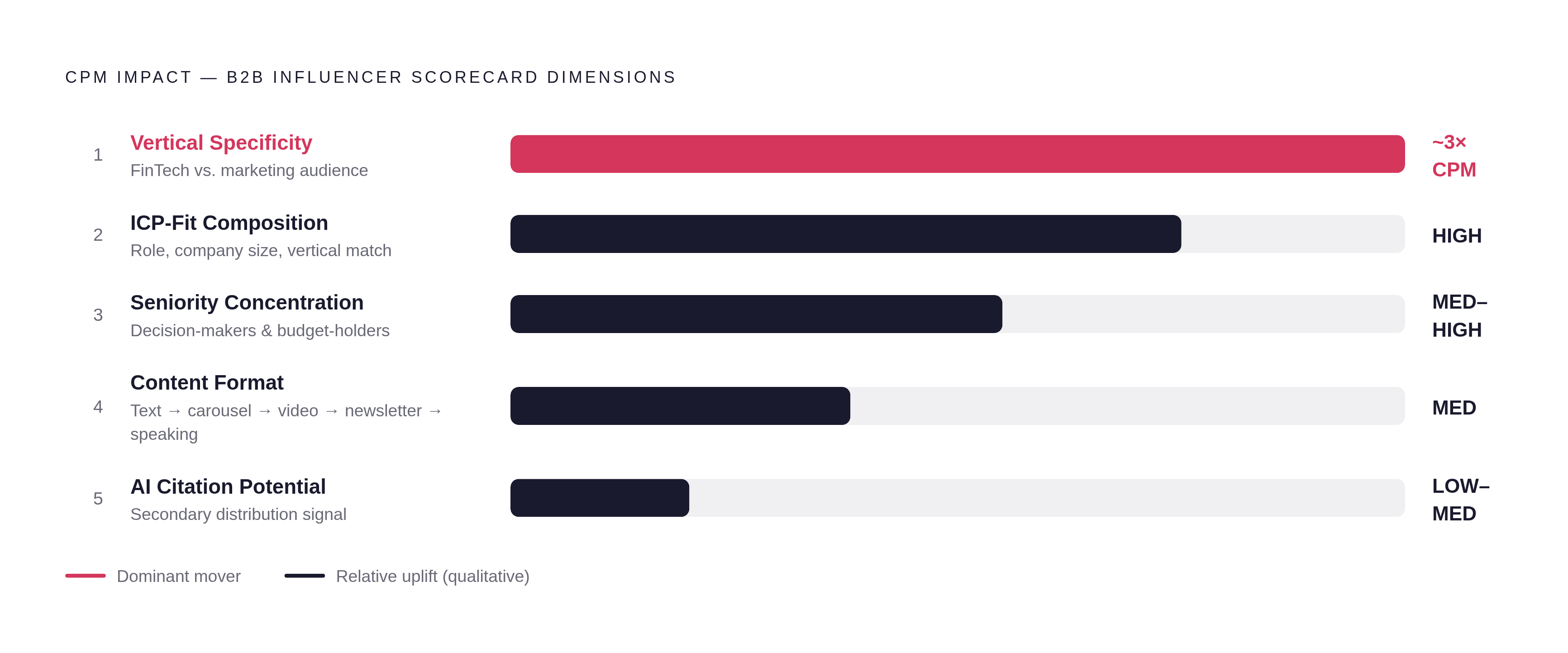
To put these principles into a pre-negotiation scorecard, a buyer should assess five dimensions before assembling the rate. The first is ICP-fit audience composition, measured as the share of engaged followers matching the target role, company size, and vertical. This is the primary distribution adjustment.
The second dimension is professional seniority concentration. What proportion of engaged followers hold decision-maker or budget-holder titles? LinkedIn audience data from the creator’s media kit should be a required deliverable before negotiation. That evidence gives the seniority premium a basis beyond the creator’s own title or reputation.
The third dimension is vertical specificity, based on the professional niche the creator actually serves. Margo Laz’s dataset provides a reference point for the premium end, including FinTech, banking and crypto, while marketing and general SaaS sit at a lower multiple in the framework. The comparison must stay relevant to the audience. A creator’s claim to be a specialist needs an audience in that niche to support the same distribution value.
The fourth dimension is content format. Favikon’s format data places text at the baseline, carousels at a moderate uplift, video at a larger uplift, newsletter co-authorship at a substantial multiple, and speaking engagements at the highest multiple. The score should reflect the format being commissioned.
The fifth dimension is the potential for downstream AI citation. Observable secondary distribution, including shared articles, forum threads, podcast appearances, and analyst references, provides the basis for that assessment. Follower count is not evidence of this effect. Once the dimensions inform the distribution estimate, production value and agreed usage rights complete the proposed rate.
The final test is cost-per-SQL against paid demand-generation programs. If the creator program produces SQLs at a meaningfully lower cost, the rate is justified regardless of its comparison with a standard CPM benchmark. If that outcome is not yet established, the scorecard supplies a defensible negotiation anchor.