What CMOs actually need from AI agents: shared, inspectable systems instead of one-prompt-at-a-time use
Buyers should judge agents on governance and auditability, not just output.

CMOs need AI agents that turn one person’s work into a marketing capability the whole team can share. That requires more than access to a capable model. The decisive shift is from private, one-prompt-at-a-time use to systems whose workflows the whole team can inspect, transfer, and audit. Buyers therefore need to assess both what an agent can produce and whether the organization can trust and govern how it works.
Why most CMOs are still stuck in one-prompt-at-a-time usage despite high AI investment
BCG’s 2026 CMO survey found that a large majority of CMOs report significant end-to-end AI transformation, yet 42% admit they still use GenAI only as an assistant for individual tasks in a handful of workflows. Those findings can coexist. A marketing team can spend heavily on AI while still using it each day in separate conversations that never become shared processes.
The gap begins with how the work happens. When interactions are private, ephemeral, and unreviewed, the rest of the team cannot inspect the process or reliably take it over. What happens when someone else needs to repeat the work?
BCG groups respondents into three maturity tiers based on deployment across the function. Leaders, roughly a third, pair agents with human oversight to orchestrate multiple newly designed workflows. Followers account for roughly a quarter. The distinction is operational, and a subset of CMOs are beginning to connect multiple agents to run certain campaign types autonomously.
What actually separates marketing leaders from followers: operating infrastructure, not tool access
Shared data foundations, governed orchestration, and human oversight explain how a team moves beyond isolated assistance. These are operating choices. BCG’s survey shows that Leaders are restructuring their agency and technology partner ecosystems while investing heavily in internal upskilling. That spending helps the technology serve the whole function.
Within that infrastructure, the distinction between a copilot and an agent is action authority. Can the system take a governed action, or can it only recommend one? A recommendation-only system remains an analytics tool with a chat interface. An AI CMO agent is better understood as a capability tier in which specialized agents coordinate at the strategic level under shared context and governance. They need one context, one memory, and one accountable trail.
Data trust comes before that authority can be useful. If customer acquisition cost has four definitions across four systems, a more capable model does not resolve which definition should govern a budget decision. The valuable unit is therefore a coordinated system that can plan, execute, measure, and replan against a common foundation. BCG also reports that 94% of CMOs say CEO expectations of marketing have increased significantly over the past two years. That pressure makes the choice of infrastructure a business decision as well as a technical one.
How the maturity ladder works: from conversational analytics to governed autonomy
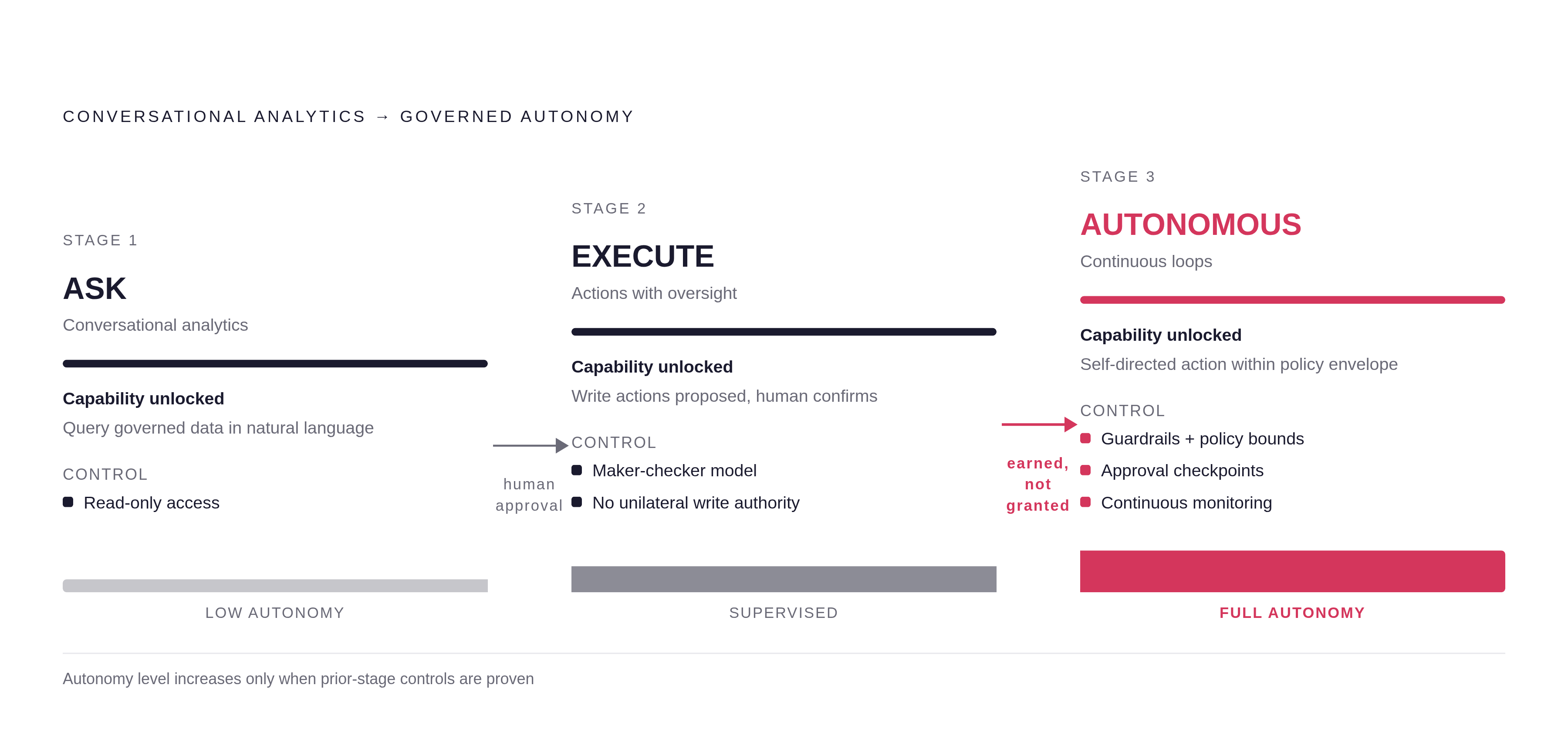
The progression has three stages, namely Ask, Execute, and Autonomous. Ask provides conversational analytics on governed data, Execute permits actions under human approval, and Autonomous allows continuous loops within a policy envelope. Autonomy is earned through the controls that make each transition safe.
At Ask, the central question is whether the answer uses trusted definitions. Without a semantic layer that fixes those definitions against the same governed source finance uses, an agent can infer meaning from column names and produce confident but incorrect numbers. No one may spot the error until a board meeting. A conversational interface does not remove the need to agree on what the data means.
Execute adds a maker-checker approval model to that foundation. The agent proposes an action, a named human confirms it, and the server re-validates it before execution. The AI never has unilateral write authority. This arrangement makes approval part of the system rather than an informal expectation that someone will check the work.
At Autonomous, continuous operation still sits inside defined policies, with guardrails, approval checkpoints, and monitoring. “No human in the loop” is not a substitute for deciding where human judgment belongs. For a CMO choosing a platform, the practical lesson is to buy for the stage the organization’s data governance supports, then build toward the next one. Skipping that work does not remove it from the risk.
Why workflows should be versioned and inspectable
Policy-document drift begins when governance lives in a PDF while the workflow lives in a tool. Over time, the two can diverge without anyone noticing. A written rule cannot show what actually ran. Versioning makes changes to the process visible and lets the team connect the live system to the review that authorized it.
To establish that connection, prompts, tool definitions, retrieval configurations, and runtime policies should be treated as code and kept in a versioned repository. Approval records need to attach to those specific versions. Otherwise, the team has a snapshot of an agent and a separate snapshot of a decision, with no assurance that they match.
The same principle applies to each run. A run should produce one log row capturing what came in, what went out, which version and model ran, what it cost, and who approved it. That record makes a process review possible after execution. Symphony Solutions’ 2026 analysis explains the urgency by noting that autonomous agents can scale mistakes faster than traditional automation.
The EU AI Act’s obligations for high-risk systems listed in Annex III are set to apply on December 2, 2027, including human oversight and automated logging. The immediate reliability test, however, is practical. A CMO should ask for a single-prompt revert and time the rollback end-to-end. A platform that cannot do this quickly is not production-ready.
A checklist for evaluating agent platforms
A platform evaluation should begin with data trust. Where does the data live, where does it come from, is it structured, and how often is it refreshed? The foundation should be explicit. A verified source of truth, such as a knowledge graph of structured brand facts, gives agents firmer ground than information inferred from scraped content.
Approvals are only one part of governance. Beyond them, the evaluation should cover four layers, including a verified source of truth, permissions for specific actions, supervision built into workflows, and an audit trail of what each agent did and when. Security belongs in the same assessment. The baseline should include SAML/OIDC SSO, role-based access control, audit logging for every agent action, encryption in transit and at rest, and a SOC 2 Type II report the buyer can review.
Those controls need deep integration to reach real work. A platform that reads the organization’s actual systems is more useful operationally than a smarter one that requires copy-paste. A “500+ integrations via Zapier” claim does not establish native integration, while Zapier adds latency, cost, and a failure point. The architecture needs scrutiny too. Buyers should demand raw architecture rather than roadmap slides and distinguish a system that plans and adapts from a fixed sequence around a model call, since both are useful but only one justifies agent pricing.
The contract is part of the architecture decision. Buyers should specify what they retain on exit, including data, records, and configuration, together with format, notice, and cost. Portability is easier to negotiate before renewal. A pitch that stresses autonomy without a control surface is another warning, because it passes on execution risk without showing that the buyer can govern what the system does.
What the CMO's role becomes when agents handle execution
When agents take over execution, decisions made early on have more sway over the work that follows. Brand rules, approval thresholds, and audience definitions shape more of the work that follows. Strategic clarity becomes more important. The CMO’s role shifts toward defining those boundaries and remaining accountable for their effects.
Agents can handle high-volume, repeatable tasks such as content production at scale, asset localization, performance report generation, and campaign variant testing. Humans stay in charge of brand strategy, audience positioning, and creative direction. Those boundaries need to be explicit.
The management work also changes at the workflow level. Approval chains built for human handoffs need redesign where they bottleneck agent execution, and each deployment needs an owner accountable for configuration and guardrail updates. Someone must own the process after launch. BCG’s finding that Leaders invest in internal upskilling reflects this need, because the required talent cannot simply be hired fully formed. In a shared system, the audit trail also makes the CMO’s choices traceable and defensible to finance and the board.
What proof of results a CMO should demand
Reports on agents often fall short because they track what agents do while finance needs proof of what the work achieved. A live pilot or a large volume of output can look persuasive until someone asks how much usable work it produced. Completion alone is an inadequate test. An agent that finishes fast but gets the work wrong can score well on throughput while leaving a lot of work to fix.
A better measure is cost per verified outcome, which is the total cost of running the agent divided by the number of completed work items that passed quality review. This puts acceptance inside the calculation. Gross labor savings also need to be multiplied by an accepted-work rate before they can be reported as value. If handling time falls but correction work is heavy and customer complaints rise, the gross saving is not the real saving.
Attribution needs the same discipline. Assigning the same conversion or pipeline effect to content, targeting, and sales assistance without a declared attribution rule inflates reported lift. The numbers will not survive a finance audit. A CMO should demand cost per interaction before and after, a payback period, and a clear projection of returns over a defined horizon. Those figures translate operational improvements into a budget case that percentages alone cannot make.
The same rigor extends to brand visibility in AI answers as discovery becomes more agentic. Presence in those answers is an outcome to track. The four core metrics are mention rate, citation rate, share of voice against competitors in the same answers, and source attribution showing which URLs the model pulled from. These should be sampled repeatedly across the relevant engines so that visibility reporting rests on recurring measurement.
Why the objection that governance kills speed gets the causality backwards
The objection sounds reasonable at first. If agents promise faster execution, will approvals, versioning, and audit trails consume the time they save? That concern is valid when approval chains are poorly designed. It does not follow that removing governance produces sustained speed, because an unreviewed first draft and a mature production workflow are different things.
Cisco research puts the share that have moved agents into production at only 5%. The deployment gaps identified in the notes include undesigned approval gates and missing observability and audit. Mature workflows gain speed through repeated review and refinement. A working rollback procedure also gives a CMO more freedom to let agents operate because a change can be reversed when necessary.
For B2B SaaS and dev-tool marketing teams, that freedom still has to survive budget scrutiny. Auditors, legal teams, and boards need to know exactly what ran, when it ran, and who approved it. Coupled with verified outcome costs, that evidence turns a promising pilot into a defensible investment. Inspectability is therefore part of the case for permanent funding.