How to track traffic from Google AI Mode — and why most teams are measuring the wrong thing
Measure citations in AI Mode, not clicks, to see where your brand actually appears.

Tracking traffic from Google AI Mode starts with a different question from ordinary search analytics. Before asking how many people clicked, a team needs to know whether the answer named its brand at all. Google’s tools show only part of that picture.
Why AI Mode makes click-through rate the wrong thing to watch
Impressions look stable, conversions are falling, and the dashboard offers no explanation. For a marketing or content team, that looks like a familiar search problem. Maybe rankings fell, or the content no longer gave readers what they needed. But when impressions hold or grow while clicks decline, the break may be happening somewhere else. The answer may no longer require a visit.
AI Mode changes the route to visibility. When a user selects it, the traditional results page gives way to a conversational interface within that tab. AI Overviews leave ordinary organic results below the generated answer, while a page needs a citation to appear in AI Mode.
That distinction changes how the “Great Decoupling” pattern should be read. Stable impressions and declining clicks can signal a citation problem rather than a ranking or content-quality problem, though the dashboard alone cannot establish the cause. The engine reads a site and decides whether to cite it before anyone can click. Click-through rate measures what happens after that decision, leaving the decision itself largely out of view.
What Google's own tools actually report — and what they leave out
Google’s Search Console Help page dates the worldwide rollout of its generative AI performance report to August 31, 2026. Impression data begins on May 18, 2026, with no historical backfill. The report groups AI Overviews and AI Mode together and allows breakdowns by page, country, device, and date. It reports impressions only. There is no click column, CTR, or query-level breakdown.
That worldwide rollout removes lack of access as the general explanation for teams not examining the report. An empty report still needs care, however. A site may have opted out of Search generative AI features through an exclusion setting, so checking that setting comes before concluding that the content never appears. Nor does an empty click column need troubleshooting. The report has no such column to populate.
The clicks themselves are not lost from reporting. AI Mode and AI Overview clicks appear in the standard Performance report under the Web search type, mixed in with ordinary organic clicks. Neither the Search Analytics API nor the BigQuery bulk export exposes the generative AI report’s data. Exporting the data therefore does not unlock an official query-level view that the interface withholds.
GA4’s AI Assistant channel, introduced May 13, 2026, solves a different problem. Google’s live documentation names ChatGPT, Gemini, Deepseek, Copilot, and Grok as external assistant sources, while explicitly excluding AI Mode and AI Overviews. Clicks from those Google surfaces come from google.com, so the visits go into Organic Search. This is the reverse of ChatGPT traffic that can arrive without a referrer and appear as direct traffic. Google AI visits retain attribution to organic search, but their AI origin remains invisible.
Three workarounds practitioners have built to surface AI Mode queries
Greetings, pasted prompts, multi-turn replies, and follow-ups such as “yes go on” appear among ordinary queries in the standard Performance report. Google has said this data was already there. Practitioners need to identify likely AI Mode queries within it.
Glenn Gabe’s approach uses Analytics Edge to pull the full set of queries through the Search Analytics API into Excel, then asks Claude to sort them and flag likely AI Mode queries. But it remains a per-run exercise in pattern sorting, and the clicks column reads zero throughout the flagged results. A broad inventory is not a complete account of visits.
Jean-Christophe Chouinard’s custom regex, published August 14, 2026, offers a lighter approach. Pasted into the Performance report’s Query filter through the Custom regex option, it flags prompt verbs, greetings, acknowledgements, refusals, and follow-ups. It is immediate and free, but its English patterns miss edge cases. MCP-based classifiers offer a third route, using a trained ML model to label queries at scale, including multilingual strings, agent harness prompts, and rank tracker probes that regex misses. They require MCP client setup, making them better suited to technical users.
These methods surface clues. A separate behavioral JavaScript approach in Google Tag Manager can detect likely AI Overview and AI Mode clicks through referrer, browser history length, navigation type, and tab visibility at page load. It deliberately excludes links opened in a new tab to reduce false positives. Even that trade-off points to the larger limitation. Better click detection still observes only the people who leave the answer.
Why clicks from AI Mode are structurally rare even when citations are won
The vast majority of AI Mode sessions end without a click to an external site. That is not simply a reporting failure. The interface delivers the answer inline, reducing the reason to visit a source after reading it. Traditional Google Search has a much lower zero-click rate. The distinction is between a channel that reliably sends traffic and one that primarily delivers answers.
What, then, does a successful citation look like in a traffic report? It may look like very little. A page can lose organic clicks while earning citations that put the brand into answers, making it more visible by a measure the session chart cannot show. Even perfect instrumentation would capture a structurally small share of that exposure.
The traffic that does arrive also needs a different reading. Visits from AI citations convert at a substantially higher rate than standard Google organic traffic, and the user has already received a synthesized answer naming the brand. That visitor arrives with context a blue-link click does not guarantee. A smaller stream of higher-intent visits can therefore outperform a larger stream of less focused ones.
The practical consequence is to evaluate conversion rate by traffic source rather than use session count as the main success signal. Yet Google’s reporting creates an important constraint here. GA4’s Organic Search bucket cannot show the conversion rate for AI Mode on its own, and behavioral detection misses some visits. Citation visibility and traffic outcomes need to be measured separately, with those limits made clear even when a number looks precise.
How citation and organic ranking have decoupled — and what drives citation instead
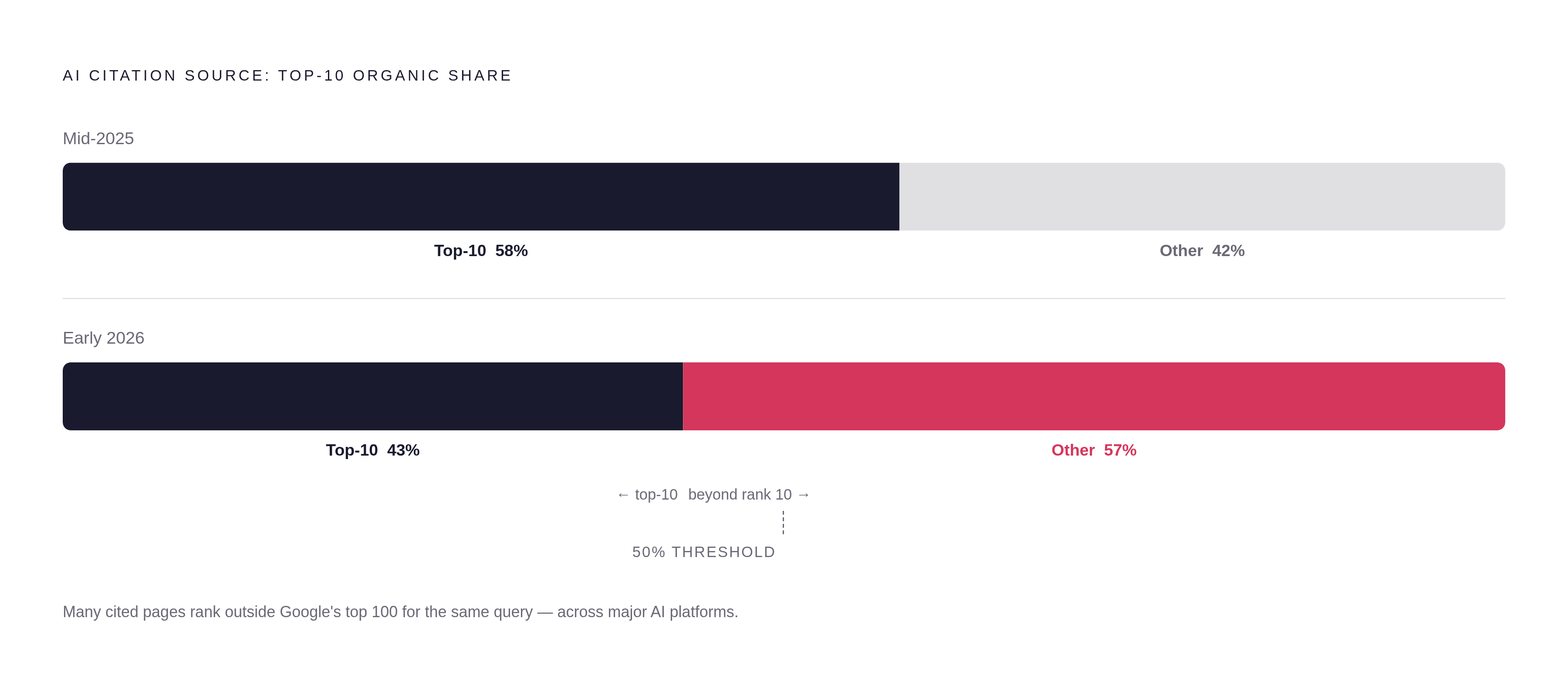
If organic rank reliably predicted citation, an existing rank tracker could fill much of the gap. It no longer does. The share of AI Overview citations from top-10 organic results fell from well over half in mid-2025 to less than half by early 2026. Across major AI platforms, many of the pages cited rank outside Google’s top 100 for the same query. Traditional search competitiveness and citation eligibility are not interchangeable.
AI systems cite pages that meet their needs for retrieval and synthesis, so the sources they choose can differ from the highest-ranking blue links. That makes a rank report an incomplete guide to the sources appearing in an answer. It also explains why a page classified as non-competitive by a traditional tracker can still earn citations. Rank alone misses that route to visibility.
The brand’s own domain is only part of the source pool. Earned, third-party content dominates citations, and brands are substantially more likely to be cited through those sources than through their own pages. Recency also has a role, with a meaningful share of cited content being recent. Measuring only the position of owned pages therefore overlooks both outside coverage and changes in the material engines retrieve.
Google’s Search Central guidance, published May 15, 2026, says foundational SEO practices remain relevant to its generative AI features and emphasizes original, non-commodity content. SEO can support retrievability and topical authority without making organic position a reliable proxy for citation. Its contribution works through a broader pathway than rank alone.
What a measurement stack actually built for AI citation looks like
Exporting AI impressions by page each month makes it possible to watch which pages enter or leave the cited set. Those additions and losses are actionable content signals even without click data. Because the report combines AI Overviews and AI Mode, however, it cannot assign those changes to either surface separately.
Chouinard’s regex or Gabe’s API-plus-Claude method can surface the conversational queries associated with visibility, but the output should remain directional because of anonymisation. Referral analytics then records the visits that reach the site, while behavioral detection can add a limited view of Google AI clicks. These are complementary observations. None can show every answer in which a brand appeared.
Dedicated GEO/AEO citation tracking supplies the missing answer-level measurement through citation frequency, brand mention sentiment, and share of voice. A structured prompt panel run on a cadence measures how often the brand is named for relevant queries across platforms. Share of voice asks what fraction of answers in a topic area name the brand compared with competitors.
The distinction between a mention and a linked citation also needs to stay explicit. Claude mentions brands more frequently than it includes URL links, so its mention rate and citation rate diverge. Anthropic’s support documentation describes direct citations and source links when web search is used. The gap is not an absence of linking. It is a reason to avoid treating brand names and source URLs as the same event.
Conversion rate by traffic source shows the value of identifiable visits, subject to the attribution limits already described. Branded query lift tracks growth in direct branded searches over time, where awareness from AI citations can appear as later search intent.
Why the content that earns citations is different from the content that ranks
Once measurement follows citations, content strategy has to follow the sources that earn them. AI engines retrieve across a site and across the third-party ecosystem that mentions a brand. The unit of work is therefore broader than improving one page’s position. A brand needs a retrievable record across the places an engine draws from.
That record also needs to keep developing. A substantial share of AI-cited content is recent, making freshness and publishing cadence competitive inputs in a different way from traditional SEO, where older authoritative pages can compound over years. Yet citation stability data shows that the domains cited for a given prompt tend to remain consistent over time. These findings describe different levels of stability. Recent material can enter the citation pool while an established set of source domains remains difficult to displace.
Earned media adds to that record with more than the brand’s own claims. Journalist coverage and reference content give engines other sources through which to encounter and cite a brand. Brands should publish on a cadence across owned and third-party surfaces, treating scale as a way to build useful, retrievable material.
This shifts the purpose of the measurement work. Session tagging still helps account for visits, but it cannot answer whether the engine knows enough about a brand to name it. That is the question the content strategy must address and the measurement system must test. The central problem is not how to tag AI Mode sessions in GA4. It is whether the brand has earned a place in the answer.