When an agency gives its agents an SEO suite's MCP server: what metered units, plan tiers and a research-only door mean for the cost and the proof of a client assignment
Semrush's MCP server turns an SEO subscription into a metered, read-only research layer.

Giving an agency’s AI agents access to the Semrush MCP server changes both the cost of research and what that research can prove. The subscription becomes a metered data layer as well as a dashboard. To price client assignments properly, an agency needs to budget the calls, choose a plan that actually funds them, and distinguish evidence of research from evidence of work completed.
What the Semrush MCP server actually does inside an agent
Semrush hosts its MCP server over Streamable HTTP, giving an agent live access to data rather than an export someone has pasted into a conversation. Semrush’s documentation names clients including Claude, Claude Code, Microsoft Copilot, ChatGPT, Cursor, VS Code, Antigravity 2.0, Antigravity CLI, Perplexity, Lovable, and Notion. Sign-in uses OAuth by default, with an API key available when the agent does not support OAuth. The connection is only the entry point. What happens after sign-in determines the cost of the assignment.
The server covers all SEO API endpoints, the Trends API reports allowed by the plan, and read-only methods from the Projects API. Within that scope, an agent can make several calls to answer one open research question. Each call spends units at the rate for the rows returned, so a single answer can draw on several billable reports. That billing event is invisible in the chat window. A person may see one request and one response, while the account pays for the research between them.
How unit metering works and why an agent burns the pool faster than a person does
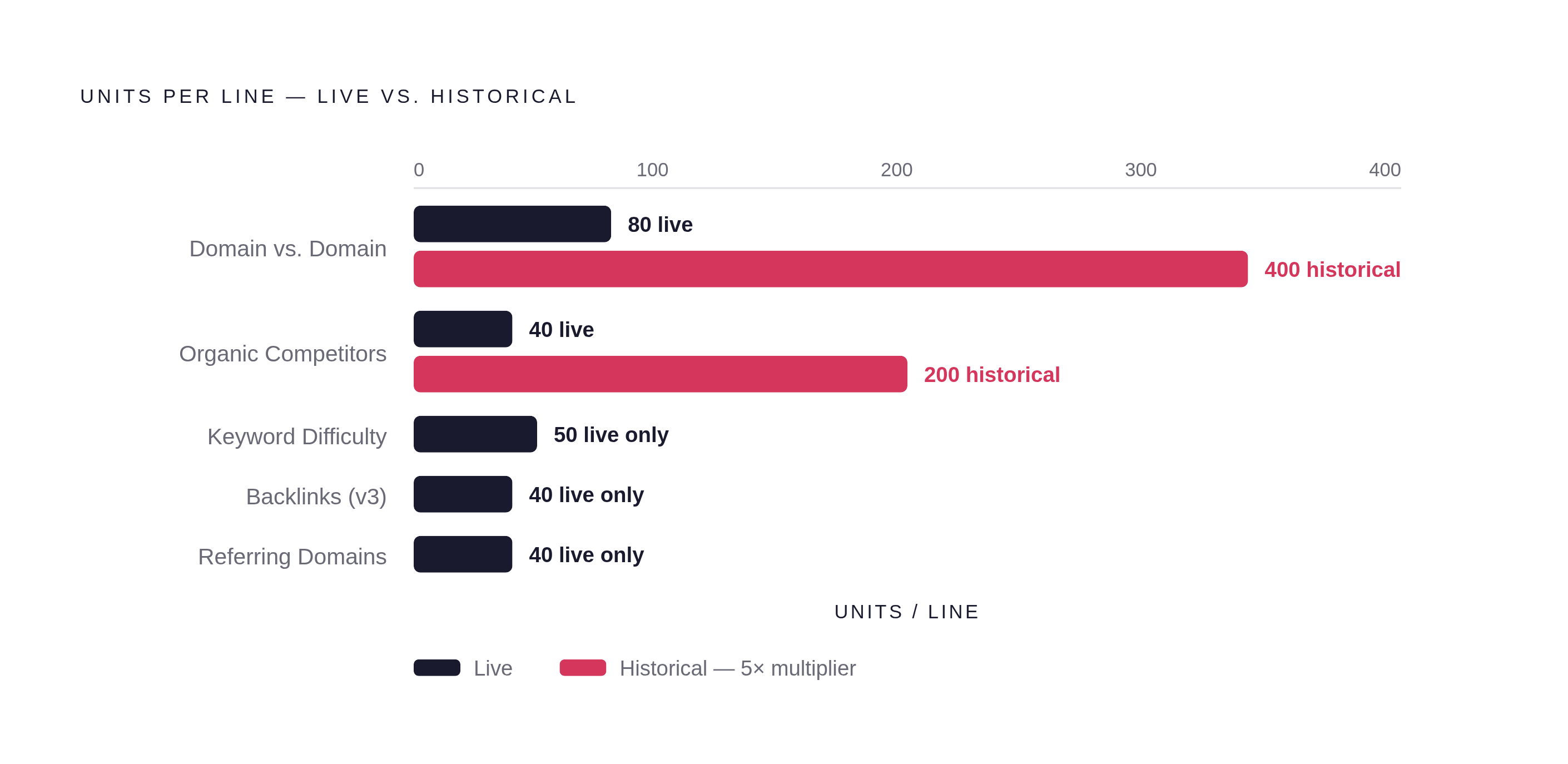
Semrush’s published rates attach costs to report lines. Keyword difficulty costs 50 units per line. For each line of organic competitor data, the cost is 40 units for live data and 200 for historical data. Domain vs. domain costs 80 units per live line and 400 per historical line. Backlinks cost 40 units per line through the v3 API, with v4 Early Access listing 45, and referring domains cost 40.
Those differences make the agent’s choice of report part of the budget. For organic competitors and domain comparisons, historical data costs five times as much as live data. If an agent chooses historical pulls without surfacing that choice, the user can approve a seemingly modest research question without seeing the more expensive route to its answer.
To make the arithmetic concrete, the prompt “compare us with our three closest competitors and suggest keywords” pulls roughly 20,000 units in the example. Qualifying plans include 50,000 units per month, so that opening request consumes close to two-fifths of the allowance before any follow-up. The example is an estimate. Its exact cost depends on which reports the agent calls and how many rows it receives. The important distinction is between the apparent size of the request and the amount of data needed to answer it.
The allowance refreshes on the renewal date, and unused units expire. Exhaustion can also affect the answer itself. Semrush’s balance documentation says the SEO API returns ERROR 132 when there are too few units, but per-line reports can instead return fewer rows than were requested. In the partial-result case, an agent can present a 30-keyword list where 100 were requested without the chat making the truncation clear. Rate limits of 10 requests per second from one IP and 10 simultaneous requests per account are secondary constraints here, because the unit balance is the limit agencies are more likely to meet.
Which plan tier an agency actually needs, and the counter-intuitive Advanced trap
The plan decision needs to come before the connection. MCP eligibility does not follow a simple price ladder, and a more expensive subscription does not necessarily include more usable units. The entry SEO plan at $139/month does not qualify, despite appearing in some comparison tables. For a new subscriber, Starter at $199/month is the safer minimum assumption. It includes MCP units and covers the website limit for five or fewer active clients.
Semrush One Pro+ costs $299/month, or $248.17/month billed annually, and includes MCP access. With room for 15 websites and 1,500 tracked keywords, it is the lowest tier that works for a small agency with more clients than Starter can cover. The older SEO Classic Pro and SEO Classic Guru plans also come with MCP. Plan names alone are not enough to compare them. The agency needs to distinguish access to the server, the included unit pool, and the capacity to accommodate its client roster.
Advanced includes no MCP units by default. Semrush’s developer documentation says that an API units package must be bought on top of Semrush One Advanced, and a package must also be bought separately for SEO Classic Business. An upgrade intended to create headroom can therefore leave the agent without a funded research pool until that second purchase is made. Advanced has been listed at $549/month, but the pricing page showed “Custom” with a “Request demo” button as of 22 October 2026. That makes a dependable budget figure subject to a sales conversation.
Seats add another layer to the decision. Extra users cost $45/month on Starter, $80/month on Pro+, and $100/month on Advanced. A team may need more websites or more people without receiving a larger included MCP pool.
What the read-only boundary means for what an agent can prove to a client
Once the agency has paid for the research, the next question is what the resulting evidence establishes. The MCP server is an intelligence layer. It returns data about domains, keywords, backlinks, and projects, but it cannot create projects, modify settings, write content, or publish anything. Its read-only boundary therefore limits the deliverable. Access to useful evidence does not give the agent the means to act on it.
A competitive keyword gap can show which terms rivals rank for that the client does not. A backlink comparison can establish how profiles differ at a point in time, while keyword difficulty and estimated traffic can support a proposed content plan. Existing position tracking projects can also be read through the server. These are substantive research outputs. But none of them establishes that a page was written, a site was changed, or a tracking project was created or updated.
The fair objection is that read-only access still proves the agency did the research. It does, and unit logs provide a timestamped record of calls made. The gap is between that record and execution. Client briefs therefore need to separate what the data shows from what the agency did with it, with writing, publishing, and site changes handled through a separate tool layer or by a person. Even a sound research brief leaves another question open when the assignment concerns AI answers rather than search rankings, because those require a different proof source.
The AI Visibility split: why MCP data and brand-citation data are on separate invoices
Semrush MCP access does not itself provide AI visibility tracking. The server gives the agent research depth on traditional SEO signals, while the AI Visibility Toolkit addresses whether a brand appears in AI answers. These are separate products with separate access rules. A keyword ranking cannot stand in for a brand citation, because the two observations answer different client questions. An agency selling GEO/AEO work needs proof of those brand citations, which it must get separately from the MCP connection.
Semrush One Starter comes with AI Visibility at $199/month and includes 50 daily tracked prompts, 300 AI visibility reports per day for any domain, and one domain for AI brand performance. With Pro+ at $299/month, the agency gets 100 daily tracked prompts and unlimited AI visibility reports. The bundle changes the purchasing arrangement. Starter and Pro+ come with both MCP access and AI Visibility in one subscription, but there is still a per-domain limit on AI brand performance tracking.
For an agency with ten active clients buying AI Visibility as a standalone add-on, that line creates a monthly expense before the MCP plan and seat fees. The available figures do not establish a standalone per-domain price, so they do not support an exact total for that roster. The agency must count how many client domains need brand performance tracking before it treats one subscription as enough to cover them all. A bundle can save the agency from buying a separate product, but it still needs to price each client’s visibility work correctly.
The proof also needs to match the promise. Measuring whether a client is named and cited in ChatGPT, Claude, Gemini, and Perplexity answers is distinct from measuring keyword rankings. An MCP-backed SEO brief can be well supported while leaving that citation question unanswered. If both forms of visibility are in the client agreement, both need a funded source of evidence.
How to price and structure a client assignment when the data layer is metered
An agency should use the published per-line rates to work out the cost of its usual research tasks, including competitor gap analysis, keyword difficulty checks, and backlink comparisons. That gives each client engagement a calculable research allowance. Narrow questions help preserve that boundary. “Top 50 organic keywords for this domain in the US” is a more controlled assignment than “tell me everything about the competitive landscape”.
The budget also needs a review rhythm. Agencies should check the unit balance weekly during the first month of agent-driven workflows and set internal alerts before exhaustion. ERROR 132 is a failure, while a truncated report may be less obvious. Neither is a useful substitute for an internal spending threshold. Because unused units expire on renewal, a monthly research cadence should use the allocation deliberately rather than leave it idle or consume it in unplanned sessions.
Starter at $199/month has room for five or fewer active clients and comes with MCP units and AI Visibility basics. For six to fifteen active clients, Pro+ at $299/month is the minimum viable tier, after which seats and AI Visibility per-domain limits become the next constraints. Larger rosters or high-volume agent workflows move into Advanced territory. Before committing, the agency should confirm unit package pricing with sales, because no package prices are published.
Research and analysis should cover the keyword gaps the agency found, the competitor positions it read, and the backlink profiles it compared, while implementation should cover what a downstream tool or person gets done. To create content, publish it, and make site changes, the agency needs a separate tool layer connected to a CMS. The MCP server cannot close that loop. Naming both deliverables makes clear which record shows what the data suggests and which shows the changes that were made.
AI visibility should receive its own scope and price within that agreement, even when the underlying subscription bundles the products. Prompt tracking and brand citation rates are the proof layer for GEO/AEO engagements, and white-label reporting through the My Reports add-on can present that data under the agency’s brand. Keyword rankings and AI citations should therefore be priced separately and both instrumented when both are promised. The final client record should distinguish what was learned, what was implemented, and which kind of visibility was measured.