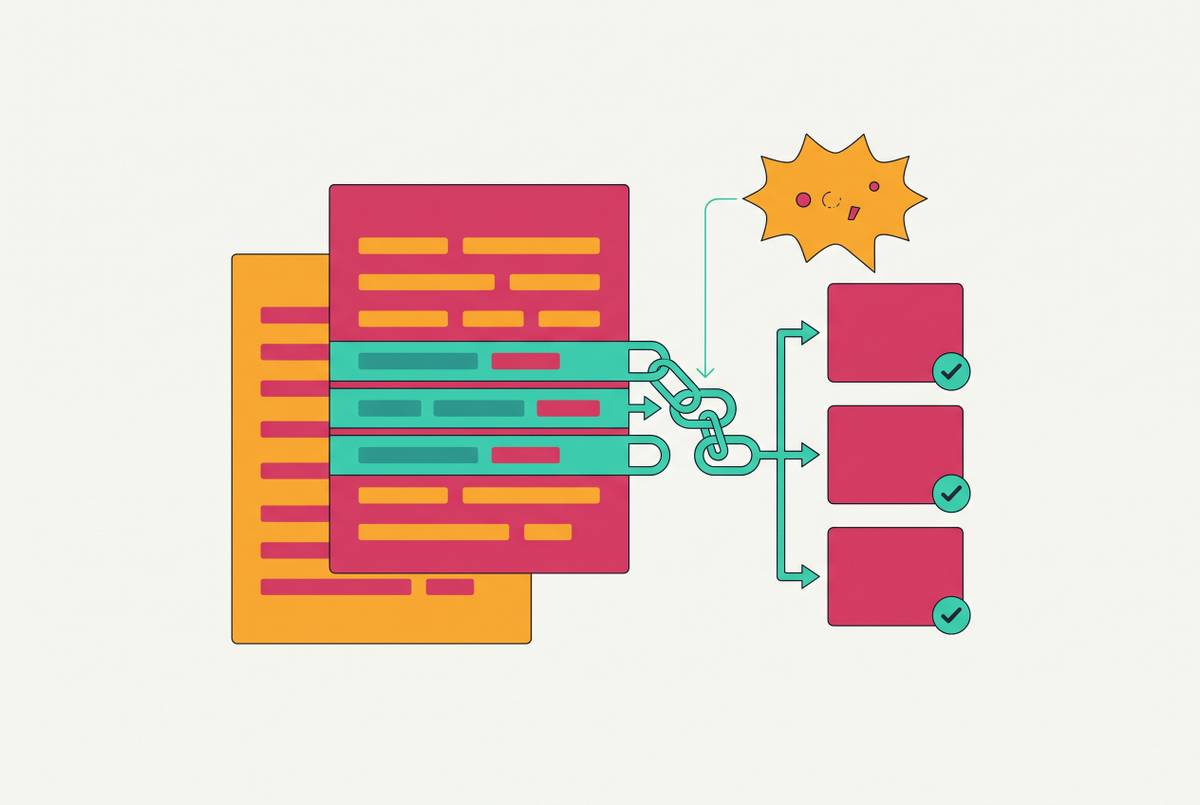
Content calendars are a content agency's deliverable — not a growth system
Calendars ship content on schedule; roadmaps build authority that compounds over time.

A content calendar is a content agency’s deliverable. It lists what will ship, but it cannot tell founders and technical marketing teams whether that work is building authority or bringing in demand. The alternative is an owned, programmable content engine in which research, writing, publishing, and measurement continuously inform one another.
The structural gap between a calendar and a growth system
The calendar is full, the team is busy, and content keeps shipping, yet authority is not building. What is missing when everyone has done their job? tiptop SEO’s 2026 analysis identifies this failure mode as the point where consistent publishing stops translating into growing authority. Completing another article and strengthening a body of knowledge are different achievements.
A calendar makes production visible to other people. Leadership can see what the team is producing, writers can coordinate their work, and agencies can show that promised pieces arrived on schedule. That helps when several people depend on the same deadlines. They answer a production question. A publish date says nothing about why a piece exists, what it reinforces, or whether it is working.
Calendar thinking asks what to publish next, treating one post as one task. System thinking asks what to reinforce next, treating each post as part of a larger idea. This requires an organizing logic that connects a new piece to the work already published and to the outcome it is meant to support.
Why agencies deliver calendars instead of systems — and what gets left behind when they do
The calendar persists because it fits a production-fulfillment relationship. An agency receives briefs, produces content, delivers it, and moves to the next assignment. Its calendar records what was promised and what was delivered, giving both sides a concrete basis for accountability. That is a legitimate job for a deliverable. The gap appears when nobody continuously asks whether the content is right for that stage of the funnel.
This is an architectural criticism. Adaptify’s 2026 agency guide distinguishes producing content from using content as a direct business growth channel, arguing that agencies that scale treat content as a system. The distinction leaves room for agencies to build and run effective systems. What it rules out is treating delivery itself as evidence of growth.
When the agency owns the calendar, workflows, and performance data, ending the relationship can mean losing access to all three. The client then starts from zero with the next vendor. Who retains the means to learn from the articles therefore matters alongside who writes them.
What about a good agency that builds strategy into its calendar? That leads to better choices in the calendar, but it does not add the missing feedback loop. Even a schedule built on strategy stays fixed if measurement never changes the plan and published work never comes back for refresh. The structure needs a way to revise its decisions.
What a roadmap does that a calendar cannot
A content roadmap gives each piece a reason to exist through its funnel stage, intended persona, and definition of success. It can live in a spreadsheet or a database. The tool is not the dividing line. A roadmap record explains the work’s purpose and its relationship to other content, while a calendar record assigns a title and date.
For a B2B SaaS company, that distinction is practical. Bottom-of-funnel SEO posts can target comparison and “best X for Y” queries, while case studies follow a quarterly cadence and founder LinkedIn posts establish a regular drumbeat. These formats do not all have the same job. A roadmap makes those jobs explicit so that each can be judged against a relevant outcome.
Related pieces also form clusters around a larger idea. Instead of treating each article as an isolated attempt to attract attention, the roadmap shows what it reinforces. The roadmap tracks whether a cluster is building authority.
Refresh belongs in this plan from the start. The competitive-term refresh window described in the notes has tightened by 2026 to 6–8 months, down from 18–24 months. A calendar without refresh cycles can therefore keep reporting completed work while older pieces quietly lose traffic. Updating a piece keeps it within the compounding logic of the roadmap. Leaving it behind makes the published piece a finished task that no one has to look after.
Why the calendar-as-deliverable model is acutely worse when AI answer engines are the front door to discovery
AI answer engines expose this weakness more sharply because discovery depends on more than publishing a page and waiting for a click. Generative engine optimization, or GEO, structures and publishes content so engines such as ChatGPT, Perplexity, Google AI Overviews, Gemini, and Claude can cite it in their responses. Answer engine optimization, or AEO, structures content to answer user questions directly. Neither is simply an extra publishing task. Both shape how teams plan, write, keep up, and judge their content.
For example, an article’s opening should directly and completely answer its primary query. That recommendation belongs in the brief template. Retrofitting it at publication makes the production process work against the intended result. Similarly, structured data such as FAQPage schema belongs in the production requirements, although its association with higher citation probability should not be confused with proof of a substantial causal effect from controlled studies.
A substantive factual update shortly after publication signals that a source is maintained and trustworthy, while aging content without updates loses citation probability. A date alone cannot manage that work. Without a refresh loop, a publish-and-hand-off process treats content as finished just when it still needs care.
The definition of success changes as a consequence. GEO focuses on citation frequency and AI mention share. LLM-referred traffic also converts at a materially higher rate than Google organic traffic, so invisibility affects pipeline as well as exposure. A process organized around filling new slots can become counterproductive if it displaces the updates and structural work that support discovery.
The two content surfaces a growth system must plan across simultaneously
Claude’s citation behavior and ChatGPT’s cannot be treated as interchangeable. Their differences make it necessary to plan across two surfaces, the owned “ground site” and the third-party “phantom site.” The ground site is the brand’s own content. The phantom site is the body of third-party content through which other sources describe, discuss, and reference the brand.
The balance between these surfaces varies by platform and study. Third-party sources account for a significant share of branded AI citations, while owned pages can also account for a substantial fraction. Neither surface is safely dismissed as negligible. A plan confined to the owned blog therefore leaves an important part of the citation network outside its scope, even if the blog itself is well run.
The phantom site includes review sites, listicles, press, and directories. Active seeding of Reddit threads, guest placements, analyst coverage, G2/Clutch profiles, and earned media gives this surface a deliberate role. Guest posts on authoritative publications, original research that others cite, and third-party brand mentions build the network that AI engines recognize.
That changes what the roadmap must coordinate. Ground-site production and phantom-site work need distinct logic, because publishing on an owned page is not the same activity as earning coverage or contributing to a third-party discussion. Yet both support the same discovery goal. A calendar focused on one blog and one cadence cannot express that relationship unless it becomes part of a wider system.
What the production pipeline looks like when research, writing, publishing, and measurement feed each other
An owned pipeline begins with query-intent and entity mapping. That research informs AI-drafted modular answer blocks, with the answer to the query placed in the opening. Human subject-matter review follows, assessing accuracy, defensibility, and brand voice before publication. Each stage has someone in charge and a clear job to do. AI helps the work scale, while people stay in charge of judgment.
The modular blocks also need to be legible to systems that generate answers from retrieved information. Clear paragraph breaks, bullet points where they fit, and sections that flow from one to the next help those systems read the blocks. Structure is not a substitute for substance, however. A neatly divided answer still needs evidence that supports its claims and a clear account of what the source knows.
Human review is therefore not optional polish at the end. AI answer engines evaluate authority, clarity, and factual accuracy, prioritizing evidence-backed content, clear structure, and transparency signals. Shallow or repetitive material can be ignored regardless of publishing volume.
The pipeline then applies a GEO checklist covering schema, FAQPage, a freshness date, and inline citations before publishing. After the work goes live, measurement feeds the refresh loop, making maintenance part of production. It also gives research a continuing role, because what the measurement reveals can change what gets investigated and written next.
Distinctive evidence remains essential within that process. Proprietary research, comments from experts, and in-depth analyses give AI material it cannot find elsewhere. Adaptify’s guide calls the complementary approach a “barbell strategy,” pairing high-volume AI-assisted foundational content with high-effort human-only thought leadership and original research. The two tiers serve different citation targets. Foundational traffic does not remove the need for work that earns backlinks and builds authority.
Measuring whether the system is working — across four AI platforms that each need independent tracking
ChatGPT, Perplexity, Claude, and Gemini each need independent tracking because their citation rates differ sharply. A blended AI visibility score hides the differences that guide investment. Only a small fraction of domains are cited by both ChatGPT and Perplexity, so success on one does not establish success on the other. The unit of measurement changes the decisions available. A single average cannot explain where a brand is absent or which surface needs attention.
Mentions and citations also need separate records. A mention names the brand in a response, while a citation links to its content as a source. Both show that the brand is visible, but citations can also bring in referral traffic.
A majority of audited brands are invisible across all four platforms, making measurement an initial action. For teams establishing that baseline, the recommended manual method is to ask ChatGPT, Perplexity, Google AI Overviews, and Claude a representative set of customer questions. The record should distinguish cited, mentioned, and absent responses. This costs nothing and shows gaps right away, though Gemini still needs its own tracking as part of the four-platform view.
Business outcomes then connect visibility to growth. In GA4, teams should set up source/medium tracking for chatgpt.com, perplexity.ai, and claude.ai to measure sessions and conversions. A mandatory open-ended field on demo and trial sign-up forms can ask how the person first heard about the company. Users increasingly name both the AI platform and the query that surfaced the brand. Those answers add to referral data, so teams can judge the results with more than proxy metrics alone.
Measurement can inform which larger ideas need reinforcement, which pieces need refresh, and how ground-site and phantom-site work should relate. It feeds back into the roadmap, which feeds the production pipeline, which produces content across both surfaces. The measurement layer then shows what is working. A calendar does not have that back edge.