What a "top advertising agencies for B2B software launches" comparison can't tell you: an agency list is a procurement input, not a measurement of whether anyone can find, cite or buy from your site
Agency rankings can pick your launch partner, but not show whether AI recommends you.
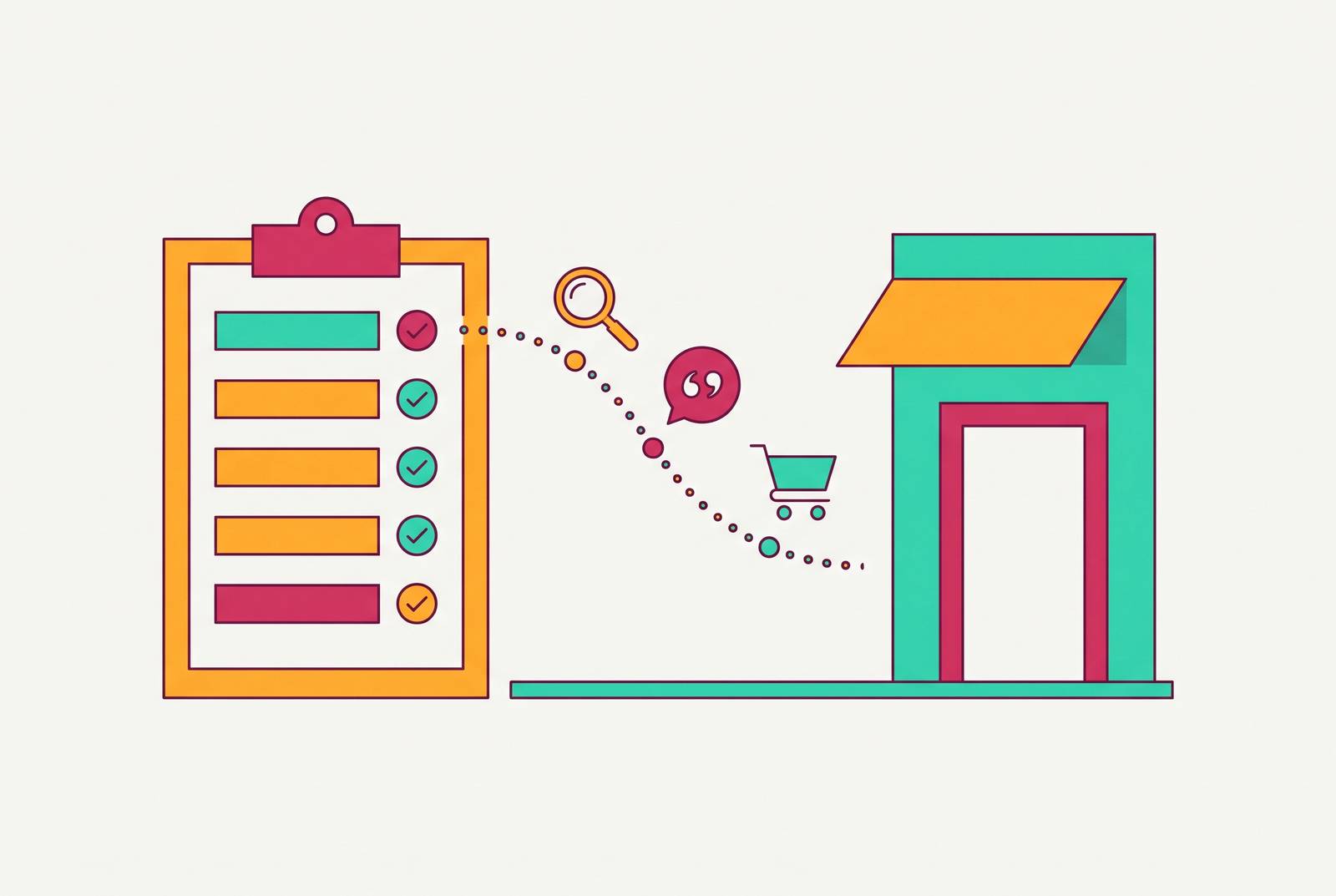
A “top advertising agencies for B2B software launches” comparison helps a team choose who should run its launch. Whether AI answer engines can find, cite, or recommend the team’s brand is a different problem to address before choosing an agency. An agency list serves as a procurement input.
Why the agency comparison list exists and what it actually solves
Choosing a launch agency is a consequential resource decision. A B2B software team needs to weigh creative work, media capabilities, and go-to-market execution against its budget and the demands of its category. A comparison list makes that search more manageable. It brings service capabilities, client rosters, pricing models, and delivery track records into a form that supports a shortlist. These are useful inputs when the question is which shop can deliver the work.
An agency’s specialization may fit the product, but its pricing model may not fit the budget. A strong client roster can show that an agency has worked with similar clients without showing whether its creative approach fits the launch.
The limit appears when the team asks the list to diagnose its own visibility. An agency’s track record does not show whether an AI assistant now recommends the software brand to buyers looking for a product. That requires evidence about the brand. Even a detailed comparison cannot establish which buyer questions surface the product, which sources support the answer, or whether a competitor appears instead.
Where B2B software buyers are now starting their vendor research
G2’s Answer Economy research, covering B2B software buyers and decision-makers in March 2026, found that a majority now start their software research inside an AI chatbot more often than Google. That share was substantially smaller a year earlier. The shift changes where a launch first encounters buyers. For buyers who begin in a chat session, an AI-generated recommendation can shape the shortlist before they encounter a search result or a campaign asset.
The broader pattern extends across independent surveys with different sample sizes and question framings. The findings support a formed research habit. That establishes that AI answers have become an important early stage in software buying, one that a plan built around search rankings and paid exposure alone does not fully address.
Consider a buyer asking for the best revenue intelligence tool for a 40-person B2B team. The answer may give the buyer enough to start weighing vendors without opening Google or seeing a sponsored result. The shortlist can start inside the answer itself. A brand’s absence from the assistant’s answer may leave its agency-funded assets out of that buyer’s research path. The campaign may be well executed, yet miss the point at which the buyer first decides which products deserve attention.
What AI answer engines actually cite — and why it is not what agencies optimize
AI recommendations depend on sources that do not map neatly onto the assets a launch agency typically optimizes. ChatGPT draws heavily from sources such as Wikipedia, Reddit, and editorial media. Perplexity draws from a wider mix of brand sites, third-party lists, and editorial coverage. Google AI Mode is more distinctively characterized by heavy self-citation to Google’s own properties, together with third-party sources. The engines do not share one source mix.
A brand can improve its own site through brand-site hygiene and structure, but it still needs the outside sources an engine uses to back up its recommendations. A strategy concentrated on one content type may therefore fit one engine better than another. The destination is not always the brand’s website. An assistant can name a product while linking only to a review, directory, or editorial roundup that supplied the supporting evidence.
Ahrefs’ study of 15,000 queries found that roughly one in eight AI-cited URLs also appeared in Google’s top ten. With so little overlap, strong search performance cannot take the place of a citation audit. The two systems draw on different corpora. A traditional SEO or advertising program can succeed on its own measures without establishing that the pages it promotes are the sources an answer engine selects.
Creative work and media placement help bring a launch to an audience, while citable content gives an answer engine material it can use to explain a recommendation. Neither function replaces the other. The old bargain connected authority signals with clicks. The answer-engine bargain adds a different requirement, which is to be verifiable in the sources the engine draws from, even when the resulting answer does not send a visitor directly to the brand.
Why most B2B software brands don't know they are absent from AI answers
An absent brand has a visibility problem. An absent brand with no way to detect that absence also has a planning problem. Its team can keep funding campaigns on the assumption that buyers will find the product during their research. Agency procurement then risks becoming a displacement activity, because selecting a capable partner feels like progress while the discovery gap remains unexamined.
Citation rates across LLMs shift materially month over month, so a successful appearance on one occasion cannot establish dependable coverage. Strong presence on one engine can conceal near-zero presence on another, leaving the team with a reassuring average that identifies no clear corrective action.
The useful diagnostic shows which engines name the brand, for which queries, against which competitors, and from which source URLs. Branded and unbranded questions need to be distinguished because appearing when a buyer supplies the name is different from being recommended when the buyer asks about a need. The source URL adds another piece of evidence. It shows whether the answer rests on owned content or someone else’s account of the product. Publishing good material alone cannot tell a team whether ChatGPT, Claude, Gemini, or Perplexity retrieves and cites it for the questions buyers actually ask.
The timing problem: AI citation slots fill before a launch campaign runs
Citation presence can be both variable over time and sticky for a particular prompt. Across ChatGPT, Google AI Mode, and Perplexity, a brand named for a given prompt is named again the next time that prompt runs at a high rate. These observations describe different parts of the problem. Month-to-month shifts make ongoing measurement necessary, while repeated appearances show why an established recommendation can be difficult for a late-arriving brand to displace.
Competitors that establish citation presence before a launch are already represented in the answers buyers receive during its campaign window. A later entrant faces a more sustained task. It must build a place in a conversation where other brands already supply the familiar recommendations, rather than establish its presence before that conversation hardens. This is not a claim that citation positions are permanent or that late entry is futile.
For a launch team, the implication is to build the citation infrastructure before commissioning demand that the brand is not ready to capture. That includes owned content architecture, off-site citation signals, and clear entity information in directories and on review platforms. Awareness spending can drive buyer queries toward an answer engine that returns competitors instead. Treating AI visibility as a follow-on project, or work that begins only when the campaign starts, leaves the launch dependent on sources that have not yet been put in place.
What the content and site infrastructure for AI citability actually looks like
The first requirement is access to the content. LLMs do not execute JavaScript, so a site rendered client-side in a JavaScript framework may rank on Google while remaining invisible to AI crawlers. Server-side or static rendering is the baseline described by this problem. More articles cannot compensate for unreadable pages. Before content quality can affect a citation, the relevant material has to be available in a form the crawler can read.
Readable content also needs a clear structure. Schema markup, clear entity signals, Q&A blocks, and a logical page hierarchy do more for the site’s citability than word count alone. Ahrefs studied 174,000 cited pages and found almost no link between word count and citation rate. Length is not the useful target here. Entity clarity across Wikipedia, Wikidata, LinkedIn, Crunchbase, and homepage schema can produce among the fastest citation lifts for B2B SaaS brands, making consistent product and company identity part of the infrastructure.
A large majority of branded-query AI citations come from other sources, including reviews, forums, editorial coverage, and third-party directories. G2, Capterra, and category-specific directories provide important visibility signals and citation sources for some engines, particularly Google AI Overviews. Evidence on direct citation rates in ChatGPT is mixed. Because that varies by engine, teams have another reason to measure the effect of off-site listings for each engine.
Accuracy in those listings is part of the task. An outdated feature description can be cited and lead an engine to recommend the product for the wrong reasons. A mention is not automatically a useful result. The citation needs to represent what the software actually offers, or greater visibility can amplify an incorrect account of the product. This makes current directory and review-platform information a practical complement to a clear, readable site.
A pipeline with several stages can use AI for the mechanical work of making content while humans stay in charge of strategy, accuracy, and voice. Human review is not an optional finishing pass. AI models can make up statistics, quotations, and source URLs, so the reviewer must open every cited source even when the reference looks complete. That control allows production to scale without turning unsupported claims into the material an answer engine is expected to trust.
How to read an agency comparison list once you know the AI visibility question exists
The agency comparison becomes more useful when the team brings a diagnosed problem to it. Its original criteria still apply, including execution capability, creative approach, and launch-campaign delivery. The decision now has a prerequisite. Before choosing the shop, the team needs to know whether measurement is running across the engines its buyers use, whether crawlers can read the owned site, and whether relevant off-site citation signals are active.
This distinction does not put AI visibility outside the agency category. Obility says its services include AI referral monitoring, prompt and citation tracking, creating content, and building off-site signals. Animalz offers AI visibility audits, citation outreach, and content refreshes for B2B SaaS. Directive says it provides citation tracking, content architecture, technical GEO, and competitive analysis. Those offerings show that agencies can help make content accessible and citable, but a service description is still not a measurement of the buyer’s brand.
The practical sequence is to audit citation presence first, design the content and citation infrastructure around the gaps, and then commission the launch campaign. That gives procurement a more exact brief. A team can evaluate an agency against the work its discovery environment requires, rather than assume a strong launch portfolio resolves every barrier between awareness and purchase. The comparison remains a tool for choosing a partner, while the audit establishes what that partner needs to help accomplish.
The question to bring into that conversation is sharper than whether an agency offers AI-related services. It asks whether the proposed work connects to the sources buyers’ answer engines actually use and whether its effect can be observed. A shop unable to explain that connection is optimizing for the previous front door. The diagnostic question is “Will this work be citable by the AI engines our buyers are already using, and how will we measure that?”