Blogging platforms through a computational lens: what the choice of publishing infrastructure actually signals about your marketing stack
Your blogging platform choice determines whether AI systems can find and cite your content.

A blogging platform is more than a place to publish. For technical founders, it reveals whether the content stack can be automated, read by machines, and connected to other systems. Those properties shape AI visibility more than an editor’s feature list does. The strongest architecture separates an owned publishing home from a distribution layer, then measures whether that arrangement earns mentions and citations.
Why platform choice is an infrastructure decision, not a publishing preference
Most founders choose a blogging platform much as they choose a font, by feel. The editor feels easy to use, the templates look right, and publishing seems simple. But for a team treating marketing as an engineering problem, that is a category error. An interface is not the whole system. The platform also determines how content enters the stack, how machines retrieve it, and whether it can leave intact.
Can an API or CI pipeline drive publication? Does the output contain clean, crawlable HTML, and who owns the canonical URL? Can the content be exported and relocated without data loss? These questions show the tradeoffs between automation and ease of editing, and between ownership and how far distribution can reach. They also distinguish a publishing tool that feels convenient today from infrastructure that remains usable as the operation grows.
The properties that actually determine whether published content is retrievable by AI systems
AI answer engines retrieve passages as well as whole pages. A useful passage still needs to reach a crawler in a form it can read. Clean HTML gives it that path, while heavy client-side rendering and paywall interstitials can obstruct it. Quotations, statistics, and explicit citations add evidence only after that access problem has been solved.
Canonical ownership answers a different question about retrieval. When an engine cites content on a third-party domain, the cited address belongs to that platform. Structured data adds another layer of machine-legibility through JSON-LD types such as Article, FAQPage, and ItemList. Control over robots.txt and support for llms.txt also belong in the access audit, especially where crawler restrictions could block retrieval.
API access is the last part of the infrastructure test and supports content production. Without a publishing API, each post depends on someone opening an editor. That dependency becomes a bottleneck as cadence increases. Together, canonical control, readable output, structured markup, and API access describe whether content can move through an automated system and emerge as an accessible, attributable asset.
How self-hosted and headless platforms score on the infrastructure checklist
WordPress.org, Ghost, and headless or static-site setups set the baseline for full control. They can support owned URLs, machine-readable output, structured data, and programmatic publishing. Their operating costs differ, however. With full control, the team has to handle the implementation and ensure that each installation produces clean output.
Self-hosted WordPress provides a REST API and extensive plugins for schema, crawler controls, and sitemaps. The operator still has to handle hosting, security, updates, and performance. Theme selection is consequential because bloated markup can undermine the benefit of ownership. Ghost has a Markdown-based editor, cleaner default output, tools for newsletters and memberships, and APIs that let a pipeline publish posts. Its smaller theme and plugin ecosystem narrows the available extensions, while self-hosting still requires technical skill.
Static-site and headless setups make the content-to-publication path particularly explicit. Markdown files stored in Git are diffable, portable, and scriptable with standard tools. A build pipeline can turn them into static HTML without requiring client-side rendering to deliver the text. A CI job can also validate and deploy a post without a browser. What these setups do not supply is a built-in audience, so discovery depends on content quality, syndication, and earned media.
Where developer-community platforms (Hashnode, Dev.to) sit on the programmability spectrum
Developer-community platforms give up some control in exchange for a distribution network that is already there. Hashnode has custom domains on its paid Pro plan at $5/month, along with Markdown editing, syntax-highlighted code blocks, and API access. Its canonical URL support also accommodates republishing from an owned source. The combination supports a hybrid stack, although structured-data injection is more limited than on fully self-hosted infrastructure.
Dev.to places the balance elsewhere on the spectrum. Posts live on its domain rather than a custom domain, so it does not provide the same owned citation anchor. It does offer a publishing API and a canonical URL field for syndicated posts. Those features make it useful as a distribution destination, with an active developer community and a fast feedback loop. Its narrower API and limited schema control constrain its role as the central publishing layer.
Publishing only on Dev.to helps content reach people quickly, while Hashnode with a custom domain gives the team both community access and owned URLs. Neither choice can be understood from the editor alone.
What Medium, Substack, and Wix signal when chosen as the primary publishing home
Medium emphasizes distribution and ease of operation. Its limited API surface and lack of control over schema injection make it harder to connect to the infrastructure. Paywalled passages add an access problem for retrieval-first engines.
With Substack, owning the email subscriber list has real value. Its tools support newsletters, paid subscriptions, and audience retention. Yet web publication on yourname.substack.com does not build authority for a brand-owned domain. The platform is not engineered around structured-data injection, API-driven publishing, or headless delivery. Audience ownership and web-content ownership are related, but they are not interchangeable.
Wix and Squarespace support custom domains and reasonably clean HTML, so they pass the basic test for domain ownership. The editor-centered publishing model does not offer the programmatic workflow required by the pipeline described here, and available schema tools are not composable with external pipelines. These platforms fit an infrequently updated marketing site more readily than a high-cadence automated operation. Convenience becomes a constraint only when the operating requirements change.
The ownership-vs-reach tradeoff resolved — why the right answer is a two-layer architecture
Ownership and community reach do not require one publishing home to perform both jobs. An owned ground site can be the canonical source, with community platforms and publications as the places where content is syndicated. The first layer controls the durable asset, and the second puts that asset before audiences the ground site does not yet reach.
On the ground site, the team controls canonical URLs, structured data, crawler access, and publication through an API or build pipeline. Copies on other platforms point back to that source through canonical tags where those platforms support them. This gives distribution a clear relationship to ownership. The architecture does not depend on treating every copy as an independent publishing home.
Perplexity’s retrieval-first model draws heavily on community discussion and third-party mentions, while Google AI Overviews draw on the Google index. When syndicated content earns engagement and links, it can help people find the content beyond direct visits to the ground site. The team can decide where content should travel after publication while retaining control.
What a programmable content pipeline actually requires from the platform layer
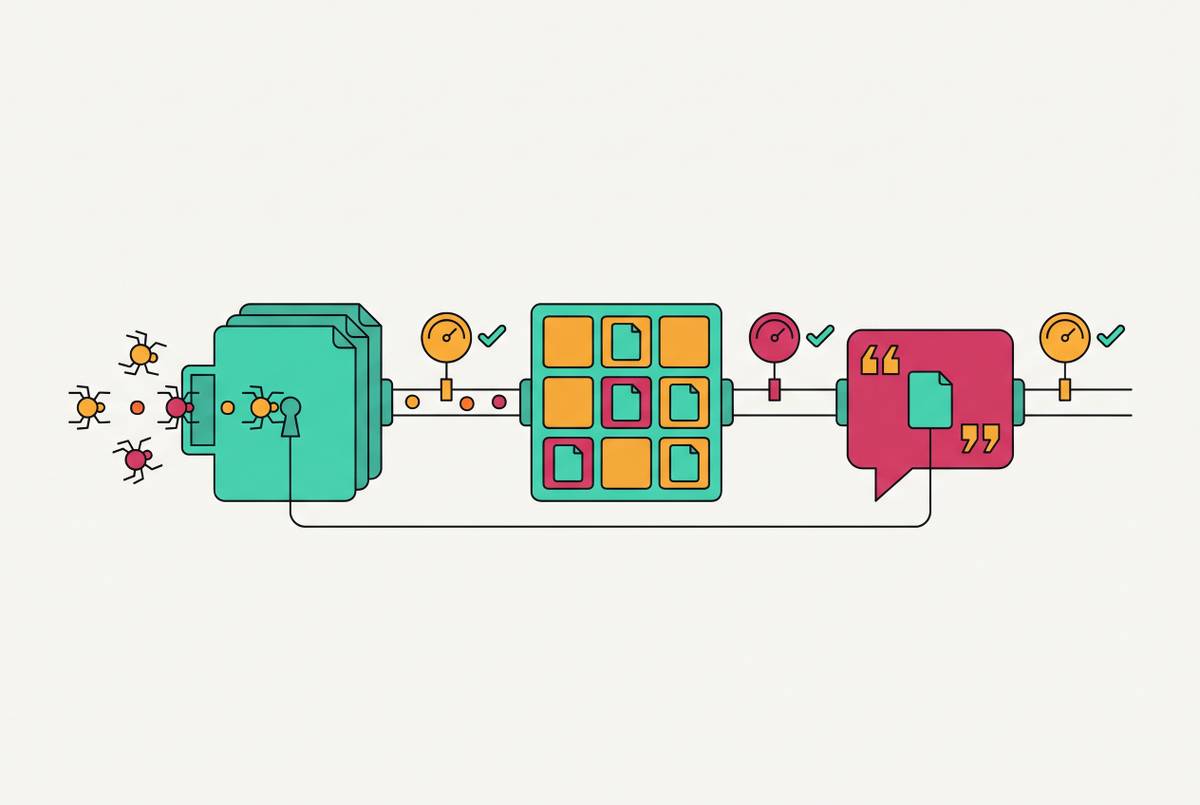
For that architecture to work, every stage of publishing has to work with the others. The seven-stage sequence runs from topic to brief, draft, structured-data injection, review, publish, and syndicate. Drafting is only one part of the path. As AI reduces the cost of producing text, topic selection, briefing, voice consistency, fact validation, and distribution become more prominent constraints.
The platform must accept structured content through an API rather than require someone to paste it into an editor. It also needs a draft or preview state that the pipeline can create before publication. Per-post canonical assignment is necessary when content moves to downstream destinations. After approval, a webhook or API call can publish the source and trigger syndication jobs. A missing interface at any of these points breaks the automated sequence.
Human review remains a gate. Without it, factual errors can ship at the same cadence as correct content, and later edits cannot prevent the initial publication. Markdown storage helps the surrounding workflow because plain files can be compared in Git, processed with standard tools, and moved between platforms. Native support removes a conversion step, making the content itself less dependent on the publishing application.
How different engines retrieve and cite content — and why this should shape publishing cadence decisions
Perplexity fetches live web results and generally supplies clickable inline citations, apart from modes that generate without retrieval. Google AI Overviews depend on the Google index, so the ground site’s organic ranking affects whether it is eligible. YouTube titles, transcripts, and high-authority editorial links also correlate with visibility there. Meanwhile, the narrow overlap between ChatGPT and Perplexity citation pools means success on one is not evidence of success on the other.
BrandMentions/MaxAEO’s panel reports a median of roughly two weeks before a new owned page receives its first AI citation, compared with about 22 days for an earned third-party mention. A team seeking visibility around a launch therefore needs to account for retrieval lag in its publishing and syndication schedule.
Format belongs in that calculation as well. Listicle-format ranking pages account for the largest single share of AI citations, making support for Article, ItemList, and FAQPage schema relevant to their production. Treat cadence, format, and distribution as variables to test across engines. Publishing more often is not, by itself, evidence that the architecture is working.
Measuring whether the content stack is actually producing AI visibility
Share of Model supplies the measurement target for that test. It is the percentage of relevant AI responses in a category that name or cite the brand, serving as the GEO equivalent of share of voice. The method is a weekly run of structured buyer-relevant prompts across ChatGPT, Claude, Gemini, and Perplexity. Mentions and citations are counted over time for each engine. A blended average can hide a retrieval gap.
Measurement tools include Nightwatch, Scrunch AI, Semrush AI Toolkit, and SE Visible by SE Ranking, but coverage varies. The toolkit’s standard tier covers ChatGPT, Perplexity, Gemini, and Google AI Overviews/Mode, while Claude belongs to the separate Enterprise AIO product. The team needs to choose tools that cover the engines it plans to measure.
Traffic attribution provides a second view of performance. Perplexity citation clicks that retain a referrer can appear in GA4 as visits from perplexity.ai, although referrer stripping sends a meaningful share into Direct. That connects some citations to visits and conversions without making every citation a traffic event. The resulting evidence can guide changes in cadence and format, including deeper, higher-authority content when Claude presence remains flat.
Reading the platform choice as a signal about everything that comes after it
The platform choice is a signal because it sets the feasible boundaries of the stack. A self-hosted or headless ground site makes ownership and automation available, but the team still has to implement them. A custom-domain community platform offers a hybrid with limits on schema control. A third-party primary home favors immediate distribution or audience retention, while an editor-centered site builder favors low-cadence convenience.
For a technical founder, the useful evaluation follows the content through its whole life. Can the platform accept a pipeline’s output, hold it for review, expose readable passages, and assign the right canonical URL? Can the team measure citations across engines and later migrate the asset intact? Those questions reveal more than a feature checklist. They distinguish control that is merely available from control the stack can actually exercise.
The two-layer model gives those capabilities separate, compatible jobs. The team keeps ownership through the canonical source, uses distribution to reach more people, and measures the result. A platform that supports those connections becomes part of a growth-instrumented system. One that blocks them constrains the system before the first automated publishing run.