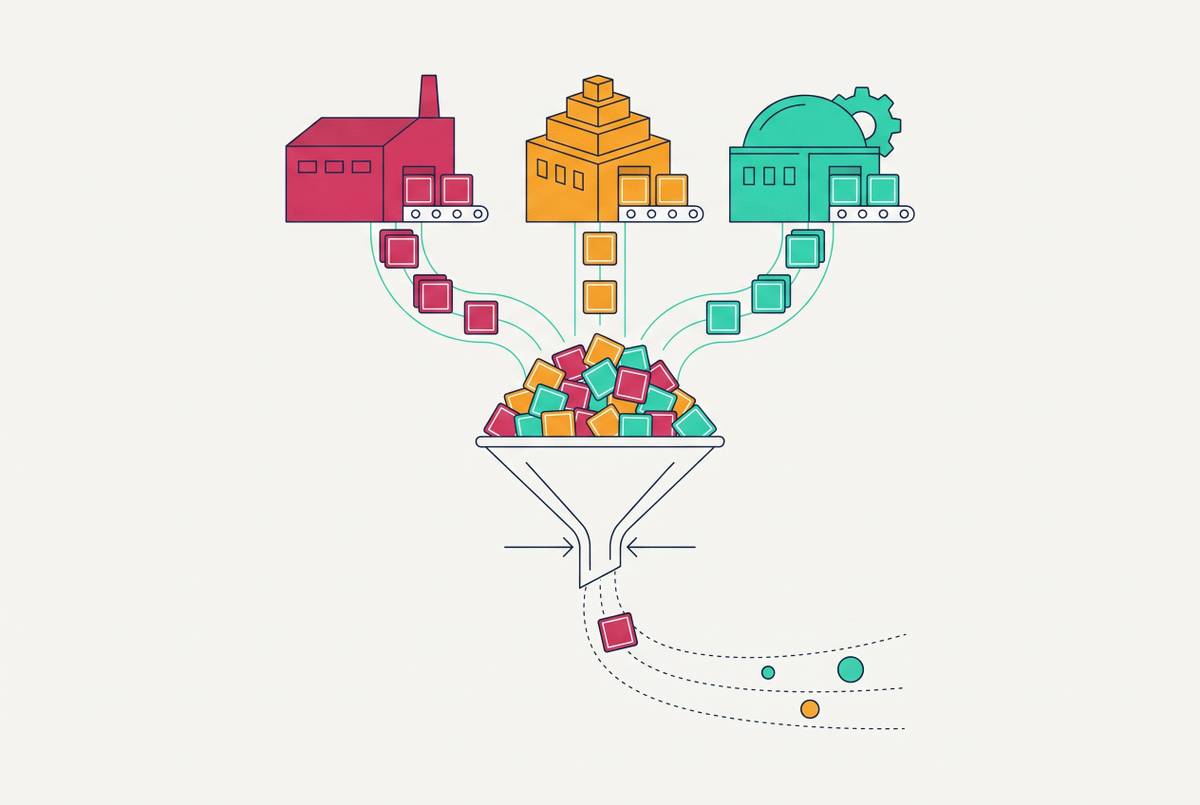
Why the agency model breaks down for SaaS marketing — and what building in-house actually looks like
Internal expertise on product knowledge and revenue metrics beats outsourced growth strategy.

SaaS marketing breaks down when a company delegates growth strategy to an agency that cannot see the whole customer journey. Build internal ownership of product knowledge, content, and revenue measurement while continuing to draw on outside expertise. That means more than hiring marketers. It means connecting their work in a system that learns from acquisition, activation, retention, and expansion.
Why agencies can't own SaaS growth strategy from the outside
An agency’s boundaries do not match the work SaaS growth requires. Recurring revenue ties the promise that brings in a customer to the experience that keeps them paying. A marketing decision therefore has consequences beyond the initial sale, through activation, adoption, retention, and expansion. The work does not end at acquisition. Yet an agency working from a brief and a monthly call cannot see or influence that whole arc.
The knowledge gap also creates a coordination problem. A SaaS customer moves through awareness, trial, conversion, onboarding, and expansion, drawing on work spread across marketing, product, and sales. Product trial interactions are part of the buying journey and remain within marketing’s scope. No single agency holds the expertise or access needed across all those functions. Even strong channel execution cannot substitute for ownership of the connections between them.
The bowtie funnel makes that distinction clear. Its post-sale side gives activation, adoption, retention, and expansion the same weight as new customer acquisition. Marketing must therefore know why someone buys and what helps them get enough value to stay and expand. An outside specialist can contribute to that work. The structural limit appears when contribution is mistaken for ownership of growth strategy.
The warning signs SaaS marketers cite are symptoms of one structural cause
When a team knows too little about its field, its content brings in traffic without getting signups. When writers lack product expertise and have no process for building it, they give the brief priority over the product’s needs. The gap is commercial as well as technical. A SaaS content program must connect its work to monthly recurring revenue, churn, customer acquisition cost payback, and lifetime value. Without that fluency, a SaaS label does not make a generalist team a product-aware one.
A “green dashboard” can show rising clicks, lower cost per lead, and more form fills while the sales pipeline barely moves. Those measures can improve without producing qualified buyers, so rewarding them makes the dashboard itself the deliverable. Brand awareness can also grow without bringing in revenue. When the working team cannot see the product and revenue data, it is easier to defend what it does than what it does for the business.
The team that sells the engagement may also differ from the team that runs it. With different teams doing that work, the senior expertise shown when choosing an agency says little about how much attention the account will get. Who will manage the account in month seven, and how many other accounts will they hold?
Control of credentials creates another warning sign. Agencies that own access to ad accounts, the CMS, and analytics create switching costs that make clean offboarding difficult. This is not simply an administrative inconvenience. It changes the relationship’s incentives because leaving becomes harder independently of whether the work is producing results.
Short contract terms and mismatched metrics make the problem self-reinforcing
Three-month agency terms can end before an enterprise B2B SaaS buying cycle brings in revenue. The agency is then judged on what becomes visible within the contract, which pushes attention toward activity it can move quickly. The timing works against revenue accountability. Even a team that wants to improve attribution cannot shorten the customer’s buying process to fit its review window.
Attribution is also incomplete when organic, paid, product trial, and sales interactions sit outside any single agency’s remit. A company focused on marketing-qualified leads and last-click attribution has the wrong foundation regardless of who executes. Net revenue retention, CAC payback, and pipeline coverage are closer to the decisions the business needs to make. Optimizing form fills instead of closed-won annual recurring revenue compounds the mismatch when acquisition costs are elevated. Better agency selection does not remove the short contract, the fragmented journey, or the pressure to prove progress before revenue arrives.
The financial and stage calculus for moving capability in-house
Building internally is not always cheaper or faster. Agencies bring ready-made frameworks and can start before a new hire has learned the product, so their speed has real value early on. An argument for ownership has to acknowledge that advantage. As the company grows, it must identify which capabilities become costly to leave outside.
At an early-to-mid ARR range, a hybrid model is defensible. A lean internal team owns the functions the company needs to develop over time, typically content, brand, and product marketing. Agencies do specialist work, including paid media and account-based marketing, where their channel expertise can make them worth hiring.
At higher ARR, marketing becomes a core competency, and what the team learns helps it do better work over time. The cost of not owning that knowledge can then exceed the cost of building the team, while agencies move toward project-based and overflow roles. In practice, internal ownership covers brand voice, messaging, positioning, customer marketing, and day-to-day content. Outside support remains useful where deep product knowledge is not the differentiator. Sustained delegation of strategy is different from buying specialist help.
What the in-house content function actually has to do
For a team making this transition, content is a practical place to build ownership because the domain-knowledge gap is both acute and repairable. Its advantage comes from embedded product knowledge, access to internal data, and repeated work on the message. Accountability must change with that access. The function serves pipeline, activation, and conversion rather than treating impressions and form fills as its final outcomes. It also helps after the sale, with content that supports adoption, retention, and expansion.
A multi-stage AI content pipeline makes that scope more manageable without handing accuracy to a drafting tool. The process begins with source collection, keyword and topic research, and content briefs before moving into AI-assisted drafting. People then add to the draft and check its quality before SEO optimization and publishing. Performance-based rewrites complete the cycle after publication. Each stage has a separate job, so generating a draft is only one part of producing useful content.
The quality gate is a two-pass fact-verification process. AI first extracts claims and identifies their sources, then a human checks that each claim has a linked source and flags unsupported assertions for rewriting or deletion. Substantive human review separates a controlled publishing process from a stream of plausible but unsupported text.
The EU AI Act also makes that distinction matter under the law. Its transparency rules, applicable from 2 August 2026, include a disclosure obligation for AI-generated text published to inform the public on matters of public interest. The exemption applies where the text has undergone substantive human review or editorial control and a natural or legal person holds editorial responsibility for publication. AI-assisted marketing must meet this specific condition to qualify for the exemption. For SaaS businesses operating in the EU, formal review can therefore serve both quality and compliance.
How much the team can do still limits what this process can achieve. A product-aware team working across too many channels can stop improving or do poorer work even though it knows more than an agency. Focused scope and realistic bandwidth are as important as pipeline design. Internal access creates an advantage only when the team has time to use it.
Why in-house content now has to perform on two surfaces, not one
Content now has two distinct discovery jobs. It must compete for Google rankings and for citations in AI-generated answers, and success on one surface does not establish success on the other. AI answers can give a reader the information they need before they reach organic results. A content program that measures only search rankings therefore leaves part of discovery unmanaged.
For the internal team, this means evaluating every asset on both surfaces. The audit pairs Google ranking with AI citation visibility across ChatGPT, Perplexity, Claude, and Gemini. A glossary that Google largely ignores may still show up often as a source in AI answers. That changes the keep-or-remove decision. Traffic alone no longer gives a complete account of the asset’s usefulness.
The work required for citation visibility also differs from conventional SEO. Original research with owned statistics gives AI answers a reason to cite the business as the source of a finding. Entity grounding helps the systems be sure of who that source is. A Wikidata entry, consistent organization schema, and corroborating presence on LinkedIn and Crunchbase support that recognition, while gaps can reduce visibility.
Recognition also depends on sources beyond the company’s website. The authoritative seed-set strategy identifies publications in the company’s vertical that AI treats as trusted sources and seeks mentions there. Those citations can propagate into AI answers.
How to measure AI answer-engine visibility so it becomes a managed metric
The measurement program begins with a structured set of prompts relevant to the business category. The team runs them across ChatGPT, Perplexity, Gemini, and Claude, documenting brand mention rate, citation rate, sentiment, and where competitors appear relative to the brand. Repetition turns an audit into a managed function. Without it, a single appearance or absence says little about how visibility is changing.
The core measures answer different questions. Brand Mention Rate shows whether the brand appears in AI outputs, while Citation Share of Voice shows how its citations compare with those of named competitors. AI referral traffic conversion rate connects visits from those surfaces to outcomes. The correlation between citation frequency and branded search volume gives an early sign of demand to come. It is not the same thing as proving that a citation caused a sale.
Advanced teams track Revenue Visibility Gap each quarter to estimate how much revenue is at risk when AI citations are missing. The estimate must remain visibly an estimate. Its role is to bring missing visibility into the commercial review as a concrete brand concern.
This program needs to be separate from traditional SEO tracking because very few of the top Google organic results are also AI-cited sources. A strong ranking report cannot stand in for citation measurement. Both can inform the same strategy, but each needs its own evidence. Otherwise the team risks recreating the green dashboard problem on a new surface.
The operating cadence that makes in-house compounding rather than just busy
Internal ownership only outperforms delegation when the functions work as a system. Positioning informs content, content is measured against pipeline and AI citation, and those results feed back into strategy. Hiring people into separate functions does not establish that loop. The internal team must own measurement as well as messaging, positioning, and the content engine, while specialists handle execution where product depth is not the differentiator.
Weekly work gives the system its production rhythm. Content goes through the brief-to-publish cycle with human review gates, while the team uses a rotating set of category prompts for an AI citation spot-check. The monthly review then covers top-of-funnel results and connects content touches to activation and expansion. AI citation share of voice appears with organic and paid performance. This gives the team a common review of discovery and commercial outcomes without pretending the measures are interchangeable.
Each quarter, the team uses those findings to make decisions about its strategy. The team revisits its ideal customer profile and positioning using evidence about which content converts and what AI cites. Revenue Visibility Gap becomes a recurring part of that review. The cadence connects publishing choices to what the company is learning about demand.
That accumulated learning is the strongest case for building. An agency’s institutional knowledge can reset when a contract ends or an account team changes, while an internal system retains its measurement data, content library, entity footprint, and citation history. Those assets reinforce one another over time. By bringing production inside its walls, the company retains the knowledge that makes the next decision better.