Building developer communities as a growth function: the computational approach
Measuring community's impact on product adoption and AI discoverability.

Developer community becomes a growth function when its activity can be connected to trials, activation, and retention. The computational approach treats forum threads, Discord answers, and GitHub discussions as observable signals. That discipline also creates a second return when useful technical answers become extractable sources for AI search.
Why developer community fails as a growth channel when it is run as a content program
The community team celebrates a member milestone while the revenue team asks what it produced. Both teams can be doing their jobs well and still lack a shared answer. Member count records who joined, but it does not show whether anyone reached first value or adopted a feature. A community built around posts, events, and Slack presence can therefore look busy while leaving its business contribution unmeasured.
This is a design problem before it is a resourcing problem. Adding more content cannot bridge the gap between taking part in the community and using the product. The strongest objection is that engagement provides a leading indicator of future growth. But what makes it a leading indicator? Without evidence connecting community touchpoints to product events, the relationship is assumed. Leadership may then defund a program because the team cannot demonstrate its compounding return.
What it means to treat community as an instrumented system rather than a channel
An instrumented community defines inputs, observes outputs, and changes its work in response to the evidence. The engineering analogy stops there. An uninstrumented service may function properly while leaving its team with insufficient evidence to guide improvements. Likewise, a community may help developers without showing which exchanges removed friction or which efforts failed to help.
The first step is to attach observable events to discovery, activation, and adoption. When a developer arrives from a community thread, that is a discovery signal. When a developer completes community-assisted onboarding, that is an activation signal, while taking up a peer-validated feature is an adoption signal. Each event needs a product outcome against which it can be assessed. Otherwise, the team has only replaced a member counter with a more elaborate activity log.
This changes the community manager’s task from keeping conversation alive to reducing friction and measuring the result. Conversation remains part of the work. Its purpose, however, becomes clearer within the community-led growth flywheel, which moves from attraction through engagement, activation, contribution, and advocacy before attracting more developers. Instrumentation turns that qualitative model into a feedback loop by showing where developers advance and where they stop.
The metrics that actually connect community activity to product outcomes
Total members, posts per day, and event attendance show how active a community is, but each needs a second step before it says anything about growth. Community-supported activation rate adds that step by comparing activation for trial users who engage with the community with activation for those who do not. The groups must remain distinct in reporting. The product milestone used to define activation must also be the same, or the comparison answers different questions for each group.
Time-to-activation adds a view of speed. Does a Discord answer shorten the path to first value, and does a docs comment thread shorten it further? Tracking the touchpoint against the activation event makes that question testable. Community question-to-resolution time also shows friction, since slow answers can warn of churn before the product team sees it. It measures the wait behind the eventual outcome.
Peer-to-peer support ratio measures the share of questions answered by members. A rising share shows whether support can scale without additional headcount. These measures apply across community surfaces, so platform choice is secondary to the behavior being tracked. They also reveal unequal participation. The tracking plan should show who the active contributors are, record what they produce, and test whether their work helps less active members start to contribute.
How the 90-9-1 distribution shapes where to invest attention
The 90-9-1 participation distribution makes recruiting members a poor substitute for developing contributors. Most members remain passive, a smaller group participates occasionally, and a tiny core generates much of the activity. That is a planning constraint. At small scale, the absolute number of active contributors can be too low to sustain conversation without staff repeatedly starting it.
The operational priority is therefore to identify, nurture, and retain that core before expanding the member base. Instrumenting their output helps distinguish activity that fills space from answers and discussions that move other developers forward.
For passive members, the more tractable goal is a small step toward occasional participation rather than an immediate leap into sustained contribution. Low-friction paths include a reaction, a short reply, or a documentation correction. Each lowers the cost of entering the conversation. The team can then measure whether those paths move members from the passive group toward the occasional-contributor group, rather than treating every silent member as a failed power user.
Wiring community touchpoints to product events in practice
The fundamental mechanism is tagging or identifying users across community and product surfaces so an interaction can be correlated with a product event. Engineering needs to be involved from the start. This is an instrumentation decision because the connection depends on how the data is collected.
At discovery, tracking parameters on community links can show which acquisition comes from the community and which comes from other organic sources. A GitHub Discussion answer might lead to documentation and then a trial signup. At activation, the connection is between the community interaction and the product’s first-value milestone. At adoption, feature events can be overlaid with participation in show-and-tell sessions or office hours to test whether peer validation accompanies faster adoption.
Feedback widgets and comment sections on high-traffic docs create community signals that can be compared with documentation-to-trial conversion by engagement level. Identity matching will not always be complete. In that case, the recommended starting point is cohort-level analysis of community-engaged and non-engaged trial users. That comparison can justify investment in identity infrastructure without requiring the team to match users across all community and product surfaces first.
Why the same community content that drives activation also determines AI search visibility
The answers that remove activation blockers can also become sources for AI-generated answers. A clear explanation of how to do something with a tool serves a developer with an immediate task. It can also serve a retrieval system looking for a relevant passage. The shared requirement is structured, retrievable, peer-validated technical content, rather than content that merely exists somewhere online.
ChatGPT, Perplexity, and Google AI Overviews use live web retrieval to ground answers, while Claude can do so when web search is enabled. That creates a route from published community knowledge to AI citations. Retrieval alone does not guarantee citation. The content must offer clean statements that can be extracted without contradictions or missing context, so a technically published answer may still be unusable as a source.
A page can rank well in Google organic results yet be absent from AI-generated responses. For community teams, the practical response is to lead technical answers with the answer, present facts clearly, and name the relevant entities without ambiguity.
How to structure community content so AI answer engines can extract and cite it
On the company’s own domain, the ground-site task is extractability. Short, factually dense paragraphs give a retrieval system usable chunks, while direct answers reduce dependence on surrounding narrative. Clear entity references establish which product or feature a statement describes. Supporting statistics and source citations give factual claims a traceable basis. An indexed page still needs this internal structure if it is to supply a clean answer.
The phantom-site task is different because it concerns presence on third-party surfaces that AI systems treat as trusted sources. Unlinked mentions on Tier 1 sites can outperform dofollow links on low-authority domains for citation purposes. Reddit and Quora discussions can add to how often a brand is mentioned, while searchable answers on GitHub Discussions and Discourse add technical material that can be found.
Brand search volume correlates with AI visibility, so community-generated word-of-mouth can contribute to citation visibility as well as acquisition. Correlation is not a promise of a citation. The actionable distinction remains between making owned content extractable and building useful third-party presence. With both in place, community content and generative engine optimization, or GEO, become the same investment serving two purposes.
The content pipeline that connects community signals to published technical content at cadence
Unresolved questions, recurring activation blockers, and peer-validated use cases provide concrete briefs for technical content. The bottleneck is processing those signals at cadence. An AI-augmented pipeline can connect them to publication by assigning research, writing, critique, and publishing to separate agents, with a CMS as the source of truth.
That division of labor needs boundaries around what agents can do. Reads can be broad while writes remain narrow, drafts stage before publication, and destructive operations require explicit intent. These controls preserve the ability to say no. Without them, accelerating production also accelerates the publication of errors or content that does not deserve the brand’s name.
People approve the brief before research starts, check the outline before drafting, and use pre-publish review to check the facts and brand voice. After publication, a performance trigger feeds results back into the community and content queue. Review is the mechanism that keeps speed from displacing the accuracy and usefulness required for publication.
The European Commission’s official FAQ states that Article 50 of the EU AI Act applies from 2 August 2026. Its disclosure exemption for AI-generated text informing the public on matters of public interest requires human review or editorial control and a natural or legal person holding editorial responsibility. The scope is specific, not a blanket exemption for AI-assisted publishing. For teams publishing in or to European audiences, the review audit trail therefore has a compliance role as well as an editorial one.
Measuring whether the instrumented community is producing AI citation outcomes
Product metrics cannot show whether developers are getting the community’s knowledge through AI answers. To track that, the team needs a second set of measures based on the queries its target developers actually ask. Brand Mention Rate records presence in AI outputs, while Citation Share of Voice compares citations with named competitors. AI referral traffic conversion rate links those appearances to what visitors do next. The correlation between citation frequency and changes in branded search volume adds a view of how citation and demand move together.
Citation volumes can vary substantially across models, so results from one cannot stand in for total visibility. The measurement stack should cover ChatGPT, Claude, Gemini, and Perplexity independently. Advanced teams also track Revenue Visibility Gap, an estimate of revenue at risk from absent AI citations, as a quarterly metric.
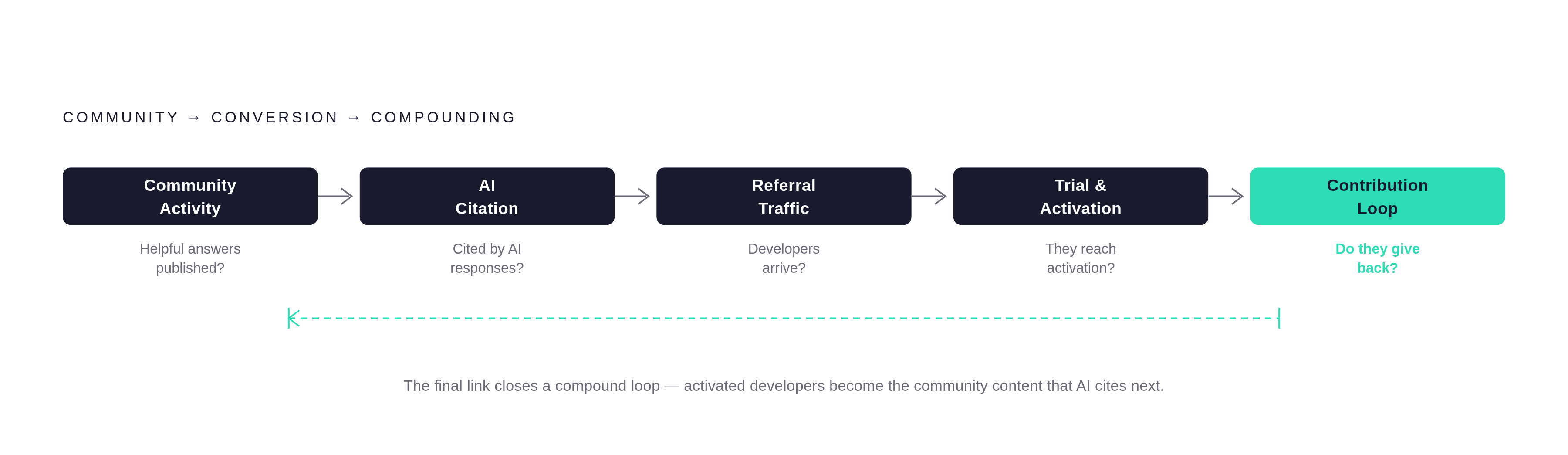
The final connection runs from community activity through extractable content, AI citation, referral traffic, trial, activation, and renewed community contribution. Each transition poses a different question. Are answers that help developers being published, are they being cited, and do the developers who visit through those citations reach activation and go on to contribute? Instrumenting those transitions gives leadership evidence of where the system compounds and where it breaks, so the next investment follows a measured gap.