Competitive Positioning When Incumbents Have Brand Advantage
AI models favor brand mentions and verified data over the backlinks that built search rankings.

A buyer no longer starts with a search bar. More than a third of US consumers now use AI at the product discovery stage, compared to roughly a seventh who still start with traditional search, according to Similarweb's Generative AI Brand Visibility Index. A buyer asks ChatGPT which platform fits a given need, forms a preference inside that conversation, and only days later searches the brand name directly, a pattern that leaves the AI mention that actually started the journey with no record in standard analytics. An April 2026 analysis of business-intent searches found AI Overviews appeared on 86.7% of business-intent queries, a dataset weighted toward commercial, buying-intent prompts rather than navigational ones. The buying decision now happens inside an AI answer before it ever reaches a results page. An enterprise guide published in July 2026 calls this the "silent shortlist," the preference a buyer forms inside an AI conversation before visiting any website, and names it the defining behavior change of 2026.
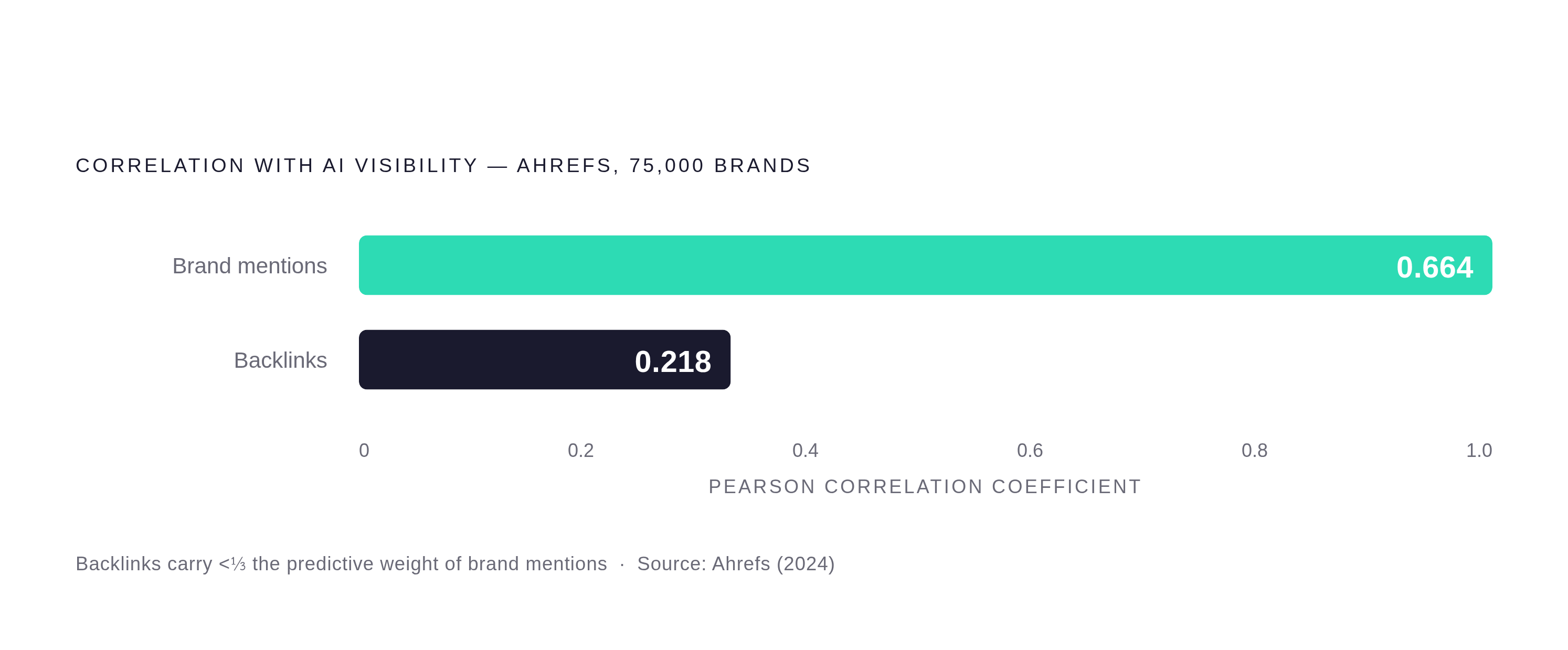
The signals that earned a brand its place at the top of a search results page are not the signals an AI model uses to decide what to cite. A company that spent a decade building backlinks and domain authority is not guaranteed any head start in this new contest. An Ahrefs study of 75,000 brands found brand mentions correlate with AI visibility at 0.664, while backlinks correlate at only 0.218. The asset incumbents built most heavily turns out to carry the least weight. MC Saatchi Performance's GEO analysis reports that the large majority of Google AI Mode citations do not come from the organic top ten, so ranking first on a results page says very little about whether a brand gets named in the answer itself. ChatGPT's citations overlap only slightly with Google's top results. This produces what the research calls a complacency trap: incumbents watch their organic traffic hold steady and assume AI visibility is following along, but the analytics they're using were never built to capture an AI-initiated journey that ends in a branded search weeks later. The confidence is real, but the measurement behind it is not.
Structured, verifiable content and the AI citation advantage
AI answer engines decide what to cite through two distinct steps, retrieval and synthesis, and a challenger with well-structured, externally corroborated content can clear both steps ahead of a far more recognized brand that only clears the first. Retrieval comes first: the system searches an index for candidate documents, and being indexed at all is necessary but nowhere near sufficient. Unstructured content, content buried behind heavy JavaScript rendering, or content built on claims the model can't verify may never surface as a candidate in retrieval. Synthesis comes second, and it's the step that actually decides the outcome: the model chooses which of the retrieved sources to cite in its answer, and it favors sources it can treat as authoritative and low-risk for hallucination. Structure and outside corroboration are what move a source from retrieved to cited.
Similarweb's GEO guide summarizes research from Princeton and IIT Delhi, published at ACM SIGKDD 2024, showing that content with added statistics and direct quotations achieved meaningfully higher visibility in AI-generated responses, while keyword density performed below baseline. A 2026 GEO tools analysis describes the hierarchy AI models lean on as a "Source Stack": verified data banks such as Wikidata and Knowledge Graph rank at the top, high-trust user content like Reddit, Quora, and verified reviews rank just below, and brand-owned assets rank at the bottom. AI answer engines use a two-gate process of retrieval and synthesis, and a challenger brand that clears both gates with well-structured, externally corroborated content can be cited ahead of a better-known brand whose content clears only the first. Reddit, specifically, was the first or second most-cited domain on every major AI engine as of March 2026, meaning ordinary community discussion now outranks brand homepages as a trusted source. An enterprise guide puts the split at roughly 80% strategic work, positioning, ecosystem presence, and brand authority, against a small technical remainder.
What challengers must do to become a citable source
Owned content earns a citation when it is structured to answer a specific question in its opening sentences, supported by citable evidence, and technically readable by AI crawlers. Few brand websites meet all three by default. AI systems extract the first sentence or two of a section to judge relevance, so a page that opens with throat-clearing and context before getting to the point gets passed over in favor of a competitor's page that states the answer immediately. The research from Princeton, Georgia Tech, IIT Delhi, and the Allen Institute for AI, published at ACM SIGKDD 2024 and cited in MC Saatchi Performance's September 2026 analysis, found that adding precise statistics raised visibility in generative AI answers by up to 40%, that citing external sources produced a large relative gain specifically for pages that started outside the top positions, and that direct quotations added a meaningful lift on their own. None of that works if the page can't be parsed. Schema markup, clean rendering, and a logical information architecture are the technical floor: content an AI system can't read cleanly never clears the retrieval gate, no matter how good the writing is.
One proposed fix deserves a direct caution rather than a recommendation. The llms.txt file, floated as a standard in 2024, is contested at best, and Google explicitly discourages aggressive content chunking, rewriting content solely for AI systems, and generating inauthentic mentions, drawing a distinction between genuine authority and artificial manipulation. Treat it as unproven rather than as a tactic to build a plan around. Google is also explicit about what to avoid altogether: aggressive content chunking built purely for machine parsing, rewriting content solely to please AI systems, and manufacturing inauthentic mentions all sit on the wrong side of the line Google draws between genuine authority and artificial manipulation. Owned-site work is the floor a challenger has to clear, not the ceiling. The majority of citations that actually appear in AI answers don't come from brand-owned domains at all. The owned-site work described here, however well executed, only sets up the next and larger part of the fight.
Winning the majority of AI citation share decided off a brand's own site
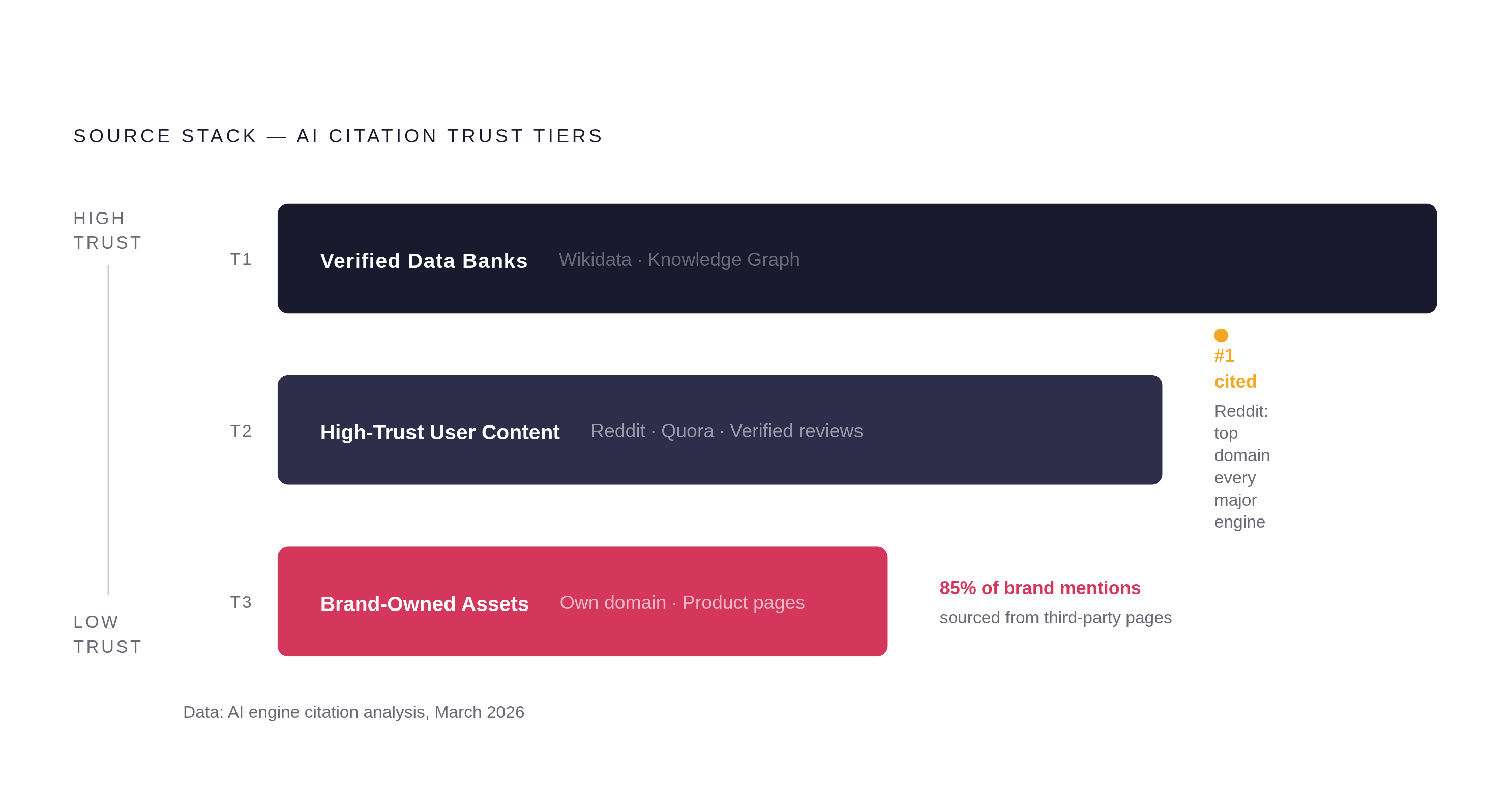
Most brand mentions inside AI answers trace back to third-party sources, listicles, comparison pages, review sites, and community platforms, rather than to a brand's own domain, and a challenger that earns prominent placement in those formats can outperform an incumbent whose investment sits almost entirely on its own site. A September 2026 analysis points to AirOps data showing 85% of brand mentions in AI answers originate from third-party pages, with brands far more likely cited through someone else's content than through their own. Among those third-party citations, the vast majority trace to listicles, comparisons, and review sites specifically, and the vast majority of cited brands appear within the first three positions of those formats. A brand absent from the key comparison page in its category is, for that query, simply invisible, regardless of how strong its own site looks.
This is the logic behind what's sometimes called the "phantom site" or third-party placement strategy: earning, and in some cases actively building, presence in roundups, comparison posts, and curated lists on neutral sites functions as a primary visibility lever rather than a secondary public-relations task. Reddit again appears as one of the most-cited sources across major AI platforms, per MC Saatchi Performance, confirming that ordinary community discussion now shapes AI-generated answers in a way traditional SEO never had to account for. Stacker research cited in this analysis found earned media distribution produces a substantial median lift in AI visibility, which carries a direct implication for how budget gets allocated: content investment has to spread across external placements rather than concentrate on channels the brand owns and controls.
This is where the incumbent's traditional advantage becomes a liability instead of a strength. Established brands have historically poured their budgets into owned content and paid channels, precisely the channels AI systems weight lowest. The third-party ecosystem that AI models actually draw from, Reddit threads, independent comparison sites, review platforms, is a surface most established brands have never deliberately built for, and that neglect gives a challenger room to establish citation presence before the incumbent even notices the battlefield has moved. The window is already closing in some categories. An enterprise guide references 5W Research's Airlines and Hotels AI Visibility Index 2026, which found the top three brands in multiple AI platform subcategories account for the strong majority of total citation share. Winner-takes-most dynamics form quickly once a category gets noticed, and a challenger that delays simply hands that concentration to whichever competitor moves first.
Producing citation-ready content at the pace this strategy demands without sacrificing quality
Everything described so far, structured owned pages, a presence across dozens of third-party comparison posts and community threads, demands a volume of content no small team produces by hand on a deadline. The model that makes this achievable without collapsing into generic output is a multi-stage AI pipeline with human review built into it at every meaningful decision point. Volume by itself stopped being a strategy. A "synthetic saturation" problem means readers reject generic AI prose. A brand that wants to scale its content still needs a human-in-the-loop content infrastructure rather than a faster version of the old content mill.
The pipeline design that has emerged in response uses specialized agents, one for research, one for drafting, one for critique, working against a content management system as the single source of truth, with a human checkpoint staged at every meaningful boundary before anything goes live. An enterprise guide points to a content agent platform that reached general availability in January 2026 and runs on Mastra and Temporal, as an example of a platform built this way: every AI-generated change is staged as a draft, and nothing publishes until a person clears it. Contentful runs bulk AI changes through a comparable review screen with the same intent. The human step in this system is not a bottleneck imposed on the process. It adds original thinking, catches factual error, and protects the brand's actual voice, the same qualities that make a piece worth a reader's time and worth an AI model's citation.
The practical discipline follows from that directly: a draft sits in review until someone clears it, and missing a publishing date costs far less than putting out something factually wrong or off-brand, either of which undermines the very citation credibility this entire strategy is built to earn. And the pipeline only means something if it's tied to the right output measure. The metric that matters isn't word count or publishing cadence, but whether the resulting content actually gets retrieved and cited across the query clusters a brand is targeting. Connecting production to that feedback loop is what separates an engineered content operation from a calendar of deadlines.
Measuring whether any of this is working, across platforms that behave very differently from each other
AI platforms don't cite the same way, and a brand's citation share on one engine says almost nothing about its share on another, so the only reliable way to know whether any of this work is paying off is to track Share of Model separately, continuously, and across each platform on its own terms. Share of Model is calculated simply: brand mentions divided by the total AI answers in a tracked query set. A score of 30% means the brand shows up in three out of every ten AI responses to its target queries. It functions as the AI era's successor to share of voice, with one important difference: unlike paid share of voice, it has to be earned rather than bought.
The overlap between platforms is low enough that treating them as one audience is a mistake. An analysis of a large volume of AI citations gathered in early 2026 found that only a small fraction of domains were cited by both ChatGPT and Perplexity. A brand that wins strong visibility on one engine cannot assume that result transfers to the next. The measurement work has to run platform by platform, continuously, with the same seriousness applied to the content strategy itself. The citation a brand earns today is the shortlist a buyer never knew they were building.