Enterprise AEO is a systems problem, not a platform problem: why multi-brand, multi-market answer-engine programs need code, an API and a warehouse, not another dashboard seat
Scaling AEO across brands and markets takes code, an API and a warehouse.
Enterprise answer engine optimization becomes a systems problem when brands, markets, languages, personas, and engines multiply together. For technical marketing leads and GTM engineers, the sustainable answer is a programmable pipeline with version-controlled configuration, public content infrastructure, an API, and a buyer-owned warehouse. Another dashboard seat may improve visibility, but it cannot supply the architecture needed to act on what becomes visible.
Why enterprise AEO stops being a marketing problem and becomes an engineering one
The tipping point comes when a marketing team realizes its AEO program is a spreadsheet and a vendor login. The spreadsheet tracks which brands and regions need attention, while the dashboard shows where answers omit them. Neither governs how a correction reaches every relevant property. A citation gain on one product page remains a local success, leaving the templates other teams use unchanged.
That gap grows as brand, legal, PR, and regional teams each gain the right to approve changes. Security review, data residency, and model-training transparency add constraints before production begins. Thousands of pages and several regulatory regimes then turn a content update into a coordination problem. Visibility alone cannot resolve those dependencies. A dashboard that surfaces two hundred fixes nobody can make has created a backlog.
Buyers can make shortlists through research the seller cannot see, using model-generated answers as part of that research. Yet an enterprise stack must support measurement, optimisation, content production, governance, and attribution, while many platforms cover only part of that work. Seat-count procurement mistakes the symptom, insufficient visibility, for its cause, the absence of a programmable pipeline.
The brand × market × language × persona × engine multiplication, and why it should be a generated config in version control
Consider a program covering 5 brands, 4 markets, 3 languages, 4 personas, and 9 engines. Its configuration space includes combinations across all these dimensions. A new language affects more than a translation queue because it intersects with brands, markets, audiences, and the engines being measured.
Some combinations need different content or a different approach. The system still needs an explicit record of which combinations apply, which entities they describe, and which prompts measure them. Otherwise, how does a team distinguish a deliberate regional difference from a setting someone forgot to update? Schema markup, structured data, and llms.txt consistency across properties become deployment concerns before they become optimisation concerns.
The practical response is to declare the matrix as data in a code repository and render the relevant configuration at build time. Pull-request review makes changes reviewable before release, auditable afterward, and reversible when needed. Adding a new market takes a configuration entry and a build step, without the need to set it up again in dashboards. The vendor interface can read this configuration without becoming its source of truth.
Ownership must be explicit from the start. A marketing engineer, GTM platform team, or SEO ops function needs responsibility for the repository and its templates. That responsibility determines who resolves differences across properties before they accumulate. Config drift is the enterprise AEO failure mode, and version control provides an established software-engineering answer to it.
Why approved claims belong on the public site in machine-readable form, not only in a vendor's internal context store
Configuration governs how the program operates, but it cannot substitute for public evidence. Approved claims stored only in a vendor’s internal context store are unavailable to other engines, crawlers, and future vendors. A private retrieval layer can support the tool using it. It does not do the work of a well-structured public site.
In a paragraph, the claim’s meaning and relationship to the brand must be inferred from the prose. The right markup and clear visible copy make those relationships easier for machines to parse. Content that directly answers a question and is organized for extraction gives the engine a clearer source to work with.
That is not a promise of citation. JSON-LD schema supports entity disambiguation, machine-readability, and rich-result eligibility, rather than acting as a switch that makes an engine cite a page. The defensible investment is clearer public evidence. Approved claims thus belong on the canonical domain in structured content that can still be retrieved when the vendor changes.
The llms.txt format complements that structure with a lightweight content map. It is a plain-text, Markdown-formatted, UTF-8 encoded file conventionally placed at the domain root, although a subpath is also possible. Unlike the allow-or-block role of robots.txt, its purpose is to identify important content. Both llms.txt and JSON-LD belong in the deployment pipeline, committed with the content they describe rather than managed separately through a vendor interface.
Review latency as a CI problem: automate claim and schema checks, humans review exceptions
How does the team catch an inconsistent entity definition or invalid schema before publication? Software teams already use linting, unit tests, and build checks for the same basic purpose. Content infrastructure needs quality gates like these that run on every deployment, without waiting for a quarterly audit.
The deterministic checks are good candidates for automation. JSON-LD validity, llms.txt syntax, agreement between schema and visible copy, and freshness timestamps can be checked repeatedly. The pipeline can also flag gaps in entity definitions and missing third-party citations before release. Catching these problems at commit time is cheaper and more consistent than finding them after publication across many properties.
Human judgment still has a defined gate. An LLM can draft answer-shaped revisions and schema, but a person edits and approves them before automation pushes the changes. Humans review flagged exceptions and all claims with legal, regulatory, or competitive sensitivity. Approval workflows and audit trails are then outputs of the pipeline.
AEOrank is a lightweight tool for developers who want scriptable page checks to run during deployments alongside an analytics platform. These checks can run alongside crawl and schema validation, and prompt results saved over time can form a regression baseline. If a deployment degrades citation signals, the pipeline can surface that change before the next publishing cycle. Automation speeds the repeatable work without taking away the ability to say no.
Owning raw probe data in your own warehouse so the vendor stays swappable
If a vendor runs prompts against ChatGPT, Gemini, Perplexity, and Claude, who retains the responses when the contract ends? Those responses are both competitive intelligence and inputs to the dashboard. A vendor is not meaningfully swappable if changing it means losing the evidence used to judge performance.
The warehouse design should make custody concrete. Each probe run belongs in a buyer-controlled time-series table with fields for prompt text, engine, timestamp, raw response, parsed brand mention, citation URL, and sentiment score. The record should be written in an open format such as Parquet or NDJSON before the vendor’s analytics layer processes it. The application connects to the buyer-owned data.
Raw export is necessary, but not sufficient. Lock-in can also sit in extracted relationships, tuned workflows, and the search index that knows the business. Keeping prompt sets in git preserves another essential part of the measurement method. With the evidence and prompts under buyer control, changing the vendor layer can become an API-adapter task using the existing data.
This separation also makes performance claims open to examination. Citation rate, mention rate, AI-sourced sessions, and share of voice in AI answers require measurement beyond traditional SEO dashboards, with probe data providing the evidence for answer-level results. Past probe records also feed the CI regression baseline. The purpose is not to distrust vendors, but to retain an independently reproducible record when the vendor changes.
What the full architecture looks like when these pieces are assembled
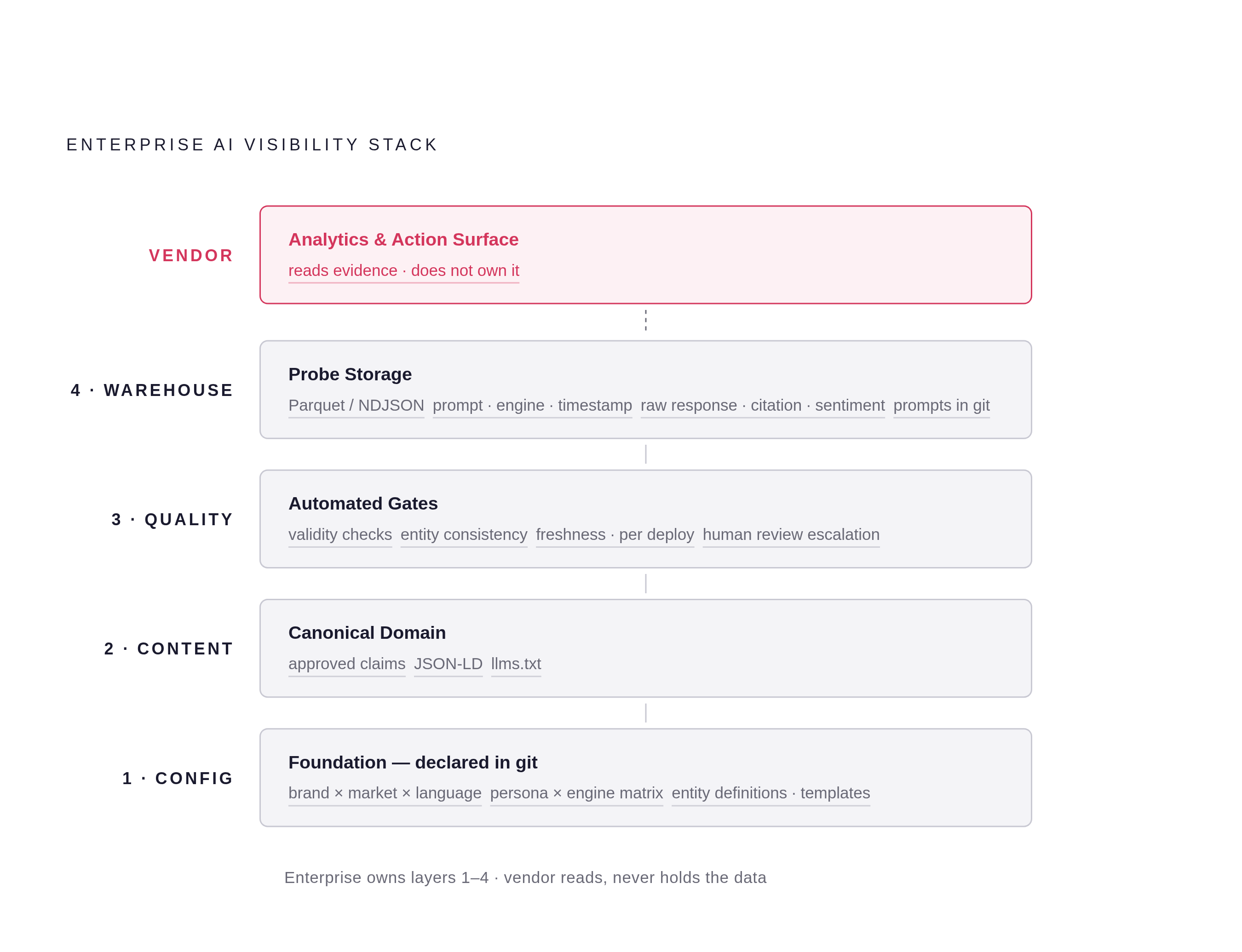
In practice, the reference architecture has four instrumented layers. The configuration layer declares the brand, market, language, persona, and engine matrix in git, with entity definitions and templates rendered at build time. The content layer publishes approved claims on the canonical domain. Its JSON-LD and llms.txt stay in the same deployment process as the content they describe.
The quality-gate layer checks each deployment for validity, entity consistency, and freshness, escalating exceptions to people. A person must still approve sensitive claims before they go live. The warehouse layer keeps a record of probe runs over time in an open format that the buyer controls, while the prompts stay version-controlled.
The vendor platform sits above the quality gates and warehouse as an analytics and action surface. It reads the stored evidence and flags exceptions while leaving the data store and CI in place. People can still use its interface to examine results. But every capability in the stack should also be reachable by an agent through an API, so publishing, checking, and measurement can work with other GTM tools.
The objection that engineering cadence is too slow for how fast AEO moves
Content freshness is a real constraint. New statistics, product claims, and responses to competitors’ moves cannot always wait for a full infrastructure release. Content more than three months old can lose ground because AI systems favor sources that reflect newer shifts in the market. A publishing process that leaves updates waiting for engineering sprints would undermine the program.
Individual content changes need not trigger a full deployment cycle when the content layer is decoupled from configuration and schema. Entity definitions, schema templates, llms.txt structure, prompt sets, and warehouse schema need greater stability. Changing those foundations without review creates drift.
Structural content updates can show citation-rate changes within weeks, allowing results to inform the next sprint without bypassing version control. A standing publishing cadence can pair automated drafting with human review while the stable layers remain protected. The goal is approval in hours. A properly designed pipeline need not be slower than ad-hoc dashboard management, and it is more auditable, which enterprise legal and brand teams require.
What to do before the next vendor renewal
For the next renewal, turn the architecture into a procurement checklist. Start by asking whether every probe run can reach a table that the buyer controls in an open format. Include the raw response and measurement fields. If that is unavailable, make it the first negotiation.
Next, check the API surface before signing. Schema validation, citation checks, and probe execution must be reachable programmatically if they are to participate in the pipeline. A core operation that requires a person to use the interface cannot serve as an automated build step. Ask which of the four architectural layers the vendor covers and which the enterprise must own itself.
Establish the configuration repository before vendor onboarding, and name its owner before the contract is signed. Decide whether a marketing engineer, GTM platform team, or SEO ops function will own it. Treat schema and llms.txt deployment as sprint-zero infrastructure work, committed with the content. Reconstructing these decisions from dashboard settings later is harder than having the vendor read an existing configuration.
Finally, set a measurement baseline from the buyer-owned warehouse before configuring the vendor’s analytics. That order keeps the starting point free of the vendor’s definitions. Procurement then concerns the capabilities needed to operate the system. Every quarter a competitor builds citation share makes the gap harder to close, so the infrastructure decisions made at renewal shape the competitive position two years out.