What Black Friday AI answers reveal: the shortlist is decided by machine-readable offer conditions, not by campaign spend
Readable offer terms, not ad budgets, decide who makes AI shortlists.

Black Friday AI answers show how the way brands reach a shopper’s shortlist is changing. The decisive input is not campaign spend but offer conditions that a system can read, retrieve, and cite. Dates, discount depth, and eligibility rules must be clear, with enough evidence for the brand to show up. That makes AI visibility an infrastructure discipline.
How AI systems decide which brands appear in Black Friday answers before any shopper sees a result
Black Friday usually starts with discounts, ad budgets, and a push to reach shoppers before other brands do. A system filters candidates before presenting its recommendations, so a shopper may never see many of the brands competing for attention elsewhere. Advertising can reach that shopper through another surface, but it cannot by itself secure a place in the answer.
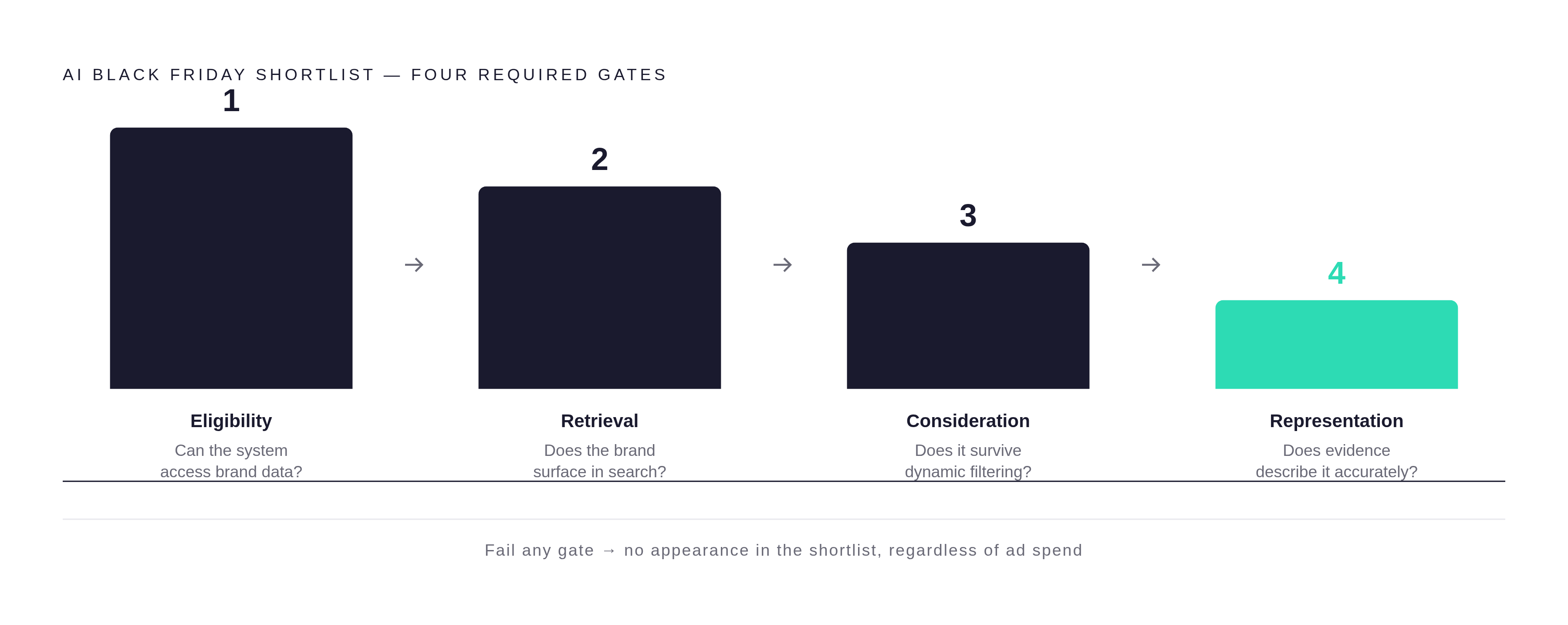
The selection process has four stages, which are eligibility, retrieval, consideration, and representation. Eligibility asks whether the system can get brand information it can use, while retrieval asks whether the brand shows up when the system looks for evidence. During consideration, the brand must survive dynamic filtering. Representation then depends on whether the available evidence accurately describes it. A brand must clear all four gates to appear.
What does that change for a retailer? It separates the ability to buy exposure from the ability to qualify for a recommendation. A campaign can communicate an attractive offer to people while leaving its conditions difficult for a machine to interpret. In that case, increasing spend addresses a different problem from the one excluding the brand. How many shoppers the campaign reaches and whether the evidence makes the brand eligible for their AI-generated shortlist both matter.
Why structured offer data — not ad copy — is the operative signal at the retrieval gate
Machine-readable offer data gives the retrieval process something unambiguous to work with. Its core fields include price, currency, validity date, availability, and URL. Structured data makes those facts readable without requiring a model to untangle promotional language. Eligibility rules also need to be explicit. An offer can then be evaluated against the shopper’s question.
An image banner may tell a person clearly about a sale while leaving its conditions out of reach of the retrieval process. Terms buried in ad copy present the same problem when they cannot be parsed reliably. The offer exists, but its usable evidence does not. This is why structured data is more than a technical finishing touch to a campaign. It supplies the substance the system needs before a discount can influence its answer.
Accuracy is as important as readability here. Wrong or missing sale data, including price, shipping cutoff, and return window, creates a high-risk failure during Black Friday because a retrieved figure can become part of the answer. A stale price is not merely a missed opportunity for visibility. It can frustrate a shopper before a sale is made. Clear structure therefore has to describe the current offer.
What the Semrush AI Visibility study shows about which brands the filter actually promotes
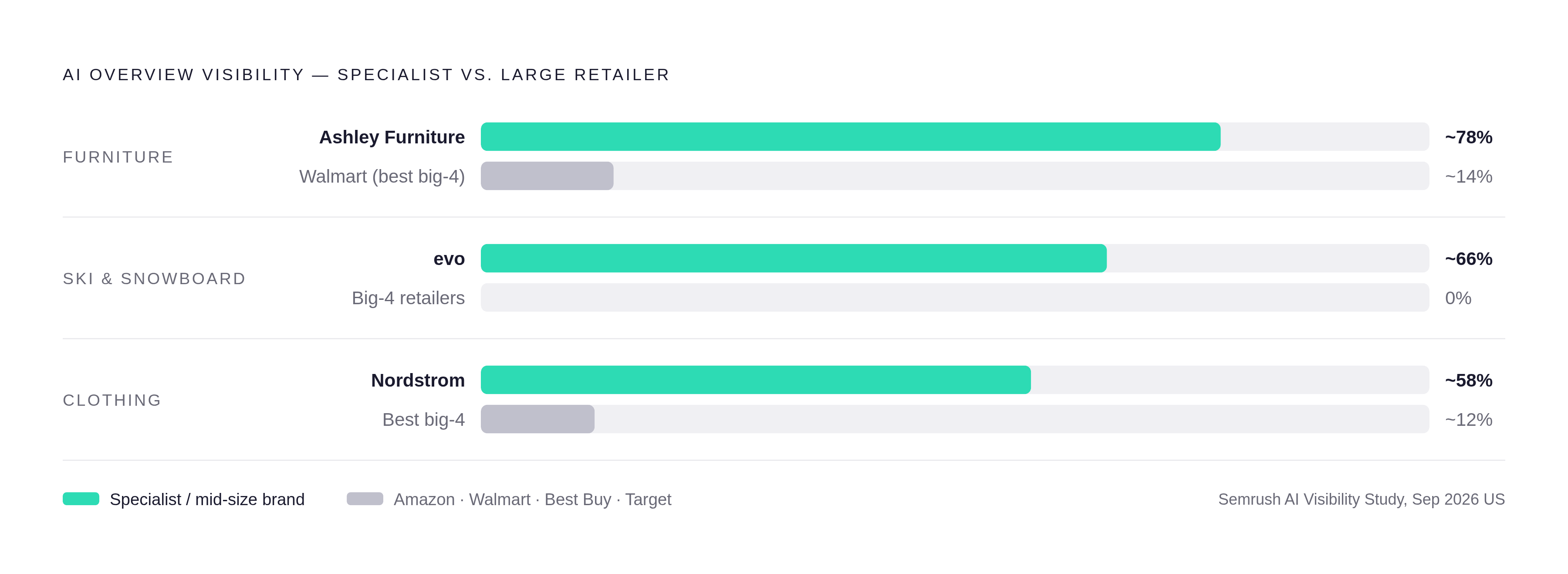
The Semrush AI Visibility study, drawn from its September 2026 US snapshot, shows how sharply AI visibility can diverge from retailer size. Ashley Furniture appeared in a large majority of AI Overview answers about Black Friday and holiday furniture deals. Walmart, the best-placed of the four largest US retailers on those prompts, appeared in only a small fraction. Scale did not determine the winner here.
The same study found that evo appeared in roughly two-thirds of answers about ski and snowboard deals, while none of the four largest retailers appeared. Clothing prompts produced another instructive contrast. Nordstrom appeared in well over half of answers, while the strongest of the big four managed a small fraction. Across topics for which a leader could be named, Amazon, Walmart, Best Buy, and Target together led fewer than a quarter. Specialist stores and product brands led most of the rest.
Those results show how brands fare against each other, but they do not prove that a given data field caused each ranking. The threat nevertheless comes into focus. A retailer is competing with the brand whose evidence fits the exact topic. The study also separates being named from being cited. Gemini mentioned Amazon more than any other site but cited amazon.com in none of its answers, showing why prominence in the text does not necessarily give a shopper a route to the brand’s page.
How discount depth interacts with structured signal — and why spend alone cannot substitute for either
A readable offer gives the system a price to evaluate, but not every price change produces a recommendation. Discount thresholds can be decisive. Testing across price conditions showed that a product could move from no recommendations to the most-recommended option once its discount passed a particular threshold. The effect depended on offer conditions being retrievable and verifiable.
The findings show that price can change a recommendation when the system has enough information to assess it. Shoppers also use AI to test whether an advertised saving is real by recalculating the percentage from dollar figures. Explicit, accurate conditions serve both tasks. They allow the offer to be considered and the claim to be examined.
Campaign spend cannot substitute for that evidence. A product with no readable offer data and a product with too little retrievable brand evidence can end up in the same position from the buyer’s perspective. Neither appears in the answer. Publishing clear sale terms fixes only the first of those failures, so the difference matters when choosing what to fix.
Why new and thin-corpus brands are practically invisible on unbranded prompts regardless of offer clarity
A retrieval corpus is the body of owned and third-party evidence from which a system can find a brand. Without enough of it, clean offer data has little chance to shape an unbranded shopping answer. Schema cannot supply a missing history of evidence. A brand may describe its sale perfectly and still be left out when someone asks for gift ideas without naming a retailer.
5WPR’s Black Friday: Why AI Models Often Skip New Brands research illustrates that limitation through a US retail brand operating for less than a year. It found little citation presence on unbranded prompts, with the overwhelming majority of the brand’s citations coming from prompts that already named it. That is a different kind of visibility. Answering a question about a known brand does not show that the system will introduce it to someone still choosing.
LEOPRD found that editorial had a smaller share of AI citations while retailer first-party pages had a larger share. That shift complicates a strategy built mainly around press coverage, but it does not make outside evidence unnecessary. Readable owned content and a consistent third-party citation corpus need to be built together. Product reviews, roundups, and reference pages give the system retrievable evidence that names the brand. Structured offer data can then contribute current sale conditions to a body of information that already exists.
How organic citations, ads around AI Overviews, and ChatGPT ads each work as visibility levers — and what actually moves
Adthena’s market data shows that Google’s AI cites google.com more often than any retailer in the five retail categories it tracks. It also shows that ads inside AI Overviews remain rare across US categories and absent in the UK.
For teams planning paid visibility in 2026, the more controllable lever is the advertising around AI Overviews. Long, specific research queries are where AI Overviews dominate, so research-phase and deal-phase searches need separate budget and bid treatment. An ad beside an answer is not a citation within it.
Adthena also found that distinct advertisers on a sample of US home prompts in ChatGPT tripled in one month. Many had minimal Google presence, and the leaderboard had not settled. Teams therefore need to track who they compete with there separately. Black Friday 2025 had no ChatGPT ads, and no Black Friday creative had appeared on those prompts by October 31, 2026. The first brand to launch such creative there sets the category’s initial benchmark.
Discounts must be live in the shopping feed before they can appear in ChatGPT Shopping results. Shopping results, ads, and organic citations share a dependency on accurate underlying data. Wrong or missing conditions can produce wrong or absent results, regardless of which surface a team hopes to use.
How to measure whether AI answer engines are actually naming and citing your brand across this season
Adobe’s analysis of visits to US retail websites found that AI-referred visitors converted at a meaningfully higher rate than visitors from non-AI sources, with substantially higher revenue per visit. A brand needs to know not just whether AI traffic arrives, but whether engines include it during the research that precedes a visit. Referral totals cannot answer that question alone.
Adobe also measured a 693% increase in traffic to US retail sites from generative AI tools over the 2025 holiday season. As that traffic grows, teams need to focus their tracking on the platforms shoppers prefer. ChatGPT is part of that mix, while Microsoft Copilot leads among the remaining platforms, followed closely by Meta AI, Grok, and Claude. One engine is not the whole market. A monitoring stack confined to it leaves other shopping conversations unmeasured.
Do ChatGPT, Claude, Gemini, and Perplexity name the brand on unbranded prompts, and do they cite it? Is that share rising or falling week over week during the peak window? Do the citations lead to current, accurate offer conditions? These checks connect visibility to the content and data decisions that are meant to improve it.
A weekly cadence fits the volatility better than a one-shot audit. Adthena found that one month was enough for the top ChatGPT advertiser to lose a third of its share, with the leaderboard still unsettled by late October. That is evidence about paid visibility. Measurement needs to distinguish the surfaces while following each through the peak window.
What last year's AI shortlist position actually means for 2026 — and what can be done before the generative window closes for 2027
AI systems re-evaluate the retrieval corpus each season, so last year’s shortlist position is not protected by spend history. An incumbent can lose ground to a brand with more explicit, retrievable current evidence. Timing limits how quickly that change can happen. Search-based AI, including Perplexity and Google AI Mode, picks up seasonal content within one to two weeks, while generative AI, including ChatGPT and Claude, takes two to four months.
For teams acting late in the 2026 season, those different lead times change the purpose of the work. Content not already indexed and cited has effectively missed the generative AI retrieval window for this Black Friday. It can still build the 2027 corpus. Search-based systems have a shorter opportunity to pick up seasonal updates, but the two time horizons should not be treated as one.
Permanent sale URLs help preserve that investment. A sale page returning to the same URL each year keeps the links, reviews, and citations it has earned, while a new URL starts without them. URL permanence is therefore a retrieval decision. With current offer data, it lets the brand use the evidence it has built up for a new season without having to rebuild its reference point.
AI serves as a research layer and shortlist-builder while purchases still close elsewhere, so exclusion can mean lost consideration without a missing referral ever appearing in a report. Treat structured offers, permanent sale pages, third-party citations, and engine-level measurement as continuing infrastructure.